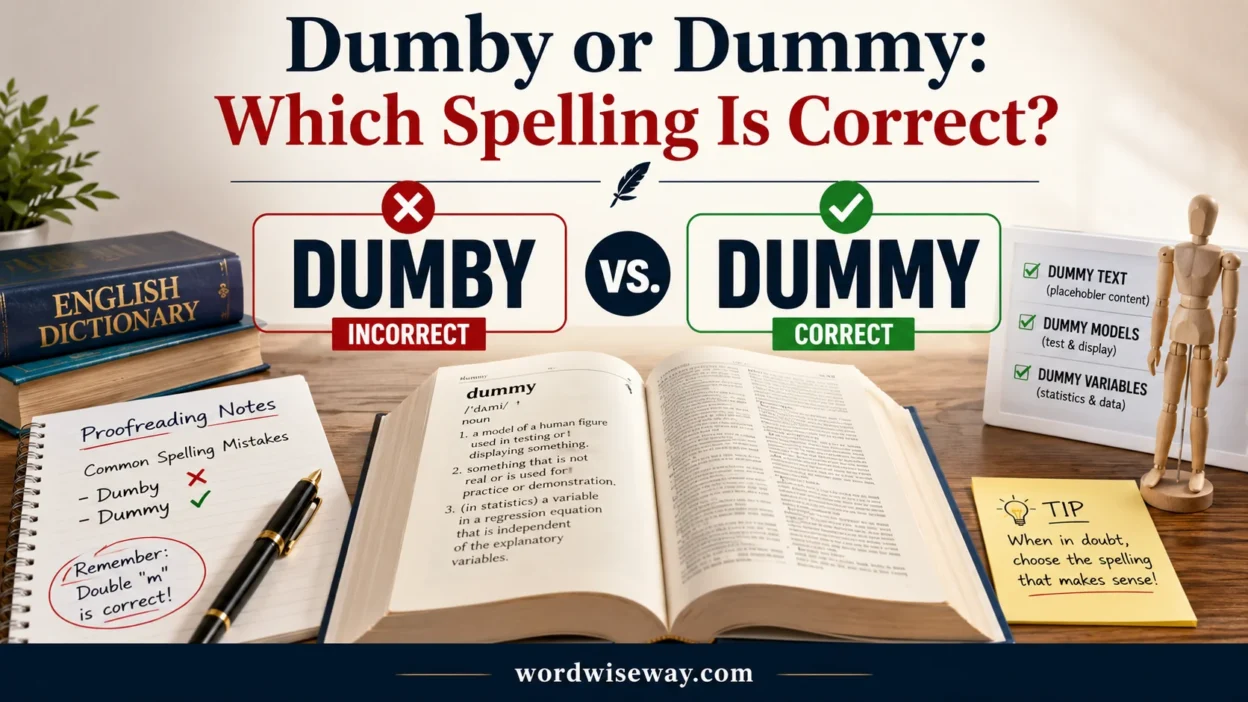
Dumby or Dummy: Correct Spelling, Meaning, and Usage explains why dummy is the correct standard English spelling, while dumby is a common misspelling. The confusion comes from similar sounds, pronunciation, and typing mistakes.
The word dummy has several meanings and can be a noun or adjective. It may describe an imitation, model, figure, sample object, substitute, or someone considered foolish. It is also used in practice, testing, and demonstration, with phrases such as dummy text, dummy account, and crash test dummy.
In statistics, computing, design, and other technical fields, it can appear in specialized expressions. Students, writers, bloggers, and professionals can use these simple explanations, examples, and expert tips to write clearly, understand the difference, and avoid the wrong spelling in school, work, emails, text messages, and writing online.
The origin, grammar rules, British English, American English, and real-life examples also help explain its proper usage.
Quick Answer:
Dummy is the correct standard spelling in modern English. Dumby isn’t the standard spelling used in contemporary American English.
The correct spelling is:
D-U-M-M-Y
| Spelling | Standard modern English? | Use it? |
| dummy | Yes | Yes |
| dumby | No | No |
For example:
- The engineers used a dummy during the safety test.
- The website contains dummy text.
- The developer created a dummy account.
- Don’t be a dummy.
So, if you’re wondering whether to write dumby or dummy, choose dummy.
What Does Dummy Mean?
Dummy has several meanings, and the intended meaning depends on the context. It can work as a noun, adjective, or verb.
As a noun, dummy can mean a model of a person, an imitation, a substitute, or an informal term for someone who has behaved foolishly.
As an adjective, it often describes something that isn’t real but represents or substitutes for something real.
For example:
- dummy model
- dummy text
- dummy account
- dummy variable
- dummy product
- dummy corporation
The word therefore has a much broader meaning than simply describing a foolish person.
Why Is It Spelled Dummy Instead of Dumby?
The rule is simple: Dummy is spelled with a y, not a b. That small distinction saves you from a surprisingly common spelling mistake. If you’re describing someone who lacks information or has made an unwise choice, consider alternatives such as uninformed, ignorant, foolish, inconsiderate, irrational, or reckless, depending on the context.
Words can develop their own established spellings over time. Although historical forms of the word have included variations, modern standard English settled on dummy. That’s why changing the spelling to dumby based on the related word creates an error in contemporary writing.
The rule is simple: Dummy is spelled with a y, not a b. That small distinction saves you from a surprisingly common spelling mistake. If you’re describing someone who lacks information or has made an unwise choice, consider alternatives such as uninformed, ignorant, foolish, inconsiderate, irrational, or reckless, depending on the context.
How Do You Pronounce Dummy?
Dummy is pronounced DUM-ee.
Its US pronunciation is represented as /ˈdʌm.i/.
You can break it into two sounds:
- dum
- ee
Together:
DUM + ee = DUMMY
The spelling contains two m’s, but the word doesn’t contain a separate b sound. In fact, the standard spelling has no b at all.
This pronunciation can also help reinforce the spelling. If you say the word naturally, there’s no audible reason to insert a b.
Dummy as a Noun
The noun dummy has several common uses. Context usually tells you which meaning applies.
Dummy as a Human Model
A dummy can be a model shaped like a person. Clothing stores may use such figures to display clothes, although mannequin is often the more specific term for this purpose.
For example:
- The store placed a dummy near the entrance.
- The designer adjusted the coat on the dummy.
- Several dummies stood in the shop window.
In these sentences, dummy refers to a physical model rather than a person.
Dummy as a Training or Test Model
A dummy can also represent a person or object during training, testing, or demonstrations.
One familiar example is a crash-test dummy. Engineers use these specialized devices to study what happens to a human body during vehicle safety tests.
Other examples include:
- training dummy
- practice dummy
- test dummy
- rescue dummy
Here, dummy means a substitute used instead of a real person or object.
Dummy as an Informal Term for a Foolish Person
In informal English, dummy can describe someone who has acted foolishly.
For example:
You dummy, you forgot your wallet.
Depending on the relationship and tone, this could sound playful or insulting. Calling a close friend a dummy after a harmless mistake may be teasing. Using the same word toward someone you don’t know could sound rude.
That makes dummy a good example of why context matters. A word can have a neutral technical meaning in one sentence and a personal meaning in another.
Dummy as a Substitute
The noun dummy can also refer to something created to stand in for the real thing.
For example:
The company prepared a dummy product for the presentation.
The product isn’t necessarily intended to deceive anyone. It may simply exist as a visual or physical representation.
Dummy as an Adjective
When dummy functions as an adjective, it usually describes something that is artificial, temporary, nonfunctional, or used as a substitute.
Consider these examples:
- dummy text
- dummy camera
- dummy package
- dummy account
- dummy magazine
- dummy product
The exact meaning changes slightly with the noun that follows it.
Dummy Text
Dummy text is temporary text used in a design, layout, or document before the final content is ready.
For example:
The designer added dummy text to check how the paragraphs would fit on the page.
The text helps reveal spacing, alignment, font size, and overall layout.
Dummy Account
A dummy account can be an account created for testing or demonstration.
For example:
The developer created a dummy account to test the website’s login system.
This type of account allows someone to test features without relying on a normal user account.
Dummy Product
A dummy product may be a model or representation created for display, testing, or demonstration.
For example:
The company displayed a dummy product during the trade show.
The important idea is that the object serves as a stand-in.
Dummy vs. Fake
Dummy and fake sometimes overlap, but they don’t always mean the same thing.
| Word | Typical meaning | Example |
| dummy | A substitute, model, or representation | dummy text |
| fake | Something that isn’t genuine | fake jewelry |
| model | A representation of something | model airplane |
| mannequin | A human-shaped display figure | store mannequin |
| placeholder | Something temporarily occupying a position | placeholder image |
| mock-up | A preliminary version of a design | website mock-up |
A dummy product may simply be a demonstration model. Calling it a fake product could suggest that someone is trying to pass it off as genuine.
That difference can be subtle but important.
Dummy in Technology and Writing
The word dummy appears frequently in modern technology, design, and data analysis.
Dummy Text in Web Design
Web designers often need to see how a page will look before the final writing exists. Dummy text fills that temporary space.
It can help designers evaluate:
- paragraph length
- heading placement
- spacing
- typography
- page balance
- content width
Once the real content becomes available, the temporary material gets replaced.
Dummy Variables in Statistics
In statistics, a dummy variable represents a category using numerical values.
A common setup uses 0 and 1.
For example:
| Category | Dummy variable |
| No | 0 |
| Yes | 1 |
A statistical model can then use those numerical values when analyzing categorical information.
This meaning has nothing to do with calling someone foolish. It’s a technical term with a precise purpose.
Dummy Accounts in Software Testing
Developers may create dummy accounts when testing websites or applications.
For example, a developer might create:
- a dummy customer account
- a dummy administrator account
- a dummy payment profile
- a dummy user profile
These accounts help developers test features without using real customer information.
Dummy as a Verb
Dummy can also function as a verb, although this use is less common in everyday American English.
One specialized use occurs in sports. A player can dummy an action by pretending to move or play the ball in one direction before doing something else.
For example:
The player dummied the defender and passed the ball to a teammate.
The related forms include:
- dummy
- dummied
- dummying
Notice that the spelling still follows the same pattern. There is no b.
Dumby vs. Dummy Examples
The difference becomes especially clear when you compare the spellings directly.
| Incorrect | Correct |
| He used a dumby for practice. | He used a dummy for practice. |
| The page contains dumby text. | The page contains dummy text. |
| Don’t be a dumby. | Don’t be a dummy. |
| She created a dumby account. | She created a dummy account. |
| The store displayed a dumby figure. | The store displayed a dummy figure. |
In each example, dummy is the standard spelling.
The mistake doesn’t change the intended meaning. It simply creates a spelling error.
Common Phrases With Dummy
You’ll encounter dummy in many established expressions.
Some common examples include:
- crash-test dummy
- dummy text
- dummy variable
- dummy account
- dummy product
- dummy corporation
- dummy model
- dummy package
- training dummy
- practice dummy
These expressions show how flexible the word has become.
In one sentence, a dummy might be a physical training model. another, it could be temporary website content. In statistics, it becomes a technical variable.
Is Dumby Ever Correct?
This question needs a little nuance.
Dumby has appeared in historical English, which means you may occasionally find it in older texts or historical records. Older English spelling wasn’t always as standardized as modern English.
However, that doesn’t make dumby the normal spelling today.
For contemporary writing, use dummy.
That includes:
- school assignments
- blog articles
- websites
- business documents
- emails
- reports
- academic writing
- everyday messages
If you’re reproducing an old document exactly, preserving its original spelling can make sense. Otherwise, dummy is the appropriate modern form.
Common Spelling Mistakes With Dummy
The most common error is:
dumby ❌ dummy ✅
However, people sometimes produce other variations.
| Misspelling | Correct spelling |
| dumby | dummy |
| dumy | dummy |
| dummie | dummy |
| dummey | dummy |
The correct spelling is:
D-U-M-M-Y
How to Remember the Spelling
A simple memory trick is to focus on the double m.
Think:
DUM + MY
Then write:
DUM-MY
There is no b between the m and y.
If you remember double M, then Y, you’ll usually avoid the dumby mistake.
What Is the Plural of Dummy?
The plural of dummy is dummies.
The final y changes to ies:
dummy → dummies
Examples:
- One dummy was used during the test.
- Several dummies were placed inside the vehicle.
- The store replaced its old dummies.
This follows a common English spelling pattern.
| Singular | Plural |
| dummy | dummies |
| baby | babies |
| city | cities |
| party | parties |
So don’t write dummys in standard English. The correct plural is dummies.
Dummy in a Sentence
Here are examples showing different meanings of dummy:
- The engineers placed a dummy inside the vehicle during the test.
- The store dressed the dummy in a winter coat.
- The website still contains dummy text.
- The developer created a dummy account for testing.
- The company produced a dummy magazine before printing the final version.
- Don’t be a dummy and ignore the warning.
- The researcher added a dummy variable to the statistical model.
- The player dummied the ball before passing it.
These examples demonstrate an important feature of English vocabulary: the same word can serve several roles without changing its spelling.
Key Facts
Here are the most important points to remember:
- Dummy is the standard modern spelling.
- Dumby isn’t the standard contemporary spelling.
- Dummy is pronounced DUM-ee.
- The word contains two m’s.
- It doesn’t contain a b.
- Dummy can be a noun, adjective, or verb.
- It can describe a model, substitute, temporary material, or foolish person.
- Dummy text is temporary text used in a layout or design.
- Dummy variable is a technical term used in statistics.
- The plural of dummy is dummies.
- Historical texts may contain dumby, but modern writers should normally use dummy.
Read More: Disfunction or Dysfunction: Correct Spelling, Meaning, and Usage
FAQs
1. Is “dumby” or “dummy” the correct spelling?
Dummy is the correct spelling in standard English. Dumby is generally considered a misspelling, although you may sometimes see it in casual online writing, comments, or typing errors.
2. Why do people spell “dummy” as “dumby”?
The confusion usually comes from pronunciation. Since dummy and dumby can sound very similar when spoken, people may incorrectly assume that the word should contain a b before the final y.
3. What does the word “dummy” mean?
Dummy has several meanings depending on context. It can refer to a model or imitation used for practice, testing, or demonstration. It can also describe a person who acts as a substitute or, informally, someone considered foolish.
4. Is “dummy” a noun or an adjective?
Dummy can be both a noun and an adjective. As a noun, it can describe an imitation, model, or figure. As an adjective, it can describe something created for practice, testing, demonstration, or imitation.
5. What are some common phrases with “dummy”?
You may encounter dummy text, dummy account, and crash test dummy. The word also appears in specialized terminology related to fields such as computing, statistics, and design.
6. Is “dumby” ever acceptable in English?
In standard English writing, dumby should be avoided. You might encounter it in user-generated content, casual messages, social media posts, or comments, but those appearances don’t make it the accepted spelling.
7. How can I remember the spelling of “dummy”?
A simple memory trick is to remember the double m in dummy. Think of the word as d-u-m-m-y, with two m’s and no b.
8. Is “dummy” spelled the same in British and American English?
Yes. Dummy is the standard spelling in both British English and American English. The spelling doesn’t change between these varieties of English, although particular meanings or uses can vary by context.
9. Can I use “dummy” in formal writing?
Yes, when its meaning fits the context. For example, technical, educational, design, or testing contexts may use dummy in perfectly formal writing. However, some informal meanings may not be suitable for every professional situation.
10. What is the easiest way to avoid writing “dumby”?
Remember that the correct spelling is dummy, not dumby. If you’re unsure while writing an email, assignment, article, or professional document, checking the spelling before submitting it can help prevent an unnecessary error.
Conclusion
The difference between dumby and dummy is straightforward once you know the standard spelling. Dummy is the correct form, while dumby is generally an incorrect spelling caused by pronunciation, typing mistakes, or confusion about the letters in the word. Learning the correct form is especially useful when writing school assignments, professional documents, articles, emails, and other forms of formal English.
Because dummy has several meanings, its exact definition depends on how it is used. It can describe a practice model, imitation, substitute, or something created for testing and demonstration, and it appears in phrases such as dummy text and crash test dummy. Remember the simple spelling pattern d-u-m-m-y, and you’ll have an easy way to avoid the common dumby mistake.

Emma Smith has dedicated 14 years to Princeton University’s English Department, mentoring students in textual interpretation, literary movements, and critical frameworks. Her research explores Shakespearean drama, Victorian serial fiction, postcolonial narrative theory, and manuscript studies and probing how literary forms evolve across cultures and centuries. Emma has delivered lectures at international humanities congresses and published findings in distinguished academic journals, underscoring her commitment to scholarly depth and vibrant teaching.