Emaculate or Immaculate: Correct Spelling, Meaning, and Usage can be confusing because both words look and sound alike.
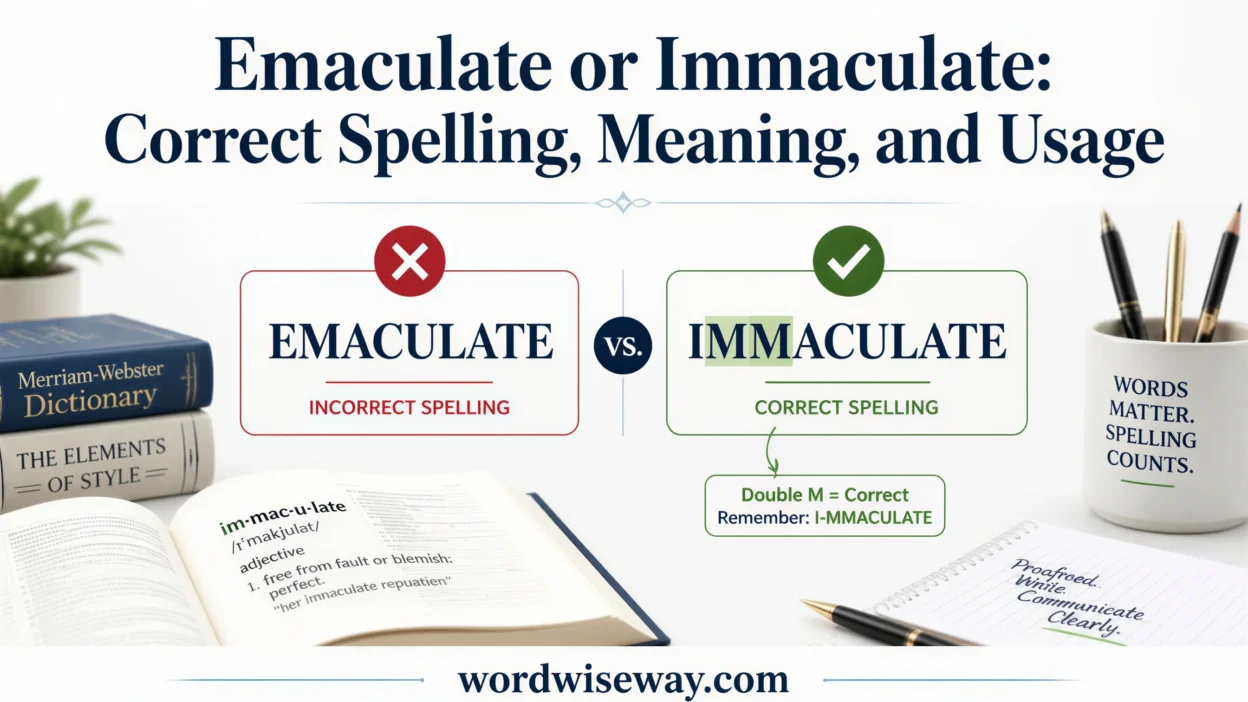
However, they have different meanings and uses. Immaculate is the correct spelling and proper word in the English language, while emaculate is a misspelling. Immaculate means free from flaws, mistakes, or dirt, and can describe something perfectly clean or pure.
The confusion becomes greater because emaculate may sound similar when spoken. English learners may search emaculate or immaculate, emmaculate vs immaculate, or is it emmaculate or immaculate after making spelling mistakes. The simple answer is that immaculate is the standard English word recognized in English dictionaries. This spelling is used in both British English and American English.
In real-life writing, you might describe an immaculate hotel room, handwriting, or kitchen after cleaning. Remembering the correct word can help you avoid common mistakes in emails, essays, social media posts, and professional writing. Once you learn this difference, the confusion becomes easy to avoid, giving you more confidence in everyday writing.
Quick Answer:
Immaculate is the correct spelling, while emaculate is a common misspelling. The word immaculate is an adjective used to describe something that is extremely clean, flawless, pure, or free from mistakes. It works in both American and British English, so there’s no spelling difference between the two varieties.
- Immaculate = correct spelling
- Emaculate = incorrect spelling
- Meaning = spotless, flawless, pure, or without blemish
For example, you can say, “The hotel room was immaculate.” Here, immaculate means the room was exceptionally clean and well maintained. You can also use it for things that aren’t physical. For instance, an immaculate performance means a performance without noticeable mistakes, while an immaculate record suggests a record without failures or blemishes.
A simple way to remember the spelling is IM + MACULATE. The word begins with “imm”, not “em” or “im” with only one m. The connection to macula, meaning a spot, stain, or blemish, can also help you remember why immaculate carries the idea of being free from a mark or flaw
Which Spelling Is Correct?
Immaculate is the correct spelling. Emaculate is incorrect when it is being used as the intended spelling of this word.
| Spelling | Correct? | Meaning |
| Immaculate | Yes | Perfectly clean, flawless, pure, or without blemish |
| Emaculate | No | Misspelling of immaculate |
If you’re writing an essay, article, email, report, or other formal text, use immaculate. There isn’t a standard English spelling variation in which emaculate replaces immaculate.
The correct form contains two m’s:
I-M-M-A-C-U-L-A-T-E
A useful way to remember it is to connect the spelling with its meaning: immaculate means without a mark or blemish. The word’s history comes from Latin and is closely connected with the idea of a stain or spot.
Merriam-Webster defines immaculate with several related meanings, including “spotlessly clean,” “having or containing no flaw or error,” and “having no stain or blemish.” It also records a specialized use in botany and zoology for something without colored spots or marks.
What Does Immaculate Mean?
Immaculate is an adjective that describes something exceptionally clean, flawless, pure, or free from defects.
The word has more than one meaning, but they all share the same basic idea: nothing undesirable is present.
For example:
- An immaculate room is extremely clean and tidy.
- An immaculate uniform has no visible dirt, stains, or untidiness.
- An immaculate performance contains no noticeable mistakes.
- An immaculate record has no blemishes or failures that would damage its reputation.
- An immaculate surface has no visible marks or stains.
Cambridge Dictionary similarly defines immaculate as meaning perfectly clean or tidy and, in another sense, perfect and without mistakes.
This makes the word more versatile than simply saying clean. If you call a room clean, you’re saying it doesn’t have dirt or disorder. If you call it immaculate, you’re emphasizing an exceptionally high level of cleanliness and neatness.
Immaculate Can Mean Spotlessly Clean
The most familiar everyday meaning relates to cleanliness.
Consider these examples:
The hotel room was immaculate.
This doesn’t merely suggest that someone cleaned the room. It creates a stronger picture of a room that looks exceptionally neat, fresh, and well maintained.
You might also say:
- Her kitchen is immaculate.
- The gardener keeps the grounds immaculate.
- His white shirt remained immaculate throughout the ceremony.
- The laboratory was kept immaculate.
Cambridge gives examples such as an immaculate garden and someone dressed in an immaculate white suit, showing how naturally the word applies to both places and clothing.
Immaculate Can Mean Flawless
The meaning extends beyond physical cleanliness.
You can describe something as immaculate when it contains no errors, flaws, or noticeable shortcomings.
For example:
- She delivered an immaculate performance.
- The technician completed the repair with immaculate precision.
- His service record remained immaculate.
- The report presented the data in immaculate detail.
Here, nobody is talking about soap and water. The word describes quality and perfection.
This figurative use is especially useful because it lets you emphasize that something has been executed extremely well.
Immaculate Can Mean Pure or Unblemished
A third sense involves purity or the absence of a stain or blemish.
Merriam-Webster lists “having no stain or blemish” as one of the word’s meanings.
This sense can appear in formal, literary, historical, or religious contexts. For example:
- an immaculate reputation
- an immaculate record
- an immaculate heart
- an immaculate surface
The exact interpretation depends on the noun that follows it.
What Does Emaculate Mean?
Emaculate is not the standard spelling of the English adjective immaculate.
If someone writes:
The hotel room was emaculate.
the intended word is almost certainly:
The hotel room was immaculate.
The incorrect form can appear because the first sound in immaculate is unstressed. When people hear a word rather than see it written, they may reconstruct the spelling incorrectly. English contains plenty of words whose pronunciation doesn’t provide an obvious roadmap to their spelling.
That doesn’t make emaculate an accepted alternative. In standard English writing, use immaculate.
Why Is “Emaculate” So Easy to Misspell?
The mistake has a logical source.
The word is pronounced approximately ih-MAK-yuh-lut in US English. Cambridge gives the pronunciation as /ɪˈmæk.jə.lət/.
Because the opening vowel sounds relatively weak, someone spelling the word from memory might choose e instead of i. The repeated m can also disappear when someone writes quickly.
That creates forms such as:
- emaculate
- imaculate
- immaculate
Only immaculate is the standard spelling.
How Do You Pronounce Immaculate?
In US English, immaculate is pronounced approximately:
ih-MAK-yuh-lut
Its dictionary pronunciation is /ɪˈmæk.jə.lət/.
The word has four syllables:
im-MAC-u-late
The strongest stress falls on the second syllable:
ih-MAK-yuh-lut
Knowing the pronunciation can help you recognize the word when you hear it, but it doesn’t necessarily tell you how to spell the opening letters. That’s why remembering the written form remains important.
A simple spelling reminder is:
immaculate = IM + MACULATE
The imm- beginning is the part worth memorizing.
How to Use Immaculate in a Sentence
The best way to understand immaculate is to see how its meaning changes slightly with context.
Examples About Cleanliness
- The hotel staff kept every room immaculate.
- Her kitchen looked immaculate after the renovation.
- The gardener maintained an immaculate lawn.
- His shoes were still immaculate after the long trip.
- The museum keeps its exhibition spaces immaculate.
These sentences use the word in its physical sense. The subject is clean, tidy, or carefully maintained.
Examples About Quality and Performance
- The pianist gave an immaculate performance.
- The surgeon’s team prepared the operating room with immaculate precision.
- She submitted an immaculate report with no formatting errors.
- The athlete produced an immaculate routine.
- His technique was immaculate throughout the demonstration.
Here, immaculate means exceptionally accurate or free from mistakes.
Examples About Reputation or Records
- The officer had an immaculate record of service.
- Years of careful work gave the company an immaculate reputation.
- She maintained an immaculate academic record.
In these examples, the word describes something without a blemish that could damage its standing.
Side-by-Side Comparison
The spelling difference becomes straightforward when the two forms appear next to each other.
| Feature | Immaculate | Emaculate |
| Standard English spelling | Yes | No |
| Part of speech | Adjective | Not the standard form intended here |
| Meaning | Spotless, flawless, pure, or unblemished | No standard meaning as the intended spelling |
| Pronunciation | ih-MAK-yuh-lut | Not the standard pronunciation of immaculate |
| Formal writing | Recommended | Avoid |
| Example | “The room was immaculate.” | “The room was emaculate.” ❌ |
The safest rule is simple: If you mean spotless or flawless, write immaculate.
Why Is Immaculate Spelled With “Imm-”?
The spelling makes much more sense once you look at the word’s history.
Merriam-Webster traces immaculate through Middle English to Latin immaculatus, meaning unstained. The Latin formation combines in-, expressing negation, with maculatus, meaning stained. Merriam-Webster records the first known English use in the 15th century.
The root macula means a spot, stain, or blemish. That same root remains visible in scientific vocabulary today. Merriam-Webster notes that macula is used for spots on skin, insect wings, and celestial objects.
Etymonline likewise traces immaculate to Latin immaculatus, meaning unstained, from in- plus maculatus, meaning spotted or defiled.
So the word’s basic historical idea is remarkably clear:
macula = spot or stain
immaculate = without a spot or stain
That connection gives you a useful memory hook. The word isn’t spelled emaculate because its historical structure points toward im- + maculate.
A Useful Spelling Trick for Immaculate
If emaculate keeps sneaking into your writing, use this simple memory technique:
Remember “IM” before “MACULATE.”
Think:
IMMACULATE = NO MARK
The spelling begins with imm, not em and not im with only one m.
Another useful visual pattern is:
IM + MACULATE
Once you recognize the beginning as imm-, the rest becomes easier to reproduce.
You can also connect the word to macula, which means a spot or blemish. If macula concerns a spot, then immaculate suggests the absence of one.
Immaculate vs. Spotless
Immaculate and spotless overlap heavily when describing cleanliness.
If you say:
The kitchen was spotless.
you mean there was no visible dirt, mess, or stain.
If you say:
The kitchen was immaculate.
you suggest the same cleanliness while often adding a stronger sense of order, care, or perfection.
Spotless tends to focus directly on the absence of dirt or stains. Immaculate can go further and describe overall condition, appearance, or even figurative perfection.
For example:
- Spotless: The windows were spotless.
- Immaculate: The entire house was immaculate.
Both work, but the second expression can carry a broader sense of exceptional condition.
Immaculate vs. Flawless
Flawless usually focuses on the absence of mistakes, defects, or imperfections.
For example:
- She delivered a flawless performance.
- The jeweler produced a flawless finish.
Immaculate can express the same idea, especially with performance, records, or execution. However, it also carries strong associations with cleanliness and purity.
So:
flawless → no faults or defects
immaculate → spotless, unblemished, or completely without flaws
The words overlap, but they’re not interchangeable in every sentence.
Immaculate vs. Pristine
Pristine often describes something that remains in its original, fresh, or untouched condition.
For example:
- The hikers found a pristine forest.
- The artifact remained in pristine condition.
Immaculate, by contrast, often emphasizes cleanliness or freedom from flaws.
A newly cleaned room may be immaculate. An untouched natural landscape may be pristine.
That distinction helps prevent the two words from becoming interchangeable simply because both can suggest excellent condition.
Immaculate vs. Perfect
Perfect is broader.
You can call almost anything perfect if it has all the qualities required in a particular context. Immaculate has a narrower flavor. It often suggests cleanliness, purity, precision, or freedom from blemish.
Compare:
- Perfect timing
- Immaculate timing
- Perfect room
- Immaculate room
The first pair isn’t identical in tone. Perfect timing is common and natural. Immaculate timing sounds more specialized and emphasizes exceptional execution.
Likewise, immaculate room strongly suggests a room that is exceptionally clean and orderly.
Immaculate in Formal and Everyday Writing
You don’t need to reserve immaculate for formal writing. It’s perfectly natural in everyday English when the context calls for a strong description.
For example:
Your room looks immaculate.
That’s conversational.
In more formal writing, you might see:
The researcher maintained an immaculate laboratory environment.
The difference isn’t whether the word is formal or informal. The difference comes from the surrounding vocabulary and context.
Because immaculate is precise and expressive, it can replace vague intensifiers such as very clean or really good when you want a sharper description.
Instead of:
The apartment was very clean.
you could write:
The apartment was immaculate.
Instead of:
Her performance was perfect.
you could write:
Her performance was immaculate.
The stronger word works when the evidence supports it.
Specialized Use of Immaculate
The word has a specialized scientific use as well.
Merriam-Webster records immaculate in botany and zoology for something that has no colored spots or marks.
That usage connects directly to the word’s historical relationship with macula, or spot.
For example, a scientific description may refer to petals as immaculate when they lack colored markings.
This is a good reminder that vocabulary sometimes carries older meanings into technical fields. A word that sounds purely descriptive in everyday conversation can have a much more precise definition in science.
Common Spelling Mistakes
The most common errors are straightforward:
| Incorrect | Correct |
| emaculate | immaculate |
| imaculate | immaculate |
| immacculate | immaculate |
| imacculate | immaculate |
The correct spelling contains:
- I at the beginning
- two M’s
- A-C-U-L-A-T-E after the double m
So the full spelling is:
I-M-M-A-C-U-L-A-T-E
If you type the word often, your eyes will eventually recognize the correct pattern. Until then, breaking it into parts can help:
IM + MACULATE
A Quick Case Study: Choosing the Right Word
Imagine you’re describing a hotel after a long trip.
You could write:
The hotel room was clean.
That’s accurate but fairly plain.
You could write:
The hotel room was spotless.
Now the reader gets a stronger picture of cleanliness.
Or you could write:
The hotel room was immaculate.
This suggests an exceptionally clean, orderly, carefully maintained space.
The same progression works when describing performance:
1. She did well.
2.She gave an excellent performance.
3.She gave an immaculate performance.
The final version emphasizes precision and the absence of noticeable errors.
This is why word choice matters. Immaculate isn’t simply a fancy replacement for clean. It carries a particular sense of exceptional condition.
Facts About the Word Immaculate
Here are several useful facts worth remembering:
- Immaculate is an adjective.
- Its US pronunciation is approximately ih-MAK-yuh-lut.
- It can mean spotlessly clean.
- It can mean free from flaws or errors.
- It can mean without stain or blemish.
- It has a specialized use in botany and zoology for something without colored spots or marks.
- Its English history reaches back to the 15th century.
- It comes through Middle English from Latin immaculatus, meaning unstained.
- Its root macula refers to a spot, stain, or blemish.
- Emaculate is not the standard spelling for the word meaning spotless or flawless.
My Personal Experience
As an English language specialist, I’ve noticed that spelling mistakes often happen when a word sounds different from the way it looks.
“Emaculate” is a good example. I’ve seen learners use this spelling because they remember the pronunciation but not the exact written form. When explaining it, I usually point out that “immaculate” is the only standard spelling and encourage learners to break it into “IM + MACULATE” to make it easier to remember.
I’ve also found that learning a word through real examples works better than simply memorizing its spelling. When students see “an immaculate room,” “an immaculate performance,” or “an immaculate record,” they begin to understand how the word changes meaning according to context.
This approach makes the difference easier to remember and helps learners use immaculate confidently in everyday, academic, and professional writing.
Key Insights
- Immaculate is the correct spelling, while emaculate is incorrect.
- Immaculate means spotlessly clean, flawless, pure, or without blemish.
- The word can describe physical things, such as a room, kitchen, uniform, or surface.
- It can also describe quality, such as an immaculate performance or immaculate record.
- A useful spelling trick is IM + MACULATE, with two M’s at the beginning.
- Immaculate is used in both American English and British English.
- The word can be pronounced approximately as ih-MAK-yuh-lut.
Practice Section:
Test yourself by choosing the correct word in each sentence. Remember that immaculate is the standard spelling and can describe something perfectly clean, flawless, or without blemishes.
- The hotel room was (emaculate / immaculate) after the cleaning service finished.
- She gave an (emaculate / immaculate) performance during the presentation.
- His academic record remained (emaculate / immaculate) throughout the year.
- The chef keeps the kitchen (emaculate / immaculate) every day.
- Her handwriting was (emaculate / immaculate) and easy to read.
Answers
- Immaculate
- Immaculate
- Immaculate
- Immaculate
- Immaculate
Quick tip: If you mean spotless, flawless, or without blemish, choose immaculate. A useful spelling trick is to remember IM + MACULATE, with two M’s at the beginning.
Quick Revision
- Immaculate is the correct spelling.
- Emaculate, emmaculate, and imaculate are incorrect forms.
- It means extremely clean, flawless, pure, or free from marks and defects.
- It can describe a room, uniform, performance, record, or reputation.
- The pronunciation is approximately ih-MAK-yuh-lut.
- A simple spelling reminder is IM + MACULATE. The word begins with two M’s.
- Immaculate is used in both American English and British English with the same spelling.
Remember: If you mean something spotless or flawless, use immaculate.
Read More: Trainor or Trainer: Correct Spelling, Meaning, and Usage
FAQs
1. Is “emaculate” a correct English word?
No. Emaculate is generally a misspelling of immaculate. The correct spelling is immaculate, which means perfectly clean, pure, or free from flaws and mistakes.
2. What is the correct spelling, emaculate or immaculate?
Immaculate is the correct spelling. If you’re writing an email, essay, social media post, or professional document, use immaculate, not emaculate.
3. What does immaculate mean?
Immaculate means extremely clean, flawless, or without mistakes. For example, you can describe a spotless room, neat handwriting, or something carefully maintained as immaculate.
4. Why do people spell immaculate as emaculate?
The mistake usually happens because the words sound similar when spoken. People may leave out the first “m”, especially when spelling the word from memory.
5. Is emmaculate correct spelling?
No. Emmaculate is also incorrect. The standard spelling is immaculate, with two m letters at the beginning.
6. Is immaculate used in American English?
Yes. Immaculate is a standard English word used in American English. Its spelling and basic meaning do not change in American English.
7. Is immaculate used in British English?
Yes. Immaculate is also standard in British English. The spelling remains the same, so there is no British-versus-American spelling difference here.
8. What are some examples of immaculate?
You can say, “The hotel room was immaculate,” or “Her handwriting was immaculate.” The word can describe something exceptionally clean, neat, or free from flaws.
9. Is immaculate the opposite of messy?
In many contexts, yes. Immaculate describes something exceptionally clean, neat, or orderly, so it can contrast with something messy, dirty, or poorly maintained.
10. How can I remember the spelling of immaculate?
Remember that immaculate begins with “imm”, not “em”. Connecting the spelling with its meaning, “free from flaws or perfectly clean,” can make the correct form easier to remember.
Conclusion
The difference between the two spellings is easy to understand once you know which form belongs in standard English. Choosing the accepted form helps your writing look clear, careful, and professional.
Spelling can sometimes be difficult when a term sounds different from the way it appears on the page. This is especially true for learners who first hear a word in conversation and later try to write it from memory.
A useful habit is to notice unusual letter patterns and practice them in complete sentences. Reading the word regularly can also help your brain recognize its correct structure without having to stop and think every time.
With consistent practice, these small spelling challenges become much easier. Building a strong vocabulary isn’t about memorizing every word at once. It’s about learning common patterns, using new terms naturally, and reviewing them when needed.

Emma Smith has dedicated 14 years to Princeton University’s English Department, mentoring students in textual interpretation, literary movements, and critical frameworks. Her research explores Shakespearean drama, Victorian serial fiction, postcolonial narrative theory, and manuscript studies and probing how literary forms evolve across cultures and centuries. Emma has delivered lectures at international humanities congresses and published findings in distinguished academic journals, underscoring her commitment to scholarly depth and vibrant teaching.