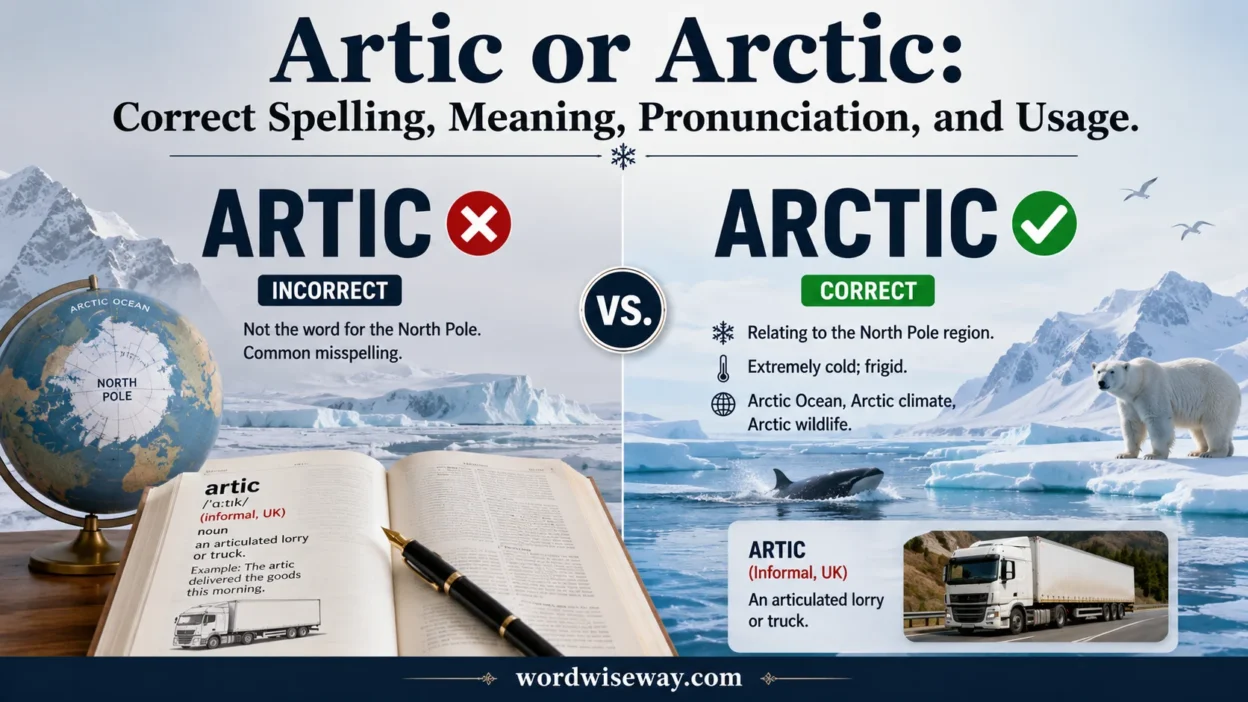
Artic or Arctic: Correct Spelling, Meaning, and Usage is a common spelling question. Arctic is the correct English word for the northern polar region and the northernmost region of the Earth.
Artic is a misspelling caused by pronunciation, as the first c is often silent or barely pronounced. The correct form is A-R-C-T-I-C, with two C’s. This spelling is used when discussing geography, climate change, wildlife, weather reports, and the far north.
This spelling mistake can affect academic writing, professional communication, and online content. Whether you’re writing a geography assignment, school paper, blog, or social media post, using the correct spelling improves credibility and clear writing.
If you search online for artic or arctic, remember this simple rule: Arctic is always the correct form.
Quick Answer:
Arctic is the correct spelling when you mean the region around the North Pole or something related to that region. It can also describe something extremely cold.
Artic is not the standard spelling of Arctic. In UK informal English, however, artic can mean an articulated lorry, a large vehicle made of connected sections that can bend at the joint.
| Word | Meaning | Typical use |
| Arctic | The region around the North Pole | Geography and science |
| Arctic | Relating to the North Pole or its environment | Climate, animals, oceans |
| arctic | Extremely cold | Figurative and descriptive use |
| artic | Informal abbreviation for articulated lorry | UK transportation |
So, if you’re writing “The Arctic is extremely cold,” you’re using the correct spelling.
If you’re writing “The driver delivered the goods in an artic,” artic can be correct in informal British English because it refers to an articulated lorry.
What Does Arctic Mean?
The word Arctic has several closely connected meanings. Its most important use refers to the northern polar region surrounding the North Pole.
As a noun, the Arctic means the very cold area around the North Pole. Cambridge Dictionary defines it as “the very cold area around the North Pole.”
For example:
- Polar bears live in the Arctic.
- Scientists study changes in the Arctic.
- The Arctic contains unique ecosystems.
- They traveled to the Arctic for research.
The word also works as an adjective. In that role, it describes something connected with the Arctic region.
For example:
- Arctic wildlife
- Arctic sea ice
- Arctic Ocean
- Arctic climate
- Arctic tundra
- Arctic fox
- Arctic research
The word can also have a figurative meaning. When someone describes a room as arctic, they usually mean it feels extremely cold rather than suggesting that the room sits anywhere near the North Pole. Cambridge gives arctic the figurative sense of very cold.
Consider this sentence:
The classroom was arctic this morning.
The speaker probably isn’t making a geographical claim. They’re emphasizing how cold the classroom felt.
What Does Artic Mean?
Here’s where the spelling gets interesting.
In ordinary American English, artic isn’t the standard spelling for the North Polar region. If you write artic when you mean the polar region, readers will generally see it as a misspelling of Arctic.
However, artic has a legitimate informal use in British English. Cambridge Dictionary identifies it as a UK informal noun and an abbreviation for articulated lorry.
An articulated lorry consists of separate sections connected by a joint. That design allows the vehicle to bend when turning. In American English, a comparable vehicle is commonly called a tractor-trailer or semi-truck. Cambridge describes an articulated lorry as a vehicle consisting of two or more parts that bend where they join.
For example:
- The company operates several large artics.
- A heavy artic was parked outside the warehouse.
These sentences use artic in the British transportation sense.
The key point is simple: artic and Arctic aren’t interchangeable spellings. They happen to look similar, but their meanings differ.
Why Do People Spell Arctic as Artic?
The main reason comes down to pronunciation.
When people say Arctic, the word can sound as though the first c disappears. That makes the spelling easy to underestimate, especially for someone who learned the word mainly through conversation.
Cambridge gives the US pronunciation as /ˈɑːrk.tɪk/ and the UK pronunciation as /ˈɑːk.tɪk/.
In American English, a useful approximation is:
ARC-tic
That pronunciation helps reveal the structure:
ARC + TIC = ARCTIC
The first c belongs to the arc portion of the word. It isn’t decorative. It forms part of the established spelling.
This is a classic example of why English spelling can’t always be reconstructed perfectly from sound. A word may contain letters that aren’t strongly noticeable in everyday speech. If you’ve only heard Arctic pronounced aloud, artic can seem like a reasonable guess.
It isn’t, when you’re referring to the polar region.
How Do You Pronounce Arctic?
In US English, Arctic is pronounced approximately:
ARK-tik
The Cambridge pronunciation is /ˈɑːrk.tɪk/. In UK English, Cambridge lists /ˈɑːk.tɪk/.
The word has two main parts:
- arc
- tic
Think of the spelling as having a small hinge in the middle:
ARC-TIC
That mental division can make the extra c much easier to remember.
Arctic vs. Artic Pronunciation
Interestingly, pronunciation doesn’t provide a reliable way to decide the spelling.
Arctic and the UK informal artic can sound very similar. The difference becomes clear from context and spelling.
For example:
The Arctic is melting.
Here, the subject is the northern polar region.
The driver parked the artic.
Here, artic refers to an articulated lorry in informal British English.
The surrounding words act like signposts. Context tells you which meaning is intended.
Arctic as a Noun
When Arctic refers to the geographic region, it commonly appears with the:
the Arctic
This is the normal construction when discussing the polar region as a place.
Examples include:
- The Arctic has a distinctive climate.
- Researchers work in the Arctic.
- The Arctic supports specialized wildlife.
- Sea ice plays an important role in Arctic ecosystems.
The Arctic isn’t simply another name for a single country or a single point on a map. It describes a broad northern polar region with distinctive environmental conditions.
That distinction matters because the term appears frequently in geography, environmental science, climate research, and news reporting.
Arctic as an Adjective
The adjective arctic describes something connected with the Arctic.
For example:
1.Arctic wildlife means wildlife associated with the Arctic environment.
2.Arctic temperatures means temperatures associated with very cold conditions.
3.Arctic research refers to scientific research involving the Arctic region.
The adjective can also describe extreme cold without directly referring to geography.
For example:
An arctic wind swept across the town.
Here, the adjective emphasizes severe cold. The wind doesn’t need to originate in the Arctic for the sentence to make sense.
Capitalized Arctic vs. Lowercase arctic
Capitalization depends on meaning and usage.
When referring to the geographic region, use Arctic:
- The Arctic is a fragile environment.
- They conducted research in the Arctic.
When using the word as a general adjective meaning extremely cold, lowercase arctic can be appropriate:
- We woke up to arctic temperatures.
- The basement felt arctic.
However, established proper names remain capitalized:
- Arctic Ocean
- Arctic Circle
This distinction is similar to many geographic terms that become ordinary descriptive adjectives in other contexts.
Real-World Examples
A practical comparison makes the difference much clearer.
| Sentence | Correct? | Why |
| Polar bears live in the Arctic. | ✅ | Refers to the northern polar region |
| The Arctic Ocean is enormous. | ✅ | Proper geographic name |
| We experienced arctic temperatures. | ✅ | Means extremely cold |
| Arctic foxes have adaptations for cold environments. | ✅ | Relates to the Arctic |
| Polar bears live in the Artic. | ❌ | Artic is misspelled here |
| The Artic Ocean is cold. | ❌ | The geographic name is Arctic Ocean |
| The warehouse uses several artics. | ✅ in UK informal English | Artics means articulated lorries |
The third and seventh examples show why simply labeling artic as “wrong” isn’t completely accurate.
It depends on what the writer means.
Common Mistakes With Arctic
The most common mistake is straightforward:
Artic ❌ Arctic ✅
A writer may know exactly what the word means but forget the first c.
Another frequent error involves the related word Antarctic.
The correct forms are:
- Arctic ✅
- Antarctic ✅
- Artic ❌ when referring to the North Polar region
- Antartic ❌ when referring to the South Polar region
Notice the spelling pattern. Both Arctic and Antarctic retain the c before the t.
That tiny letter has a habit of disappearing when people type quickly.
Incorrect and Correct Examples
Incorrect:
The artic climate can be harsh.
Correct:
The Arctic climate can be harsh.
Incorrect:
Scientists traveled to the Artic.
Correct:
Scientists traveled to the Arctic.
Incorrect:
The Artic Ocean contains sea ice.
Correct:
The Arctic Ocean contains sea ice.
Incorrect:
Antartic research provides valuable data.
Correct:
Antarctic research provides valuable data.
The pattern becomes easier once you stop treating the missing c as a random spelling detail.
Arctic and Antarctic: A Useful Spelling Comparison
Arctic and Antarctic are often learned together because they refer to opposite polar regions.
The Arctic lies around the North Pole, while Antarctica is the continent surrounding the South Pole.
Their spellings share an important feature:
ARCTIC
ANTARCTIC
The c remains in both words.
This creates a useful memory shortcut:
If you can remember the C in Arctic, you can carry it into Antarctic.
The two words shouldn’t be confused geographically, either. The Arctic is a polar region in the north, while Antarctica is a continent in the south.
Common Phrases With Arctic
You’ll encounter Arctic in many established expressions. Learning these combinations can strengthen both spelling and vocabulary.
| Phrase | Meaning |
| Arctic Circle | A major geographic circle in the far north |
| Arctic Ocean | The ocean surrounding the North Pole |
| Arctic climate | Climate associated with Arctic conditions |
| Arctic air | Very cold air associated with Arctic conditions |
| Arctic wildlife | Animals living in Arctic environments |
| Arctic fox | A fox species adapted to Arctic environments |
| Arctic tundra | Treeless northern terrain with cold-climate vegetation |
| Arctic sea ice | Sea ice found in Arctic waters |
| Arctic exploration | Exploration of the Arctic region |
| Arctic temperatures | Extremely cold temperatures or temperatures associated with the Arctic |
These phrases also show why spelling matters. A single missing c can make a familiar scientific or geographic term look incorrect.
Why Is Arctic Spelled With a C?
The spelling has a historical explanation.
Arctic comes through Latin arcticus, from Greek arktikos, which means “of the bear” or “northern.” The word connects with Greek arktos, meaning bear.
That reference isn’t about polar bears specifically. It relates to the northern constellations associated with the Great Bear, including Ursa Major.
The history helps explain why the spelling contains the c that people sometimes omit.
English has borrowed thousands of words from Greek and Latin. Their historical spellings often remain visible even when modern pronunciation doesn’t make every letter obvious.
So Arctic isn’t an arbitrary arrangement of letters. Its spelling reflects its linguistic history.
A Simple Way to Remember Arctic
When you’re tempted to write artic, stop and divide the word:
ARC + TIC
That gives:
A-R-C-T-I-C
The easiest memory trick is to associate the beginning with arc.
Think:
ARC + TIC = ARCTIC
You can also connect it with Antarctic:
ARCTIC
ANTARCTIC
Both contain the important C.
Another useful technique involves saying the word while spelling it. Don’t rely entirely on how quickly the word sounds in conversation. Instead, deliberately pronounce the first part as arc when you’re checking the spelling.
A few repetitions can make the correct form automatic.
A Practical Case Study: Choosing the Right Word
Imagine you’re writing a school report about polar environments.
You type:
The artic region contains animals that have adapted to extreme cold.
The meaning is understandable, but the spelling is wrong for the intended geographic meaning.
The corrected sentence is:
The Arctic region contains animals that have adapted to extreme cold.
Now imagine a completely different context involving British transportation:
The company operates several artics for long-distance deliveries.
Here, artics can be correct because the word functions as an informal abbreviation for articulated lorries in UK English.
The lesson is important: context determines whether the shorter spelling has a legitimate meaning.
Calling every instance of artic wrong would overlook this genuine British usage.
Quick Comparison
| Feature | Arctic | artic |
| Correct for the North Pole region | Yes | No |
| Means related to the Arctic | Yes | No |
| Can mean extremely cold | Yes | No |
| Geographic noun | Yes | No |
| Common in American English | Yes | Not for the polar meaning |
| Informal British transportation term | No | Yes |
| Refers to articulated lorry | No | Yes |
| Common spelling mistake | No | Yes, when intended to mean Arctic |
Facts
Here are the key facts to keep in mind:
- Arctic is the standard spelling for the northern polar region.
- The Arctic functions as a geographic noun.
- arctic can work as an adjective meaning extremely cold.
- Arctic appears in geographic names such as Arctic Ocean and Arctic Circle.
- Cambridge lists the US pronunciation of Arctic as /ˈɑːrk.tɪk/.
- Artic has a legitimate UK informal use as an abbreviation for articulated lorry.
- In American English, artic should not replace Arctic when discussing the polar region.
- The c in Arctic is part of its standard spelling.
- Antarctic also retains the c, making the pair useful for spelling practice.
Read More: Dumby or Dummy: Correct Spelling, Meaning, and Usage
FAQs
1. Is “Arctic” or “Artic” correct?
Arctic is the correct spelling. Artic is a common misspelling caused by the way the word sounds when spoken.
2. What does “Arctic” mean?
Arctic refers to the northern polar region around the North Pole. It can also describe its climate, wildlife, geography, or other things connected to the region.
3. Why do people spell Arctic as “Artic”?
The confusion mainly comes from pronunciation. The first c may sound weak or almost silent, making Arctic sound similar to “ar-tik.”
4. How do you spell Arctic correctly?
The correct spelling is A-R-C-T-I-C. Remember that Arctic contains two c’s, including one before the t.
5. Is “Artic” a real English word?
In standard English, Artic is generally considered a misspelling when someone means the northern polar region. The correct word is Arctic.
6. How is Arctic used in a sentence?
You can write, “Many animals have adapted to the Arctic climate.” The word can describe the region itself or things associated with its environment.
7. Is Arctic related to climate change?
Yes. The Arctic is frequently discussed in climate science because changes in its ice, temperatures, and ecosystems are important indicators of a changing climate.
8. What is the easiest way to remember Arctic?
Remember that Arctic has an extra c before the t: ARC-TIC. This can help prevent accidentally writing Artic.
9. Is Arctic used in geography?
Yes. Arctic is widely used in geography when discussing the northern polar region, the North Pole, surrounding areas, climate patterns, and geographical features.
10. Should I use Arctic in academic writing?
Yes. Always use Arctic when referring to the northern polar region or something associated with it. Using the correct spelling makes academic and professional writing clearer.
Conclusion
The difference between Arctic and Artic is simple once you know where the confusion comes from. Arctic is the correct spelling, while Artic is generally a misspelling caused by pronunciation. The extra c is easy to overlook, especially when writing quickly, but remembering the spelling A-R-C-T-I-C can help you avoid the mistake.
Whether you’re writing about geography, climate change, wildlife, weather, or the northern polar region, choosing Arctic keeps your writing accurate and professional.