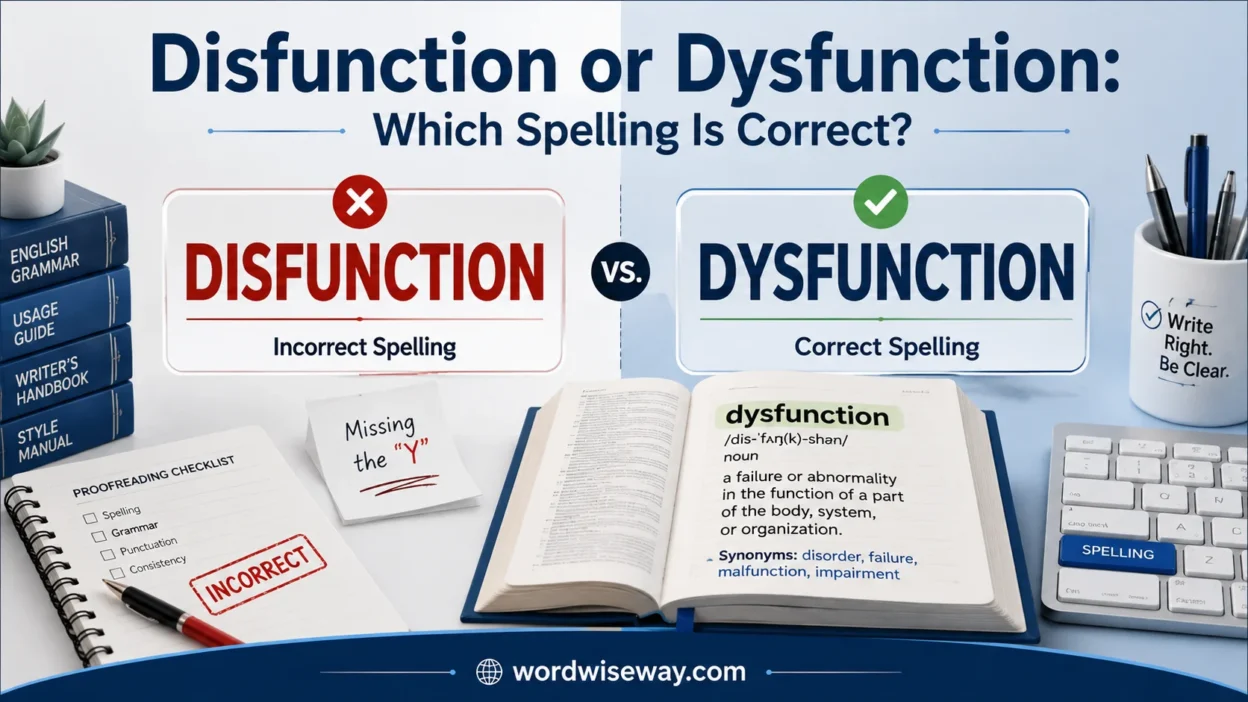
Disfunction or Dysfunction: Correct Spelling, Meaning, and Usage can confuse speakers, students, and writers because both terms look and sound familiar.
The correct spelling is Dysfunction, and its meaning, usage, origins, and related expressions matter for clarity and credibility.
The history of the term also explains why the distinction matters in professional settings, academic work, and casual writing.
Understanding nuances, real-world applications, and modern standards helps you avoid mistakes, choose the correct term, and communicate in a clear, precise, and credible way.
Quick Answer:
Dysfunction is the preferred and standard spelling.
Disfunction is a less common variant of the same word. Merriam-Webster specifically identifies it as a “less common spelling” of dysfunction.
| Spelling | Status | Meaning | Best choice for standard writing |
| Dysfunction | Standard, widely established | Impaired or abnormal functioning | Yes |
| Disfunction | Less common variant | Essentially the same meaning | Usually avoid |
So, if you’re writing an essay, blog post, report, email, academic paper, or professional document, choose dysfunction. It’s the spelling that will look natural to most readers.
What Does Dysfunction Mean?
Dysfunction is a noun that describes impaired, abnormal, or ineffective functioning. In simple terms, something has dysfunction when it doesn’t work or operate as it normally should.
Cambridge Dictionary defines dysfunction as a problem or fault in part of the body or a machine. Its American Dictionary also gives the broader meaning “failure to operate or work well.”
The word can describe very different situations depending on context. For example, a doctor might discuss kidney dysfunction, while a manager might talk about organizational dysfunction. A writer could also describe family dysfunction in a novel.
Here are some natural examples:
- The tests showed evidence of liver dysfunction.
- Poor communication created dysfunction within the team.
- The machine developed a serious electrical dysfunction.
- The novel explores family dysfunction.
- The organization struggled with internal dysfunction.
The central idea stays the same: normal functioning has been impaired.
Why Is Dysfunction Spelled With “Dys”?
The spelling becomes much easier to remember once you understand the prefix.
Dysfunction comes from dys- + function. Merriam-Webster identifies dys- as a prefix meaning things such as abnormal, difficult, impaired, or bad.
The prefix has Greek roots. The Online Etymology Dictionary traces dys- to Greek and explains its connection with ideas such as difficulty, abnormality, and impaired function.
That gives us a useful word-building pattern:
dys- + function = dysfunction
The same prefix appears in other English words:
- dyslexia
- dysplasia
- dysphagia
- dysregulation
- dystrophy
- dysentery
This doesn’t mean every word beginning with dys- has exactly the same meaning. The useful point is that dys- is an established prefix associated with abnormality or difficulty.
Why Not Disfunction?
The confusion comes partly from pronunciation.
Dysfunction is pronounced approximately dis-FUNK-shun. Cambridge gives the US pronunciation as /dɪsˈfʌŋk.ʃən/.
Notice the problem: the word begins with a sound that resembles dis-.
When people hear dysfunction, they may naturally think of familiar words such as:
- disagree
- dislike
- disconnect
- disapprove
- disappear
That sound-based association can lead to the spelling disfunction.
The pronunciation, however, doesn’t tell you whether the word uses dis- or dys-. English spelling has plenty of situations where pronunciation alone isn’t enough.
Is Disfunction a Word?
Yes, but there’s an important qualification.
Disfunction is recognized as a spelling variant of dysfunction. Merriam-Webster lists disfunction as a less common spelling and gives the same basic meanings as dysfunction.
The historical record also supports this relationship. The Online Etymology Dictionary dates disfunction to 1914 as a variant of dysfunction. It gives dysfunction the same 1914 origin and traces it to dys- plus function.
So there’s a useful distinction:
Disfunction isn’t simply an imaginary spelling. It is a documented variant, but dysfunction is the standard choice.
That distinction prevents two common mistakes. You don’t need to claim that disfunction never exists. At the same time, you shouldn’t treat both spellings as equally common or equally preferable.
For everyday American English, dysfunction wins.
Dysfunction Meaning and Examples
The word has a broad range of uses. Its meaning becomes clearer when you see it working in different contexts.
Dysfunction in Medical Contexts
In medicine, dysfunction often describes abnormal or impaired activity in an organ, body part, or physiological system.
For example:
- liver dysfunction means impaired liver function.
- kidney dysfunction refers to impaired kidney function.
- cardiac dysfunction describes abnormal heart function.
- cognitive dysfunction refers to impaired cognitive functioning.
- brain dysfunction describes abnormal functioning involving the brain.
Cambridge lists combinations such as brain dysfunction, cardiac dysfunction, and cognitive dysfunction among its recorded collocations.
A medical sentence might read:
The patient developed temporary liver dysfunction after the infection.
Here, dysfunction doesn’t necessarily mean that an organ has stopped working completely. It can describe impaired or abnormal function.
That distinction matters because dysfunction is broader than total failure.
Dysfunction in Relationships and Families
Outside medicine, dysfunction often describes unhealthy or ineffective patterns within a group.
You might encounter phrases such as:
- family dysfunction
- relationship dysfunction
- social dysfunction
- interpersonal dysfunction
For example:
Years of poor communication created dysfunction within the family.
The word doesn’t merely mean that people disagree. It suggests that the way the group operates has become unhealthy, ineffective, or impaired.
Cambridge also uses dysfunctional in contexts such as a dysfunctional family, showing how the word extends beyond physical systems.
Dysfunction in Organizations and Workplaces
A workplace can also experience dysfunction.
Imagine a company where departments don’t communicate, managers give conflicting instructions, and employees can’t agree on basic procedures. The organization may have internal or organizational dysfunction.
For example:
The company struggled with organizational dysfunction after several leadership changes.
Here, dysfunction describes a problem in how the organization operates.
The same concept can apply to:
- teams
- schools
- institutions
- governments
- departments
- committees
- social systems
The common thread is simple: the system isn’t functioning effectively.
Dysfunction vs. Dysfunctional
Another common source of confusion is the difference between dysfunction and dysfunctional.
The words are closely related, but they don’t perform the same grammatical job.
Dysfunction is a noun.
Dysfunctional is an adjective.
| Word | Part of speech | Meaning | Example |
| Dysfunction | Noun | Impaired or abnormal functioning | The team experienced dysfunction. |
| Dysfunctional | Adjective | Not functioning normally | The team had a dysfunctional communication system. |
Cambridge defines dysfunctional as something that isn’t behaving or working normally.
Compare these sentences:
- The organization has serious dysfunction.
- The organization has a dysfunctional structure.
In the first sentence, you’re naming the problem.
In the second, you’re describing the structure.
Is “Disfunctional” Correct?
If you’re looking for the standard adjective, use dysfunctional.
The preferred pattern is:
dysfunction → dysfunctional
Not:
disfunction → disfunctional
Merriam-Webster lists dysfunctional as the adjective formed from dysfunction.
That makes the spelling easier to remember. Once you learn dysfunction, keep the same dys- spelling when forming the related adjective.
How to Pronounce Dysfunction
Dysfunction is pronounced:
dis-FUNK-shun
The IPA pronunciation listed by Cambridge is /dɪsˈfʌŋk.ʃən/.
The pronunciation explains much of the spelling confusion because dys- sounds like “dis.”
Try breaking the word into three parts:
dys + func + tion
Then say it naturally:
dis-FUNK-shun
Don’t let the sound trick you into changing the spelling. English contains many words whose spelling isn’t obvious from pronunciation alone.
Common Phrases With Dysfunction
You’ll see dysfunction paired with many different nouns. Learning these combinations can help you recognize the standard spelling naturally.
Family Dysfunction
Family dysfunction describes unhealthy or ineffective patterns within a family.
The story examines how family dysfunction affects the characters.
Organizational Dysfunction
Organizational dysfunction refers to problems that interfere with how an organization operates.
The new director tried to address years of organizational dysfunction.
Cognitive Dysfunction
Cognitive dysfunction refers broadly to impaired cognitive functioning. Cambridge lists it as an established collocation.
The researchers examined possible causes of cognitive dysfunction.
Brain Dysfunction
Brain dysfunction refers to abnormal functioning of the brain.
The researchers investigated changes associated with brain dysfunction.
Systemic Dysfunction
Systemic dysfunction describes problems that affect the operation of a larger system rather than one isolated part.
The audit revealed systemic dysfunction across several departments.
These phrases demonstrate why learning the spelling matters. Dysfunction appears in medical, academic, workplace, social, and everyday writing.
Common Mistakes With Dysfunction
The biggest spelling mistake is straightforward:
❌ disfunction
✅ dysfunction
However, a few related mistakes deserve attention.
| Incorrect or less preferred form | Preferred form | Why |
| disfunction | dysfunction | The latter is the standard spelling |
| disfunctional | dysfunctional | The adjective follows dysfunction |
| dysfuntion | dysfunction | The second “c” is missing |
| dysfuncton | dysfunction | The “i” is missing |
Incorrect: The company suffers from disfunction.
Correct: The company suffers from dysfunction.
Incorrect: Their communication system is disfunctional.
Correct: Their communication system is dysfunctional.
The easiest strategy is to learn the complete word family together:
function → dysfunction → dysfunctional → dysfunctions
Once the spelling pattern becomes familiar, the common errors become much easier to spot.
Dysfunction in a Sentence
Seeing the word in different sentence structures can make its usage much clearer.
Medical examples
- The test revealed mild liver dysfunction.
- The treatment was designed to improve organ function rather than simply manage symptoms.
- The researchers studied cardiac dysfunction in the affected group.
Workplace examples
- Poor communication created dysfunction within the department.
- The manager identified several sources of organizational dysfunction.
- The team overcame its earlier dysfunction after changing its workflow.
Family and relationship examples
- The novel explores family dysfunction across three generations.
- Constant arguments contributed to dysfunction within the household.
- The documentary examines relationship dysfunction from several perspectives.
General examples
- The committee’s internal dysfunction delayed the decision.
- The report identified serious dysfunction in the system.
- Political dysfunction can make long-term reforms difficult.
Notice how the word doesn’t always describe a physical problem. Dysfunction can describe anything whose normal operation has become impaired or ineffective.
Dysfunction vs. Malfunction
Both overlaps, but they aren’t perfect substitutes.
Malfunction generally focuses on something failing to work correctly. Cambridge defines the noun malfunction as a failure to work or operate correctly and commonly illustrates it with machines and equipment.
Dysfunction has a broader range. It can describe abnormal functioning in a body part, a relationship, a family, an organization, or a social system.
| Word | Typical focus | Example |
| Dysfunction | Abnormal or impaired functioning | The patient experienced kidney dysfunction. |
| Malfunction | Failure to operate correctly | The computer suffered a hardware malfunction. |
Consider a broken printer.
You’d naturally say:
The printer has a malfunction.
Now consider a workplace where departments repeatedly fail to cooperate:
The company has organizational dysfunction.
You wouldn’t normally describe that situation as a malfunction. The context determines which word fits.
Dysfunction vs. Disorder
These words also overlap in some contexts, especially medicine, but they aren’t identical.
A disorder generally refers to a condition involving abnormal structure or function. Dysfunction focuses more specifically on impaired functioning.
For example:
- The disorder affects the nervous system.
- The condition causes neurological dysfunction.
The words can appear together, but they emphasize different aspects of a problem.
A useful rule is to ask what you want to emphasize. If the focus is the abnormal condition itself, disorder may fit. If the focus is how something is functioning poorly, dysfunction may be more precise.
A Simple Case Study: Choosing the Right Spelling
Imagine you’re writing a report about a company whose departments rarely communicate.
You write:
The company has serious disfunction between its departments.
The meaning is understandable. However, the spelling looks unusual because dysfunction is the established form.
A polished version would be:
The company has serious dysfunction between its departments.
Now suppose the sentence needs an adjective:
The company has a disfunctional communication system.
The standard form is:
The company has a dysfunctional communication system.
This tiny spelling change makes the writing look more polished and consistent.
The lesson is straightforward: learn the word family rather than memorizing one isolated spelling.
How to Remember the Correct Spelling
A useful memory trick is to connect dysfunction with other familiar dys- words.
Think:
dyslexia → dysfunction → dysfunctional
All three retain the dys- spelling.
Another useful approach is to remember the word’s construction:
dys- + function = dysfunction
The prefix contributes the idea of abnormality or impaired function. Merriam-Webster specifically defines dys- as a prefix associated with abnormality, difficulty, and impairment.
Once you remember that structure, disfunction becomes easier to recognize as the less common variant rather than your default spelling.
Facts About Dysfunction
Here are a few useful facts that clear up the spelling and history:
- Dysfunction is a noun.
- Dysfunctional is its common related adjective.
- The standard pronunciation begins with the sound “dis.”
- Merriam-Webster lists disfunction as a less common spelling variant.
- Merriam-Webster gives the first known use of dysfunction as approximately 1916.
- The word was originally used in anatomy and medicine before gaining broader social and organizational uses.
- Cambridge records uses involving body functions, machines, families, organizations, and cognitive processes.
- The plural form is dysfunctions.
Read More: Publish or Perish: Meaning, Examples, and Correct Usage
FAQs
Is “Disfunction” or “Dysfunction” the correct spelling?
Dysfunction is the standard and widely accepted spelling in modern English. Disfunction is generally considered an incorrect spelling, even though it may appear online or seem logical because of the familiar prefix “dis-.” When you want your writing to follow standard English usage, choose dysfunction.
Why do people confuse “Disfunction” with “Dysfunction”?
The confusion mostly comes from how closely the two words look and sound. Both can appear familiar at first glance, especially when someone types quickly or relies heavily on spellcheck. Since dysfunction is the accepted form, learning to recognize it directly can prevent repeated spelling mistakes.
What does “Dysfunction” mean?
Dysfunction refers to abnormal, impaired, or ineffective functioning. It can describe a problem with how something works, whether that involves a system, organization, relationship, body part, or other process. The exact meaning depends on the context in which the word appears.
Is “Disfunction” ever considered an alternative spelling?
In standard modern English, disfunction is not normally treated as an acceptable alternative to dysfunction. You may encounter it in websites, informal writing, older material, or user-generated content, but its appearance does not make it the preferred spelling. For professional and academic writing, dysfunction is the safer choice.
Is “Dysfunction” used in medical writing?
Yes. Dysfunction is commonly used in medical contexts to describe impaired or abnormal functioning. Its meaning can change according to the specific condition or body system being discussed. Because medical writing depends heavily on precision, using the established spelling is particularly important.
Can “Dysfunction” be used outside medical contexts?
Absolutely. The word isn’t limited to medicine. You can encounter dysfunction when discussing families, relationships, workplaces, organizations, systems, or other situations where something fails to work effectively. Context tells the reader what kind of functioning problem you mean.
Does British English use “Dysfunction” differently from American English?
Both British English and American English use dysfunction as the standard spelling. There isn’t a major spelling difference between the two varieties for this word. Although vocabulary and spelling can vary between British and American English in many cases, dysfunction remains the established form in both.
How can I avoid spelling “Dysfunction” incorrectly?
A simple approach is to connect the word with its standard spelling whenever you write it: dysfunction. If you’re unsure, check a reliable dictionary rather than assuming that a familiar-looking form is correct. Reading the word regularly in professional, academic, and everyday contexts also makes the correct spelling easier to remember.
Why does correct spelling matter in professional writing?
Small spelling errors can affect how readers perceive your work, particularly in professional or academic settings. A word such as disfunction may distract readers or make the writing appear less carefully edited. Choosing dysfunction helps maintain clarity and shows attention to language and detail.
What is the easiest way to remember “Dysfunction”?
Remember that the standard spelling begins with dys-: dysfunction. Once you recognize this form, you can apply it consistently in sentences, articles, essays, emails, and other types of writing. When in doubt, pause before using disfunction and verify the spelling rather than trusting what merely looks familiar.
Conclusion
The difference between disfunction and dysfunction may seem like a tiny spelling issue, but it can make a noticeable difference in clear communication. Dysfunction is the standard spelling used in modern English, while disfunction is generally regarded as incorrect. The word can appear in medical discussions as well as everyday conversations about relationships, organizations, systems, and other situations where something does not function properly.
Knowing the correct form is especially useful when you’re writing an essay, preparing professional material, creating an article, or communicating about a technical or medical subject. Instead of relying only on what looks or sounds familiar, pay attention to established spelling and context. Once dysfunction becomes familiar, the distinction becomes much easier to remember. A small check can save you from an avoidable spelling error and keep your writing clear, polished, and credible.

Amelia Sanders has spent 14 years in Harvard University’s English Department, helping students navigate literary analysis, interpretive theory, and narrative techniques. Her academic pursuits center on 18th-century British prose, romantic poetry, diasporic writing, and digital editing exploring how textual choices influence cultural perspectives. Amelia has spoken at major international meetings and contributed essays to respected academic volumes, demonstrating her dedication to thoughtful scholarship and effective teaching.