Can or Could: Meaning, Difference, and Correct Usage helps English learners understand these modal verbs in everyday communication. When writing sentences, you may ask, “Can you help me?” or “Could you help me?” Both express ability, possibility, or permission, but their meaning, time, and politeness can change with the situation.
Can usually sounds direct and suits present ability, while could often sounds softer and more polite. This difference matters in emails, school writing, job interviews, and daily conversations, where your tone should sound natural, respectful, and professional. These small words can make a noticeable change.
A useful guide to can vs could should explain grammar rules, common mistakes, real-life examples, FAQs, and expert tips. Check the time reference and level of politeness before deciding which form to use. This approach helps you choose each one correctly, whether you’re making a request or asking for permission.
Quick Answer:
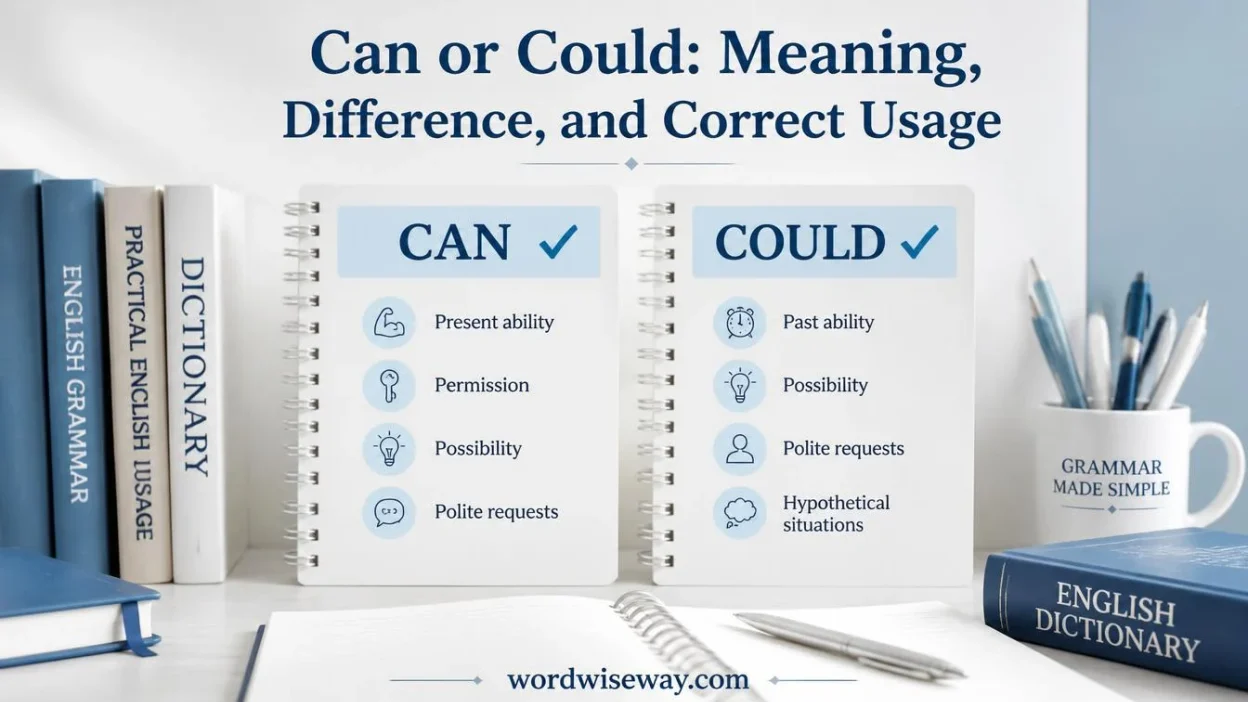
Use can when you usually want to express present ability, present permission, general possibility, or a direct request.
Use could when you usually want to express past ability, uncertain possibility, a polite request, a suggestion, or a hypothetical ability or result.
| Situation | Can | Could |
| Present ability | I can swim. | Usually not |
| General past ability | Usually not | I could swim at age five. |
| Present possibility | It can happen. | It could happen. |
| Uncertain possibility | Less typical | It could rain tonight. |
| Asking permission | Can I leave? | Could I leave? |
| Direct request | Can you help? | Could you help? |
| Polite request | Possible | Often preferred |
| Suggestion | You can try this. | You could try this. |
| Hypothetical ability | Less common | I could help if I had time. |
A useful shortcut is this: can often sounds more direct and immediate, while could often adds distance, uncertainty, politeness, or a past-time meaning.
However, that shortcut doesn’t explain every situation. The rest depends on how the modal verb functions in the sentence.
What Does “Can” Mean?
Can is a modal verb with several important uses. It can describe ability, permission, possibility, requests, offers, and suggestions.
Because can doesn’t take an infinitive marker, you say “I can swim,” not “I can to swim.” After can, use the base form of the main verb.
Can for Present Ability
The most familiar use of can describes something a person is able to do now.
Examples:
- I can speak English.
- She can solve difficult problems.
- They can finish the project today.
- He can play the guitar.
- You can access the file from your computer.
The ability doesn’t necessarily have to happen at this exact moment. The sentence can describe a skill or capability that currently exists.
For example, “Maria can drive” means driving is within Maria’s present ability. It doesn’t mean she’s driving right now.
Can for Permission
Can also appears frequently when people ask for or give permission.
Examples:
- Can I use your phone?
- Can we leave early?
- You can sit here.
- You can take one more cookie.
In everyday American English, “Can I…?” is completely normal for asking permission. The older classroom rule that can only means physical ability doesn’t reflect ordinary modern usage.
Consider the difference:
Can I borrow your pen?
The speaker isn’t asking whether borrowing is physically possible. They’re asking whether the listener gives permission.
Can for Possibility
Can can describe something that is generally possible.
Examples:
- Winter storms can cause power outages.
- Driving at night can be difficult.
- Mistakes can happen when you’re tired.
- Too much heat can damage electronic equipment.
Here, can often describes a possibility that exists as part of a general pattern.
Compare:
Heavy rain can cause flooding.
This means flooding is a possible result of heavy rain in general.
Heavy rain could cause flooding tonight.
This focuses on a particular possibility that may or may not happen tonight.
That small change shifts the meaning.
Can for Requests
Can you…? is one of the most common request patterns in everyday English.
Examples include:
- Can you help me?
- Can you send the document?
- Can you wait a minute?
- Can you close the door?
These questions usually sound natural and direct. They aren’t necessarily rude. Tone depends heavily on the relationship between speakers and the surrounding context.
For example, “Can you pass the salt?” sounds perfectly ordinary at a family dinner.
Can for Offers and Suggestions
Can can also introduce an option or offer.
Examples:
- I can help you with that.
- You can take the bus instead.
- We can meet tomorrow.
- You can try restarting the computer.
In these sentences, can presents an available action or option.
What Does “Could” Mean?
Could has several functions, and this is where many learners get tripped up. Although could is historically related to can, it doesn’t simply mean “past can” in every sentence.
It can express past ability, possibility, polite requests, suggestions, and conditional situations.
Could for Past Ability
Could commonly describes a general ability that existed in the past.
Examples:
- I could read when I was four.
- She could swim when she was six.
- He could run faster when he was younger.
- We could stay awake all night as teenagers.
The important word here is general.
If someone says:
“When I was a child, I could climb trees easily.”
The sentence describes an ability that existed over a period of time.
However, could isn’t always the best choice for one specific successful event.
For a particular completed achievement, English often uses was able to or managed to.
For example:
I was able to fix the computer yesterday.
This emphasizes that the person actually succeeded in that particular situation.
Could for Possibility
Could frequently expresses something that is possible but not certain.
Examples:
- It could rain tonight.
- The package could arrive tomorrow.
- This plan could work.
- She could be at home.
The speaker doesn’t present the outcome as certain.
Compare these sentences:
- The train can arrive late.
- The train could arrive late today.
The first can describe a general possibility. Trains sometimes arrive late.
The second points toward a particular possibility. The speaker doesn’t know whether today’s train will actually arrive late.
Could for Polite Requests
One of the most useful differences between can and could appears in requests.
Compare:
Can you help me?
and
Could you help me?
Both are grammatically correct. The second usually sounds more polite, softer, or less direct.
You might use can with someone you know well:
Can you send me the photo?
In a more formal or courteous situation, could may fit better:
Could you send me the report when you have a moment?
The difference isn’t about correctness. It’s primarily about tone and social distance.
Could for Suggestions
Could can introduce a possible option.
Examples:
- You could ask your teacher for help.
- We could take the train.
- You could try a different approach.
- She could apply for the position.
Notice that could doesn’t force the suggestion.
Compare:
You should call him.
This sounds like advice or a recommendation.
You could call him.
This presents calling as one possible option.
That distinction makes could useful when you want to offer an idea without sounding overly forceful.
Could in Conditional Situations
Could frequently appears when an ability or possibility depends on a condition.
For example:
If I had more time, I could help you.
The speaker has the ability to help, but a condition prevents them from doing so now.
Other examples include:
- If we left earlier, we could catch the first train.
- If she practiced more, she could improve quickly.
- If you saved enough money, you could buy the laptop.
In these sentences, could connects an imagined condition with a possible result.
Key Differences
The clearest way to understand can or could is to compare their main functions side by side.
| Function | Can | Could |
| Present ability | I can cook. | Usually not |
| Past general ability | Usually not | I could cook at age ten. |
| General possibility | Exercise can improve health. | Possible, but different emphasis |
| Specific uncertain possibility | Possible | It could happen tomorrow. |
| Direct request | Can you help? | Could you help? |
| More polite request | Possible | Could you help? |
| Permission | Can I leave? | Could I leave? |
| Suggestion | You can try this. | You could try this. |
| Conditional ability | Less common | I could help if I were free. |
The biggest lesson is that can and could don’t have one fixed meaning each. Their meaning changes according to tense, context, certainty, and tone.
Can or Could for Requests?
Both forms work for requests, but they create slightly different impressions.
Can you help me? is direct and natural.
Could you help me? is generally more polite or less abrupt.
Neither sentence is automatically rude or formal. The situation matters.
For instance, a friend might say:
Can you send me the notes?
A student speaking to someone they don’t know well might choose:
Could you send me the notes, please?
The second version creates more distance and courtesy.
Can vs. Could Request Examples
| Sentence | Typical impression |
| Can you open the door? | Direct, everyday |
| Could you open the door? | Polite, softer |
| Can you explain this? | Direct and natural |
| Could you explain this? | More courteous |
| Can you wait here? | Direct request |
| Could you wait here? | Softer request |
If you’re unsure which one to use in a polite situation, could is often a safe choice.
Can or Could for Permission?
Both can and could can ask for permission.
Can I use your laptop?
Could I use your laptop?
The first sounds straightforward and conversational. The second sounds more cautious or polite.
There’s also may, which can sound more formal:
May I use your laptop?
In ordinary conversation, however, Can I…? is extremely common.
Can I vs. Could I
Consider these examples:
- Can I leave now?
- Could I leave now?
- May I leave now?
All three can request permission. The difference largely concerns tone and formality.
Can I…? feels natural and conversational.
Could I…? sounds a little more tentative or courteous.
May I…? often carries a more formal tone.
Can or Could for Ability?
When you’re talking about current ability, can is normally the natural choice.
I can swim.
When you’re talking about a general ability in the past, could often works.
I could swim when I was five.
This creates a straightforward time contrast:
| Time | Example |
| Present | I can swim. |
| Past general ability | I could swim when I was five. |
However, remember the specific-event rule.
I could swim when I was five. describes an ability.
I was able to swim across the pool yesterday. describes a particular successful event.
That distinction becomes especially useful in more advanced writing.
Can or Could for Possibility?
This is one of the trickiest areas because both words can express possibility.
The difference often depends on whether you’re discussing a general possibility or a particular uncertain possibility.
General Possibility
Use can to describe something that happens or is possible under certain circumstances generally.
Strong winds can damage roofs.
This doesn’t predict that strong winds will damage a roof today. It states a general possibility.
Specific Possibility
Use could when you’re considering one possible outcome.
Strong winds could damage the roof tonight.
The speaker considers this outcome possible but doesn’t know whether it will happen.
Can vs. Could for Possibility Examples
| Can | Could |
| Mistakes can happen. | A mistake could happen here. |
| This road can become dangerous in winter. | This road could become dangerous tonight. |
| Lack of sleep can affect concentration. | Lack of sleep could affect your performance tomorrow. |
The boundary isn’t absolute. Context controls the meaning. Still, the general-versus-specific distinction gives you a reliable starting point.
Can vs. Could in Conditional Statements
Conditional sentences often favor could when the result depends on an imagined or uncertain condition.
For example:
If I had enough money, I could buy a new computer.
The speaker isn’t saying they can buy it now. The ability depends on having enough money.
More examples:
- If we left now, we could arrive before sunset.
- If he studied harder, he could pass the exam.
- If you changed the settings, the program could run faster.
- If they reduced the price, more customers could afford it.
Here, could connects a condition with a possible outcome.
By contrast, can commonly appears when the condition is real or achievable:
If you finish your work early, you can leave.
That sentence describes a real option rather than a purely hypothetical one.
Can or Could in Questions
Questions with can and could are extremely common.
| Question | Main function |
| Can you drive? | Asking about ability |
| Could you drive when you were younger? | Asking about past ability |
| Can you help me? | Direct request |
| Could you help me? | Polite request |
| Can I sit here? | Permission |
| Could I sit here? | More polite permission request |
| Could this be the answer? | Possibility |
The surrounding words tell you what the modal means.
That’s why memorizing can = present and could = past isn’t enough. It works for some sentences, but it breaks down quickly.
Can vs. Could in American English
In everyday American English, can and could both appear frequently in ordinary conversation.
Can often sounds natural when the speaker wants to make a direct statement or request:
Can you pass me the charger?
Could often softens the request:
Could you pass me the charger?
American English also commonly uses can for permission:
Can I go outside?
This usage is normal in informal and everyday communication.
The important point is that grammar and politeness aren’t identical. A sentence can be grammatically correct while still sounding more direct, tentative, formal, or casual depending on the modal chosen.
Common Mistakes
Using Could for Every Past Ability
Learners sometimes assume that every past form of can must become could.
That’s too broad.
Could works well for general past ability:
I could read simple books at six.
For one specific successful event, was able to often provides a clearer meaning:
I was able to solve the problem yesterday.
The distinction becomes important when the sentence focuses on one completed outcome.
Treating Can and Could as Completely Interchangeable
Although both can describe possibility, changing one for the other can alter the meaning.
Compare:
It can happen.
This can describe a general possibility.
It could happen.
This often suggests a particular possibility that remains uncertain.
The words overlap, but they aren’t identical.
Using Could When You Mean Certainty
Could often introduces uncertainty or a hypothetical idea.
If you know something is true, a stronger statement may be more appropriate.
Compare:
She could be at home.
This suggests uncertainty.
She is at home.
This presents the information as certain.
A single modal verb can therefore change the speaker’s level of commitment.
Assuming Can Is Always Informal
Can isn’t automatically informal.
It appears in casual conversations, professional communication, instructions, explanations, and formal writing.
The context determines whether the tone feels appropriate.
For example:
This medication can cause side effects.
That’s a straightforward factual statement. There’s nothing inherently informal about it.
Confusing Ability With Permission
Consider:
Can you drive?
This usually asks about ability.
Can you leave now?
Depending on context, this can ask whether someone has permission or whether leaving is possible.
The surrounding situation determines the intended meaning.
Real-World Examples
Imagine a student wants help with an assignment. They might say:
Can you explain this question?
That’s a direct everyday request.
If the student wants to sound slightly more courteous:
Could you explain this question?
Now imagine the student discussing a previous skill:
When I was younger, I could solve these problems quickly.
The meaning changes again because could refers to past ability.
Finally, imagine a hypothetical situation:
If I had more time, I could solve every question.
Here, could doesn’t describe past ability. It describes a potential result under a condition.
These examples reveal why context matters more than memorizing a simple tense formula.
A Simple Decision Guide
When you’re choosing between can or could, check what the sentence actually means.
- Are you describing present ability?
Use can.
I can drive. - Are you describing general ability in the past?
Use could.
I could drive when I was seventeen. - Are you making a direct request?
Can works naturally.
Can you help me? - Do you want a softer or more polite request?
Could often fits better.
Could you help me? - Are you describing a general possibility?
Can often works.
Cold weather can damage pipes. - Are you discussing an uncertain particular possibility?
Could often works.
The pipes could freeze tonight. - Are you making a suggestion?
Could can make the suggestion feel less forceful.
You could try restarting the device. - Does the result depend on a hypothetical condition?
Could is often appropriate.
If we left now, we could arrive early.
This checklist covers most everyday situations without turning grammar into a maze.
Read More: Ones or One’s: Meaning, Difference, and Correct Usage
FAQs
Is “can” or “could” more polite?
Could is generally more polite and softer than can, especially when you make a request. For example, “Could you open the window?” sounds more courteous than “Can you open the window?”
Can “can” and “could” both show ability?
Yes. Can usually describes present ability, while could often describes ability in the past. For example, “I can swim” refers to now, while “I could swim when I was six” refers to the past.
When should you use “can” for permission?
Use can when asking for or giving permission in everyday situations. For example, “Can I use your phone?” is a common and natural question in casual communication.
When is “could” used for possibility?
Could can describe a possible situation, especially when something isn’t certain. For example, “It could rain tonight” means rain is one possible outcome.
Is “could” always the past form of “can”?
No. Although could commonly refers to past ability, it can also express polite requests, possibility, or hypothetical situations. Its meaning depends on the context and sentence.
Should you use “can” or “could” in formal requests?
Could often works better in formal requests because it creates a softer and more respectful tone. However, can isn’t necessarily wrong, particularly when the relationship is familiar or the setting is less formal.
Can “could” sound too formal in daily conversations?
Usually, no. People commonly use could in everyday conversations when they want to sound polite. The choice depends on how direct or gentle you want your request to sound.
What is the easiest way to remember can vs could?
Think about two ideas: can often connects with present ability or direct requests, while could often connects with past ability, possibility, or polite requests. Context remains important.
Can “can” express possibility?
Yes. Can may describe general or theoretical possibility. For example, “Roads can become dangerous during heavy rain” describes something that can happen under certain conditions.
Which one should English learners use in requests?
Both are correct, but can usually sounds more direct and could sounds more polite. If you’re unsure in a respectful or formal situation, could is often a comfortable choice.
Conclusion
Understanding can or could becomes much easier when you focus on context rather than memorizing isolated rules. Can commonly refers to present ability, permission, or general possibility, while could can describe past ability, possibility, or a more polite request. The difference may seem tiny, but it can noticeably change the tone of your sentence.
When you choose between these modal verbs, consider the situation, time reference, and level of politeness. Can often feels direct and natural in casual communication, while could gives requests a softer, more respectful feel. Practicing with real-life examples can help you recognize the difference without stopping to analyze every sentence.
With regular practice, you’ll become more confident using can and could in emails, conversations, school writing, and professional situations. Pay attention to how each form works in context, and soon the choice will feel natural rather than confusing. The goal isn’t simply to remember the rules, but to use both forms correctly and communicate your meaning clearly.

Amelia Sanders has spent 14 years in Harvard University’s English Department, helping students navigate literary analysis, interpretive theory, and narrative techniques. Her academic pursuits center on 18th-century British prose, romantic poetry, diasporic writing, and digital editing exploring how textual choices influence cultural perspectives. Amelia has spoken at major international meetings and contributed essays to respected academic volumes, demonstrating her dedication to thoughtful scholarship and effective teaching.