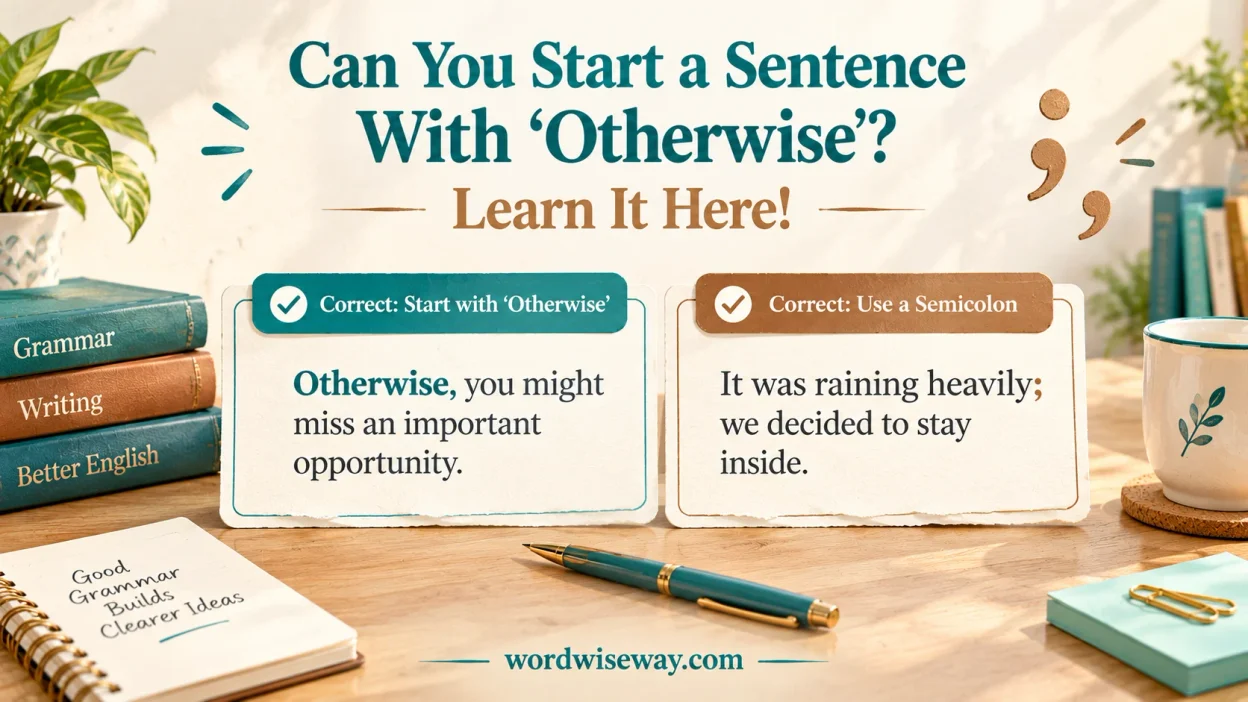
Can You Start a Sentence With Otherwise? Learn It Here! Yes, you can start a sentence with otherwise. English grammar has no rule that prevents this word from appearing at the beginning. For example, “Study regularly. Otherwise, you might struggle during exams.” Here, otherwise connects ideas and introduces a possible consequence.
The word otherwise usually means “if not” or “in a different way.” Its meaning depends on the context. You can use it as a sentence opener to connect contrasting ideas, explain conditions, or introduce alternative outcomes. Correct usage helps your writing sound natural and clear.
Grammar myths sometimes make writers question sentence-starting rules. However, starting sentences with otherwise is grammatically acceptable. Use this transitional word carefully, maintain proper sentence structure, and choose punctuation that makes your meaning clear.
Quick Answer:
Yes, you can start a sentence with otherwise. It is grammatically acceptable in both everyday and formal writing when you use it correctly.
When otherwise begins a sentence, it often means “if not” or “or else.” It connects the new sentence to an earlier statement by explaining what might happen if a condition isn’t met.
For example:
- Submit your assignment before Friday. Otherwise, your teacher might not accept it.
- Take an umbrella with you. Otherwise, you could get caught in the rain.
- The restaurant was crowded. Otherwise, everything was excellent.
Notice how each example uses otherwise differently. The first two describe possible consequences, while the third introduces a contrasting detail about the restaurant.
The basic punctuation rule: When otherwise begins a sentence as a connecting adverb, place a comma after it.
What Does “Otherwise” Mean?
Before using otherwise at the beginning of a sentence, you need to understand what it communicates. The word has several related meanings, and the surrounding context determines which one applies.
Its three main uses involve consequences, differences, and circumstances that remain true apart from a particular detail.
Otherwise Meaning “If Not” or “Or Else”
One of the most common meanings of otherwise is “if not.” It introduces a possible result when someone fails to complete an action or meet a condition.
For example:
- Finish your homework today. Otherwise, you won’t have time tomorrow.
- Keep the receipt. Otherwise, you may have trouble returning the item.
- Leave now. Otherwise, you’ll miss the beginning of the movie.
- Follow the instructions carefully. Otherwise, the machine might not work properly.
In each example, the first sentence establishes an action or condition. The second explains what could happen if the person ignores it.
This use is especially helpful when giving advice, explaining procedures, or warning someone about a possible consequence.
Writing tip: If you can replace otherwise with “if you don’t do that” without changing the main meaning, you’re probably using it correctly in this sense.
Otherwise Meaning “In Another Way” or “Differently”
Sometimes, otherwise describes a different opinion, interpretation, method, or situation. In this sense, it doesn’t necessarily warn the reader about a consequence.
Consider these examples:
- I thought the meeting would be difficult. My colleagues believed otherwise.
- The evidence suggests otherwise.
- She assumed the shop was closed, but the sign indicated otherwise.
- We planned to travel by train, but the weather forced us to think otherwise.
Here, otherwise refers to a different belief, conclusion, or course of action. The exact meaning becomes clear from the preceding context.
For example, “The evidence suggests otherwise” means that the evidence supports a conclusion different from the one previously mentioned.
This usage appears frequently in discussions, academic writing, reports, and arguments where someone compares an assumption with a different conclusion.
Otherwise Meaning “Apart From That”
The word can also describe something that is true except for one particular detail. This meaning often appears when a writer acknowledges a problem but explains that the remaining situation is satisfactory.
For example:
- The apartment is small but otherwise comfortable.
- He was tired but otherwise healthy.
- The presentation had a few errors but was otherwise excellent.
- The road was wet but otherwise safe to drive on.
In these sentences, otherwise means something close to “apart from that” or “in all other respects.”
You can also begin a sentence with this meaning when the context supports it.
For example:
“The hotel room had a broken lamp. Otherwise, it was clean and comfortable.”
The second sentence acknowledges the room’s positive qualities while setting aside the one problem.
However, this meaning depends heavily on context. Without the earlier statement, readers may not know which detail otherwise excludes.
When Can You Start a Sentence With “Otherwise”?
Starting a sentence with otherwise works best when the word creates a clear relationship between the new sentence and the information that comes before it. It shouldn’t appear simply because you want a transition. The reader should understand what alternative, consequence, or contrasting situation you’re introducing.
To Explain a Possible Consequence
Use otherwise when you want to explain what might happen if someone doesn’t take a particular action.
For example:
“Back up your files before updating the computer. Otherwise, you could lose important information.”
The first sentence recommends an action. The second explains the potential consequence of ignoring that advice.
This structure works well in instructions, tutorials, reminders, and explanatory articles. It helps readers understand why an action matters rather than merely telling them what to do.
More examples include:
- Check the address before sending the package. Otherwise, it might reach the wrong destination.
- Save your document frequently. Otherwise, an unexpected shutdown could erase your recent work.
- Read the application requirements carefully. Otherwise, you might overlook an important document.
Notice that otherwise doesn’t need to introduce a guaranteed result. It can describe a possibility, risk, or likely outcome.
To Give Advice or a Warning
When you want to encourage someone to make a sensible choice, otherwise can connect your recommendation with its possible consequences.
For example:
“Wear comfortable shoes for the walking tour. Otherwise, your feet may hurt before the trip ends.”
The opening sentence offers advice, while the second explains its practical value.
This pattern is useful in everyday communication because it sounds direct without requiring a lengthy explanation.
Consider these additional examples:
- Leave enough time to reach the airport. Otherwise, traffic could make you late.
- Read the recipe before you begin cooking. Otherwise, you might discover that you’re missing an ingredient.
- Review your notes before the examination. Otherwise, you may forget an important detail.
When writing a warning, keep the relationship between the action and its consequence realistic. Otherwise connects ideas; it doesn’t make an exaggerated claim more convincing.
To Present an Alternative or Different Situation
You can also start a sentence with otherwise when you want to introduce information that differs from an earlier statement.
For example:
“The team expected the project to fail. Otherwise, they would have continued investing resources in it.”
In this example, the second sentence presents an alternative explanation for the team’s behavior.
Consider another example:
“The forecast predicted heavy rain. Otherwise, we would have held the event outdoors.”
Here, otherwise connects the weather conditions with a different plan. It explains what would have happened under different circumstances.
Use this construction when the alternative is easy to identify. If readers must guess what otherwise refers to, rewrite the sentence for clarity.
How to Punctuate “Otherwise” at the Beginning of a Sentence
Correct punctuation helps readers understand how your ideas fit together. Although otherwise is easy to use, its placement can affect the punctuation you need.
Use a Comma After Sentence-Initial “Otherwise”
When otherwise begins a sentence as a connecting adverb, follow it with a comma.
Correct: The library closes at five. Otherwise, we could study there all evening.
Correct: Take your identification card. Otherwise, you might not be allowed to enter.
Correct: The instructions seemed complicated. Otherwise, the process was straightforward.
The comma marks a brief pause after the introductory word. More importantly, it follows the conventional punctuation pattern for this use of otherwise.
Remember that the comma doesn’t connect the two sentences by itself. The period already separates the complete thoughts, while otherwise explains their relationship.
Use a Period to Separate Complete Sentences
A period works when you want to present the original statement and its consequence as two separate sentences.
For example:
“Charge your phone before leaving home. Otherwise, you may not have enough battery for the entire trip.”
Both sentences express complete thoughts. The first gives advice, and the second explains what could happen if the advice isn’t followed.
This structure is particularly effective when you want to emphasize an instruction before presenting its consequence.
Here are two more examples:
- Keep your ticket somewhere safe. Otherwise, you may struggle to find it at the entrance.
- Confirm the meeting time today. Otherwise, you might arrive when nobody is available.
Use a Semicolon to Connect Related Independent Clauses
You can also use otherwise within a single sentence when you want to connect two closely related independent clauses.
For example:
“Charge your phone before leaving home; otherwise, you may run out of battery.”
A semicolon connects the two complete clauses without creating a comma splice. The word otherwise explains the logical relationship between them.
Compare the two correct patterns:
| Sentence structure | Example |
| Two sentences | Save your work. Otherwise, you might lose it. |
| One sentence with a semicolon | Save your work; otherwise, you might lose it. |
Both versions are grammatically acceptable. Choose the one that fits the rhythm and structure of your writing.
Why a Comma Alone Can Be a Problem
One common punctuation mistake occurs when writers use a comma to connect two independent clauses with otherwise.
Incorrect in standard formal writing: Save your work, otherwise, you might lose it.
Correct: Save your work; otherwise, you might lose it.
Also correct: Save your work. Otherwise, you might lose it.
The problem in the first example is the comma splice. Two independent clauses cannot generally be joined by a comma alone when otherwise functions as a conjunctive adverb.
A conjunctive adverb connects ideas logically, but it doesn’t automatically function as a coordinating conjunction. Words such as and, but, and so follow different punctuation patterns when joining independent clauses.
For a dependable rule, use a period or semicolon when otherwise connects two complete clauses. When it begins a new sentence, place a comma after it.
Examples of Sentences That Start With “Otherwise”
Understanding grammar rules is helpful, but seeing them in real contexts makes them easier to apply. The following examples show how sentence-initial otherwise works across different types of writing.
Everyday Conversation
In everyday conversation, otherwise helps explain consequences without adding unnecessary words.
- Bring a jacket with you. Otherwise, you might get cold tonight.
- Call me before you leave. Otherwise, I won’t know when to expect you.
- We should book the tickets today. Otherwise, the seats might sell out.
- Put the leftovers in the refrigerator. Otherwise, they’ll spoil sooner.
- Leave a little earlier. Otherwise, we could get stuck in traffic.
These examples sound natural because the second sentence clearly relates to the first. Readers don’t have to work out what the word refers to.
Academic and School Writing
In academic writing, otherwise can explain the consequences of an action or clarify the relationship between evidence and a conclusion.
For example:
- Review the question carefully. Otherwise, you may answer a different question from the one assigned.
- Define each variable before solving the equation. Otherwise, the calculation may become difficult to follow.
- Include supporting evidence in your argument. Otherwise, your conclusion may lack sufficient justification.
- Compare the results with the original hypothesis. Otherwise, the significance of the findings may remain unclear.
Academic writing benefits from precise relationships between ideas. Use otherwise when the intended consequence or alternative is clear, not simply to make the paragraph sound formal.
Professional and Business Writing
Professional communication often involves deadlines, instructions, procedures, and decisions. In these situations, otherwise can help you communicate practical consequences directly.
Examples include:
- Please send the revised report by noon. Otherwise, the team may not have enough time to review it.
- Confirm the appointment with the client. Otherwise, the meeting could be scheduled incorrectly.
- Submit the expense forms this week. Otherwise, reimbursement may be delayed.
- Check the final figures before publishing the report. Otherwise, the document could contain inaccurate information.
The word works well in these examples because it connects an action with a relevant business outcome.
However, consider your tone. In a sensitive email, an overly strong consequence may sound threatening. If the outcome is uncertain, words such as may or could help communicate that uncertainty accurately.
Formal Writing
Formal writing doesn’t prohibit sentence openings with otherwise. The important consideration is whether the word expresses the intended relationship clearly.
For example:
- The proposal must meet the stated requirements. Otherwise, the committee may reject the application.
- Researchers should account for possible sources of bias. Otherwise, the findings could be misleading.
- The agreement requires written approval. Otherwise, the proposed changes may not take effect.
- The evidence supports the initial interpretation. Otherwise, a different explanation would need consideration.
These examples demonstrate that otherwise can fit naturally into reports, formal correspondence, and analytical writing.
The best choice depends on meaning and sentence structure, not on an arbitrary rule that every sentence must begin with its subject.
Common Mistakes
Although starting a sentence with otherwise is correct, certain mistakes can make your writing confusing or grammatically incorrect. Learning to recognize these problems will help you use the word with confidence.
Using “Otherwise” Without Clear Context
The word often points back to an earlier statement. If that connection is missing, readers may struggle to understand what you mean.
Unclear: Otherwise, the results were satisfactory.
What does otherwise refer to? Without additional context, readers don’t know which problem or alternative you’re discussing.
Clearer: The experiment took longer than expected. Otherwise, the results were satisfactory.
Now the reader understands that the results were satisfactory apart from the unexpected delay, although the wording may need adjustment if the delay affected the experiment itself.
A clearer example would be:
“The equipment failed during the first trial. Otherwise, the experiment went smoothly.”
Here, the relationship between the problem and the remaining experience is easier to understand.
Practical tip: Before using otherwise, ask yourself whether a reader can identify the condition, alternative, or detail the word refers to.
Creating a Sentence Fragment
A sentence fragment fails to express a complete thought when the context and structure require a complete sentence.
For example:
Incomplete: Otherwise, if the weather changes.
This wording introduces a condition but doesn’t explain what happens if that condition occurs.
Correct: Otherwise, we will move the event indoors if the weather changes.
An even clearer version might be:
“We will hold the event outdoors. Otherwise, we’ll move it indoors if the weather changes.”
The important point is that otherwise doesn’t automatically turn an incomplete clause into a complete sentence.
Confusing “Otherwise” With “However”
Both words can connect ideas, but they don’t mean exactly the same thing.
Otherwise often introduces a consequence, alternative, or detail that differs from a previously mentioned condition. However generally introduces a contrast or qualification.
Compare these examples:
- “Wear a helmet. Otherwise, you could be injured.” This explains a possible consequence.
- “The helmet was expensive. However, it was comfortable.” This contrasts the price with a positive feature.
Replacing one word with the other can change the relationship between your ideas.
For example, “The evidence suggests otherwise” means the evidence supports a different conclusion. Replacing otherwise with however would require a different sentence structure to express the intended meaning naturally.
Using Incorrect Punctuation Between Independent Clauses
A comma splice can weaken an otherwise well-written sentence.
Incorrect: The deadline is tomorrow, otherwise we would have more time.
Correct: The deadline is tomorrow; otherwise, we would have more time.
Also correct: The deadline is tomorrow. Otherwise, we would have more time.
Both corrected versions clearly separate the independent clauses while preserving their relationship.
When editing your writing, check whether each side of otherwise contains a complete thought. If both sides can stand alone, a period or semicolon is often the right choice.
“Otherwise” vs. Similar Words and Phrases
Choosing the right transition can make your writing more precise. Although several expressions overlap with otherwise, each has its own typical use.
Otherwise vs. However
Otherwise commonly introduces a consequence, an alternative, or a different conclusion. However introduces a contrast, qualification, or unexpected detail.
| Word | Main function | Example |
| Otherwise | Introduces a consequence or alternative | Leave now. Otherwise, you’ll miss the bus. |
| However | Introduces a contrast | The bus was crowded. However, we found seats. |
How to choose: Use otherwise when the second idea depends on a condition or differs from an earlier conclusion. Use however when you want to contrast two statements.
Otherwise vs. Instead
Instead usually introduces a replacement action, choice, or outcome. Otherwise can refer to a different possibility or explain what happens if a condition isn’t met.
Compare:
- “We didn’t drive. Instead, we took the train.”
- “Leave early. Otherwise, you may miss the train.”
The first sentence describes a choice that replaced another option. The second explains a possible consequence.
You can sometimes use both words in similar contexts, but they don’t always fit interchangeably.
Otherwise vs. Alternatively
Alternatively explicitly presents another available option. Otherwise often points to an implied alternative or explains a consequence.
For example:
- “You can submit the form online. Alternatively, you can deliver it in person.”
- “Submit the form today. Otherwise, your application may be delayed.”
The first example offers two methods. The second connects an action with a possible result.
When presenting a list of choices, alternatively is often more precise. When explaining what could happen if someone doesn’t act, otherwise is usually more natural.
Otherwise vs. Or Else
Or else often introduces a warning or consequence, while otherwise can express the same idea in a more neutral tone.
For example:
- “Leave now, or else you’ll miss the bus.”
- “Leave now. Otherwise, you’ll miss the bus.”
Both sentences communicate a possible consequence. However, or else can sound more forceful or threatening depending on the context.
Otherwise often suits instructions, professional communication, and explanatory writing because it can present the consequence without adding unnecessary emotional weight.
Can You Start a Sentence With “Otherwise” in Formal Writing?
Yes. You can begin a sentence with otherwise in formal writing when it communicates the intended meaning and connects logically to the surrounding text.
The idea that every sentence must begin with its subject is an overly restrictive writing rule. English allows different sentence openings, including introductory words and phrases, when the structure is grammatically sound.
For example:
“The application must include all required supporting documents. Otherwise, the review process may be delayed.”
This construction works in formal communication because the second sentence explains the consequence of failing to meet the stated requirement.
Consider another example:
“The researchers controlled the main experimental variables. Otherwise, the results might have reflected differences in the testing conditions rather than the treatment itself.”
Here, otherwise introduces a hypothetical alternative that helps explain why the researchers took a particular step.
When using otherwise in formal writing, keep these points in mind:
- Maintain a clear connection: Readers should understand which earlier condition or statement the word refers to.
- Use precise language: Describe realistic consequences instead of relying on vague warnings.
- Check the punctuation: Use a comma after sentence-initial otherwise and a period or semicolon when separating independent clauses.
- Avoid unnecessary repetition: If several consecutive sentences begin with otherwise, consider whether a different construction would improve the flow.
Formal writing values clarity and accuracy. A well-placed otherwise can help achieve both.
Read More: 7 Ways to Spell the Sound of a Fart: Funny and Creative Examples
FAQs
Can you start a sentence with otherwise in formal writing?
Yes, you can start a sentence with otherwise in formal writing. It works well when you want to introduce an alternative outcome or explain what might happen if something else doesn’t occur.
Does otherwise need a comma at the beginning of a sentence?
Usually, yes. When otherwise begins a sentence as a transitional adverb, place a comma after it. For example, “Leave early. Otherwise, you might miss the bus.”
Is otherwise a conjunction or an adverb?
Otherwise is commonly used as an adverb. It can connect ideas by showing an alternative possibility or consequence, but it doesn’t function exactly like a coordinating conjunction such as “and” or “but.”
What does otherwise mean at the beginning of a sentence?
At the beginning of a sentence, otherwise often means “if not” or “if that doesn’t happen.” For example, “Bring your notebook. Otherwise, you won’t be able to take notes.”
Can I use otherwise to begin an academic essay sentence?
Yes, otherwise can appear at the beginning of an academic sentence. Use it when the relationship between the previous point and the possible alternative is clear. Avoid using it when a more precise transition would communicate your meaning better.
Is starting a sentence with otherwise grammatically incorrect?
No, starting a sentence with otherwise is grammatically acceptable. The idea that certain words can never begin sentences is a common grammar myth. What matters is correct sentence structure, punctuation, and meaning.
How is otherwise different from however?
Otherwise usually introduces an alternative or a possible consequence, while however introduces a contrast. For example, “Follow the instructions. Otherwise, the result may be incorrect” expresses a consequence. “The instructions were difficult. However, I completed the task” expresses contrast.
Can otherwise begin a sentence after a full stop?
Yes, otherwise can follow a full stop and begin a new sentence. For example, “Save your document. Otherwise, your changes could be lost.” This structure keeps the ideas separate while showing their logical connection.
Should I use otherwise at the beginning of every other sentence?
No, repeating otherwise too often can make your writing sound unnatural. Use it when you genuinely need to express an alternative, condition, or consequence. Vary your transitions to keep your writing smooth and easy to follow.
What are some alternatives to otherwise at the beginning of a sentence?
Depending on your meaning, you can use phrases such as “if not,” “in that case,” “or else,” or “under different circumstances.” Choose the alternative that fits your sentence because these expressions don’t always have exactly the same meaning.
Conclusion
Starting a sentence with otherwise is completely acceptable in English. Despite common grammar myths, no rule prevents you from using this word at the beginning of a sentence. Whether you’re writing a school assignment, a professional email, or a blog post, otherwise can help you express an alternative or explain what might happen if something doesn’t occur.
The key is understanding its meaning and using it in the right context. When otherwise introduces a consequence at the beginning of a sentence, a comma usually follows it. For example, “Save your work regularly. Otherwise, you could lose your progress.” This simple structure connects two ideas and keeps your writing clear and natural.
Next time you hesitate to begin a sentence with otherwise, focus on clarity rather than outdated grammar myths. Choose words that express your meaning accurately, check your punctuation, and make sure each sentence flows naturally into the next. With practice, you’ll use otherwise confidently in everyday conversations and formal writing alike.

Evelyn Shaw has spent 14 years at Yale University’s English Department, leading students through close readings, genre studies, and interpretive methodologies. Her scholarly interests include Renaissance drama, gothic fiction, feminist literary criticism, and archival research and examining how texts generate meaning across historical periods. Evelyn has presented at major academic conferences and published essays in peer-reviewed journals, reflecting her passion for rigorous analysis and student-centered learning.