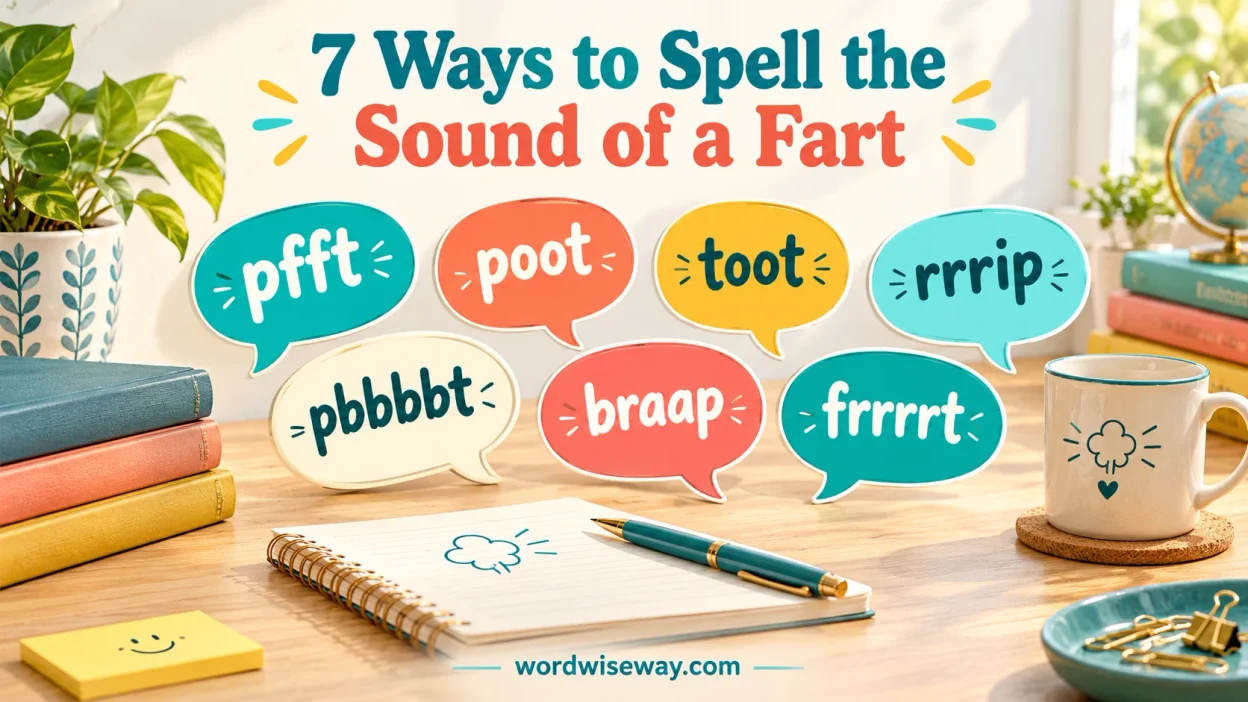
7 Ways to Spell the Sound of a Fart: Funny and Creative Examples explores how onomatopoeia makes humorous writing more lively. Words like “pfft,” “toot,” and “raspberry” imitate different fart sounds, helping readers imagine the noise without lengthy explanations.
Choosing the best spelling depends on the sound you want to describe. Some words suggest a short burst, while others create a longer, playful effect. These creative sound words add variety to your vocabulary and make examples more entertaining.
In humorous writing, the right expression can make an ordinary sentence memorable. Use fart onomatopoeia to create a clear audible effect through verbal imitation and sound representation. Experiment with different spellings to find the best fit for your writing style.
Quick Answer:
You can spell the sound of a fart in several ways, depending on the sound you want to represent. Seven playful options include:
- Pfft: A short, airy burst.
- Poot: A soft, rounded sound.
- Toot: A brief, light sound.
- Rrrip: A sharp, rough sound effect.
- Pbbbbt: A sputtering or vibrating sound.
- Braap: A loud, buzzy burst.
- Frrrrt: A longer, vibrating sound.
These spellings are informal sound effects rather than standardized spellings. Some are more familiar than others, and writers can adjust them to match a particular scene.
What Is the Word for the Sound of a Fart?
The sound of a fart doesn’t have one universally accepted written form. Instead, writers use onomatopoeic expressions to represent what they hear.
Onomatopoeia appears throughout everyday language. Words such as buzz, hiss, pop, and bang imitate recognizable sounds. Fart sound effects follow the same principle, although their spellings often rely on playful exaggeration.
For example, pfft suggests a quick release of air, while frrrrt looks longer and more vibrating. Neither spelling guarantees that every reader will imagine exactly the same sound.
Context matters, too. A comic-book character might produce an exaggerated “BRAAAP!” while a quiet scene might call for a simple “pfft.” Both can work when they suit the intended effect.
7 Ways to Spell the Sound of a Fart
Different spellings create different impressions. The following examples show how each expression can work in writing, especially in humorous dialogue, comics, and fictional scenes.
Pfft: A Short, Airy Fart Sound
Pfft is a useful choice when you want to represent a brief, airy burst. Its compact spelling makes it easy to fit into dialogue, captions, and short comic scenes.
The opening p creates a quick starting point, while the fft ending suggests escaping air. Together, the letters give readers a visual clue about the sound without requiring a long description.
For instance, imagine two friends sitting quietly when one hears a strange noise.
“Was that the chair?” Maya asked.
“Pfft! Maybe,” Ben replied, trying not to laugh.
The spelling works because it feels quick and understated. It doesn’t demand attention with capital letters or repeated characters.
When to use pfft:
- When the sound is brief and airy.
- When you want a subtle comic effect.
- When writing casual dialogue or short sound captions.
- When a long, exaggerated spelling would feel out of place.
Although pfft can represent a dismissive noise in other contexts, its meaning becomes clear when the surrounding scene establishes the intended sound.
Poot: A Soft, Rounded Fart Sound
Poot offers a softer, more playful alternative. The rounded oo vowel gives the word a gentle sound when read aloud, making it suitable for lighthearted stories and cartoon-style humor.
Unlike a sharp burst such as pfft, the spelling looks smooth and simple. It can suggest a small, mild, or deliberately silly sound rather than an explosive one.
Consider this example:
The classroom fell silent. Then a tiny “poot” came from the back row, followed by several suppressed giggles.
Here, the word adds humor without requiring a detailed description. Its simplicity also makes it easy for younger readers to understand.
However, poot doesn’t have one fixed meaning in every English-speaking community. Some people use it as a childish or informal word associated with passing gas, while others use it specifically as a sound effect.
When to use poot:
- In children’s stories and playful dialogue.
- For a soft or cartoon-like sound.
- When you want a mild, humorous expression.
- When a simple spelling works better than exaggerated lettering.
The key is tone. Poot generally feels gentler on the page than a dramatic spelling filled with repeated consonants.
Toot: A Brief, Light Fart Sound
Toot is another short option, although it has an important difference from some other fart sound spellings. In everyday English, toot commonly refers to a short sound made by a horn, whistle, or similar source.
Writers can also use it humorously to suggest a brief fart sound. The spelling is familiar, easy to read, and naturally suited to light comedy.
For example:
A tiny “toot” interrupted the serious conversation. Everyone paused, then burst into laughter.
The word works because readers already recognize its short, high-sounding quality. Still, the surrounding context helps distinguish a fart sound from a horn or whistle.
This distinction matters when you’re writing a scene without pictures. If the source of the noise isn’t clear, readers might imagine a car horn instead.
When to use toot:
- For a brief, lighthearted sound effect.
- In playful dialogue or family-friendly humor.
- When you want a familiar, easy-to-read word.
- When the context makes the intended sound obvious.
Remember that toot is not exclusively a fart sound. Its meaning depends on how the writer uses it.
Rrrip: A Sharp, Rough Fart Sound
Rrrip is a creative sound-effect spelling that emphasizes a rough or abrupt noise. The repeated r gives the word a vibrating appearance, while the final p creates a firm stopping point.
This expression is particularly useful in comics and exaggerated storytelling. Its visual shape suggests more activity than a short spelling such as pfft.
Imagine a cartoon character trying to sneak out of a room.
“Rrrip!”
The character freezes. Everyone slowly turns toward the sound.
The spelling helps create a comic pause. Readers can imagine the noise, then enjoy the character’s awkward reaction.
However, rrrip is an invented or informal representation rather than a standard English word for a fart sound. Some readers might interpret it as fabric tearing, paper ripping, or another rough noise.
To avoid confusion, use it where the scene makes the intended meaning clear.
When to use rrrip:
- In comic strips and visual storytelling.
- For an abrupt, rough-sounding effect.
- When you want a dramatic pause after the noise.
- When an exaggerated spelling supports the scene’s humor.
The repeated letters are a stylistic choice. They help convey the writer’s intended sound rather than follow a formal spelling rule.
Pbbbbt: A Sputtering Fart Sound
Pbbbbt represents a sputtering or vibrating sound through repeated letters. Its unusual appearance makes it especially suitable for cartoons, playful dialogue, and exaggerated comic effects.
The repeated b characters suggest a series of quick vibrations rather than one clean burst. The spelling also resembles the written effects people use to imitate a vibrating-lip noise.
For example:
“Pbbbbt!” went the imaginary sound effect in the comic strip, sending the characters into fits of laughter.
This spelling is more expressive than poot or toot. It looks deliberately exaggerated, so readers are more likely to treat it as a humorous performance than a precise transcription.
There is an important distinction, though. Pbbbbt is not a standardized English spelling, and different readers may pronounce it differently. Some might interpret it as a lip trill, while others may imagine a sputtering fart sound.
When to use pbbbbt:
- In cartoons and comic-book dialogue.
- For a sputtering or exaggerated effect.
- When visual humor matters as much as pronunciation.
- When a simple word doesn’t convey enough personality.
Use repeated letters thoughtfully. Too many can make a sound effect difficult to read, especially in a sentence with several other exaggerated expressions.
Braap: A Loud, Buzzy Fart Sound
Braap suggests a louder, buzzy, or extended burst. Its strong opening and broad vowel give it a bold appearance, which makes it useful for exaggerated sound effects.
The spelling also resembles brrap and similar expressions used to imitate engine noises or other loud bursts. As a result, readers may associate it with a buzzing mechanical sound rather than a natural fart unless the context makes the joke clear.
For example:
“BRAAP!” declared the cartoon sound effect as the character’s face turned bright red.
Capital letters make the sound seem louder on the page. The spelling itself doesn’t establish an actual volume, but visual choices influence how readers interpret a written effect.
You can adjust the presentation to suit your scene:
- braap for a straightforward sound effect.
- BRAAP! for an exaggerated comic moment.
- Braaaap! for a deliberately extended effect.
These variations are stylistic, not formal spelling rules.
When to use braap:
- For a loud or buzzy comic effect.
- In exaggerated cartoons and humorous fiction.
- When capital letters can emphasize the moment.
- When a mechanical-sounding effect fits the joke.
Because braap has several possible associations, use surrounding words or illustrations to make the intended sound unmistakable.
Frrrrt: A Longer, Vibrating Fart Sound
Frrrrt uses repeated r characters to suggest a longer, vibrating sound. Its appearance gives readers the impression that the noise continues instead of ending immediately.
The final t provides a sharp visual finish. That contrast between the repeated middle and the short ending makes the expression useful in comic scenes.
For example:
“Frrrrt!” The sound echoed through the cartoon room, and every character stopped talking.
The spelling looks more sustained than pfft. It also gives writers a way to exaggerate the duration of a sound without adding a full sentence of description.
Like the other creative forms in this list, frrrrt has no official spelling standard. Readers may pronounce it differently, and some may interpret it as a raspberry or another vibrating noise.
When to use frrrrt:
- For a longer, vibrating sound effect.
- In comics and animated-style stories.
- When you want to emphasize duration.
- When repeated letters add visual energy to the scene.
A shorter version may work better in ordinary prose. Save the extended form for moments when the exaggerated appearance adds something to the writing.
Comparing the Seven Fart Sound Spellings
Choosing the right spelling becomes easier when you compare the impressions each one creates.
| Sound spelling | Suggested sound | Style | Common writing use |
| Pfft | Short and airy | Subtle | Dialogue and brief captions |
| Poot | Soft and rounded | Playful | Children’s stories and light humor |
| Toot | Brief and light | Familiar | Casual dialogue |
| Rrrip | Rough and abrupt | Dramatic | Comics and exaggerated scenes |
| Pbbbbt | Sputtering and vibrating | Silly | Cartoons and comic effects |
| Braap | Loud and buzzy | Bold | Exaggerated sound effects |
| Frrrrt | Longer and vibrating | Expressive | Comics and humorous narration |
Important: These descriptions explain the impressions the spellings may create. They aren’t scientific measurements or universal definitions. A writer’s pronunciation, the scene, and the reader’s experience can all change how a sound effect is interpreted.
How to Choose the Right Fart Sound Spelling
The best spelling depends on what you want readers to imagine. Instead of searching for one perfect answer, think about the sound’s qualities and the purpose of your writing.
Match the Fart Sound Spelling to the Sound
Start by considering whether the sound is brief, sustained, soft, or exaggerated. A compact spelling often works for a quick effect, while repeated letters can suggest a longer performance.
Use these general guidelines:
- For a short, airy sound: Try pfft.
- For a soft, rounded effect: Try poot.
- For a brief, light effect: Try toot.
- For a rough or abrupt sound: Try rrrip.
- For a sputtering effect: Try pbbbbt.
- For a loud, buzzy effect: Try braap.
- For a longer, vibrating effect: Try frrrrt.
These are creative suggestions rather than fixed rules. If another spelling better matches the sound in your imagination, you can use it.
Consider the Context and Audience
The same sound effect can feel different depending on where it appears. A children’s book, an online comic, and a realistic short story may need different writing choices.
For example, a children’s story might use poot because it sounds gentle and uncomplicated. A comic strip may use BRAAP! because the large lettering fits the exaggerated artwork.
In more restrained prose, a simple description such as “a brief fart interrupted the silence” may read more naturally than a long string of repeated letters.
Before choosing a spelling, ask yourself:
- Who will read this?
- Does the scene call for subtle humor or exaggeration?
- Will the sound appear in dialogue, narration, or an illustration?
- Can readers understand the intended noise without extra explanation?
A good sound effect supports the scene. It shouldn’t distract readers from the story itself.
Use Repeated Letters Carefully
Repeated letters can make a sound effect appear longer, louder, or more animated. For example, frrt looks shorter than frrrrrrt, even though neither spelling provides an exact measure of duration.
This technique is common in expressive writing. Writers stretch words to suggest emphasis, hesitation, shouting, or prolonged sounds.
However, excessive repetition can make a passage harder to read. It can also make readers unsure how to pronounce the expression.
Compare these examples:
- “Pfft!” The noise stopped almost immediately.
- “Frrrrt!” The exaggerated sound continued through the comic panel.
- “Frrrrrrrrrrrrrrrrt!” The extended spelling may look cluttered without adding much meaning.
The second example offers a useful balance between expression and readability. Add letters when they contribute to the effect, not simply to make the word longer.
Why Is the Sound of a Fart Spelled in Different Ways?
The main reason is that spoken sounds don’t always translate neatly into written words. English spelling doesn’t provide one universal method for representing every noise people make.
Onomatopoeia Connects Words With Sounds
Onomatopoeia occurs when a word imitates or evokes a sound. Familiar examples include tick-tock, hiss, clang, and whoosh.
Fart sound effects use the same broad idea. Writers select letters that help readers imagine the sound, even though the written expression cannot reproduce the original noise perfectly.
For instance, pfft emphasizes a quick burst, while frrrrt visually suggests vibration. The letters serve as clues that guide the reader’s imagination.
People Interpret Sounds Differently
Two people can hear the same noise and describe it differently. One might focus on its opening burst, while another notices its length or vibrating quality.
That difference affects the spelling they choose. A writer who hears a short release of air may prefer pfft, while someone aiming for a cartoon effect might write pbbbbt.
Neither choice must be universally correct. Informal sound effects depend on interpretation and context rather than a single official spelling.
Writing Style Influences the Result
Sound effects also reflect the style of the material. Comics often use bold lettering and unusual spellings because readers see the sound alongside an image.
Ordinary prose usually benefits from a lighter touch. A brief expression may work well in dialogue, while a detailed narrative may describe the sound instead.
The goal is to help readers imagine the moment. The spelling should fit the tone and remain easy to understand.
Examples in Sentences
The following examples show how each expression can work in a fictional setting. Each sentence uses the spelling as a creative sound effect rather than a standardized word.
| Spelling | Example sentence |
| Pfft | “Pfft!” The tiny noise interrupted their otherwise serious conversation. |
| Poot | A little “poot” came from the cartoon character as everyone looked around. |
| Toot | A quick “toot” made the characters pause before laughing. |
| Rrrip | “Rrrip!” The sound effect appeared across the comic panel in bold letters. |
| Pbbbbt | The character made an exaggerated “pbbbbt” noise to ruin the dramatic moment. |
| Braap | “BRAAP!” announced the oversized caption in the silly cartoon. |
| Frrrrt | A drawn-out “frrrrt” filled the scene before the narrator continued. |
A Short Case Study: Choosing a Sound Effect for a Comic
Imagine a cartoon scene in which a character sits quietly during a serious meeting. The writer wants a funny interruption, but the right spelling depends on the intended mood.
Option A: A subtle interruption
“Pfft!”
This version creates a quick, understated moment. It works when the characters’ reactions provide most of the humor.
Option B: An exaggerated interruption
“BRAAP!”
The capital letters and bold appearance create a more dramatic comic effect. This version suits a cartoon that relies on exaggerated reactions.
Option C: A prolonged interruption
“Frrrrt!”
The repeated letters suggest a longer sound, making the interruption feel more drawn out.
The underlying joke stays similar, but each spelling changes the reader’s impression. This illustrates a useful writing principle: sound effects work best when their visual form supports the intended mood.
Common Mistakes
Even playful writing benefits from a little consistency. Avoiding a few common mistakes can make sound effects clearer and more effective.
Treating One Spelling as the Only Correct Answer
Informal sound effects don’t always follow standardized spelling conventions. A writer can choose among different representations as long as the context makes the intended sound clear.
However, don’t confuse a creative spelling with an established dictionary word. Expressions such as pbbbbt and frrrrt are best understood as invented sound effects.
Using Too Many Repeated Letters
Repeated letters can add emphasis, but excessive repetition may clutter the sentence. Readers shouldn’t have to work hard to understand a simple comic moment.
Choose a length that communicates your intended effect. If the scene doesn’t need exaggeration, a short spelling will often work better.
Ignoring Other Possible Meanings
Words such as toot and braap can evoke sounds beyond farting. Without context, a reader might imagine a horn, engine, or other noise.
Make the intended meaning clear through dialogue, narration, or accompanying artwork.
Forgetting the Audience
A spelling that fits an exaggerated comic may not suit a realistic story. Consider the tone, age group, and format before adding a dramatic sound effect.
The best choice is the one that feels natural within the piece.
Read More: 4 Words To Describe the Sound of Coughing
FAQs
What Is the Funniest Way to Spell the Sound of a Fart?
“Pfft,” “toot,” and “brap” are funny ways to spell a fart sound. The funniest choice depends on the situation and the effect you want to create.
Is “Pfft” a Real Word for a Fart Sound?
Yes, “pfft” is an example of onomatopoeia. It represents a short, airy sound and works well in casual writing or comedy.
How Do You Spell a Loud Fart Sound?
You can use words like “BRAAAP,” “prrrt,” or “blat.” Capital letters can make the sound seem louder or more dramatic in a comic scene.
What Is Onomatopoeia in Fart Sounds?
Onomatopoeia uses words that imitate sounds. For example, “toot,” “pfft,” and “raspberry” help readers imagine a fart without a lengthy description.
Can You Write a Fart Sound as “Toot”?
Yes, “toot” is a playful way to represent a short, light fart sound. It can also describe the sound of a small horn, depending on the context.
What Is the Difference Between “Poot” and “Toot”?
“Poot” often suggests a soft, silly fart sound, while “toot” can sound lighter and more musical. Both work well in humorous writing.
How Can I Make Fart Sounds Funny in a Story?
Choose a sound that matches the scene, then use timing and the characters’ reactions to build humor. A short sound can sometimes be funnier than a long description.
Are There Different Ways to Spell the Same Fart Sound?
Yes, because written sound effects don’t have one fixed spelling. You might write “prrt,” “brrt,” or “pfft” to suggest different versions of a similar noise.
Should I Use Capital Letters for Fart Sound Effects?
Capital letters can make a sound effect feel louder or more dramatic. For example, “PFFT!” may grab attention, while “pfft” can feel quieter and more casual.
Where Can I Use Funny Fart Sound Words?
You can use them in comic strips, fictional stories, playful dialogue, jokes, and informal social posts. Choose wording that fits your audience and keeps the humor appropriate.
Conclusion
Finding the right way to spell a fart sound can make funny writing more entertaining. Words like “pfft,” “toot,” “brap,” and “raspberry” each create a different effect. These playful examples show how onomatopoeia turns ordinary noises into memorable written expressions.
The best spelling depends on your scene, audience, and sense of humor. A short sound might suit a quick joke, while a dramatic version can bring a comic moment to life. Feel free to experiment with different spellings until the sound feels right.
Whether you’re writing a funny story, creating a comic, or adding humor to dialogue, these seven ways offer a useful starting point. Keep your wording natural, match the sound to the situation, and let your creativity shape the final expression