Roll Call vs Role Call: Correct Usage, Examples, and Real-World Context appears often in schools, workplace, and official meetings, where students, teachers, and leaders deal with confusion, identical meanings, and sound alike terms that often confuse writers and affect accurate communication in daily life.
A formal process like Roll Call is used for checking attendance, reading names aloud, and marking presence through a register or attendance sheet, while Role Call connects to a person’s role, function, or duty, often misunderstood due to similar pronunciation and mistaken spelling in writing, emails, and meeting agendas.
People often face writing errors, communication errors, and awkward writing in academic writing, professional communication, and everyday communication, especially when dealing with homophones, phonetics, and semantics, where words are pronounced identically but carry different meanings and different things in English language usage.
Using correct grammar, vocabulary, and proper pronunciation ensures clarity in writing, clarity in speech, and prevents careless writing, confusion, and mistakes in classroom documents, published articles, and official meetings, where participants’ attendance, confirming names, and checking lists are part of a systematic procedure followed by facilitators, record keepers, and teachers to maintain accuracy and proper identification.
Quick Answer
Let’s cut straight to it.
- Roll call = correct term for checking attendance
- Role call = common mistake in most writing contexts
If you remember one thing, make it this:
Roll call is about calling names from a list. Role refers to jobs, characters, or functions, not attendance.
That simple distinction removes 90% of the confusion.
What “Roll Call” Means (Real Definition and Usage)
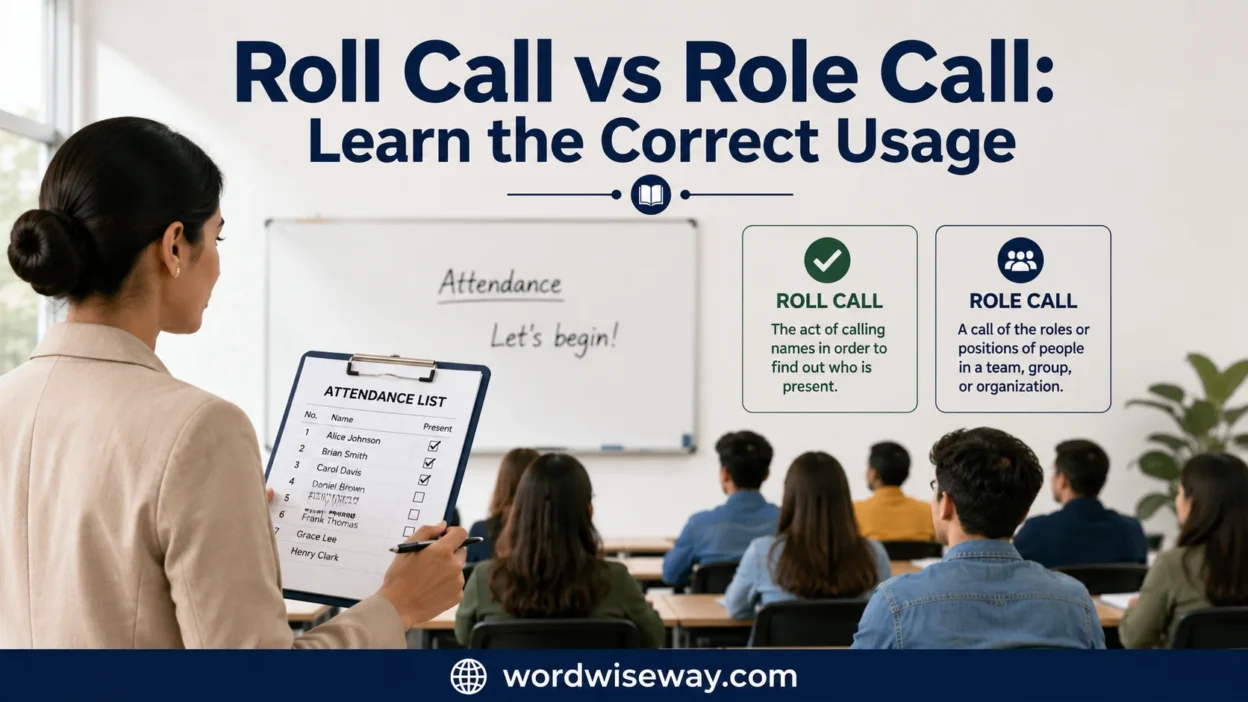
The phrase roll call refers to the act of calling out names from a list to confirm who is present.
You’ll hear it in structured environments like:
- Schools and colleges
- Military formations
- Government meetings
- Corporate training sessions
- Conferences and official events
A teacher might say:
“We’ll begin with roll call.”
A commander might say:
“Roll call at 0600 hours.”
In both cases, the meaning stays the same: checking presence through a name list.
Why It Is Called “Roll Call” (Simple Etymology Explained)
The word roll here does not mean “spin” or “roll a ball.” That’s where many people get confused.
Historically, a roll referred to a written list of names recorded on a scroll or sheet of paper rolled up for storage. Think of old administrative records in schools or armies where information was literally written on rolled parchment.
So:
- Roll = a list of names
- Call = calling those names aloud
Put together:
Roll call = calling names from a list
This origin is why the phrase stuck even in modern digital systems where no actual scroll exists anymore.
What “Role Call” Means (And Why It’s Usually Wrong)
Now let’s talk about the mistaken version: role call.
The word role means:
- A function someone performs
- A character in a story or film
- A responsibility in a group or organization
Examples:
- Job role: manager, assistant, engineer
- Movie role: hero, villain, supporting character
- Team role: leader, strategist, coordinator
So when people write “role call,” they often confuse:
“calling names” with “calling roles”
But in standard English usage, role call is not the correct term for attendance.
You might see it in casual writing or online posts, but it remains grammatically incorrect in formal contexts.
Why People Confuse Roll Call and Role Call
This confusion is more common than you think. It comes from a few real linguistic traps.
1. Sound similarity
Both words sound identical in spoken English. This makes the error invisible in speech but obvious in writing.
2. Familiarity with “role”
People use the word “role” frequently in daily life:
- “What’s your role in the project?”
- “She played the main role in the play.”
So the brain naturally leans toward “role” instead of “roll.”
3. Autocorrect and typing habits
Phones often don’t flag “role call” as wrong in casual contexts, which reinforces the mistake.
4. Misinterpretation of meaning
Some assume attendance is about people’s “roles” being called out. That logical guess feels correct, even though it’s not linguistically accurate.
Roll Call vs Role Call: Clear Comparison Table
| Feature | Roll Call | Role Call |
| Correct usage | Yes | No (standard English) |
| Meaning | Calling names for attendance | Misused phrase |
| Context | School, military, meetings | Informal errors or confusion |
| Word origin | From “rolled list of names” | From “role = function/job” |
| Acceptability in exams | Correct | Incorrect |
Correct Usage of Roll Call in Real Life
Let’s ground this in real examples so it sticks.
In School
- The teacher takes roll call every morning.
- Students must be present during roll call or marked absent.
In Military Settings
- Soldiers line up for roll call before duty.
- Officers verify unit strength through roll call.
In Workplaces
- Managers conduct roll call during emergency drills.
- Training sessions often start with roll call for attendance tracking.
In Events
- Organizers perform roll call before sessions begin.
- Attendance sheets match roll call data.
Incorrect Usage of Role Call (Common Mistakes)
Here are examples that often appear online or in informal writing:
- ❌ “The teacher did role call before class.”
- ❌ “We started with role call in the meeting.”
- ❌ “Role call showed missing members.”
Even though these sentences sound natural, they are not standard English usage.
Simple Memory Trick to Never Confuse Them Again
This trick works surprisingly well:
Imagine a rolled-up paper list of names.
Now link it like this:
- Roll = scroll of names
- Call = reading those names aloud
So:
Roll call = reading a rolled list
Another shortcut:
- If it involves attendance, think roll
- If it involves jobs or characters, think role
Common Mistakes People Make With Roll Call
Even when people know the difference, errors still slip in.
Mistake 1: Overthinking the spelling
People try to match meaning instead of memorizing usage.
Mistake 2: Using “role call” in formal writing
This often appears in emails, assignments, and reports.
Mistake 3: Assuming both are interchangeable
They are not interchangeable in standard grammar.
Mistake 4: Relying only on speech
Since both sound identical, learners never notice the written difference.
Related Terms You Should Know
Language rarely exists in isolation. These terms often appear near “roll call”:
- Attendance check
- Headcount
- Register call
- Attendance register
- Sign-in process
Each serves a similar purpose, but “roll call” remains the most widely recognized formal term.
When “Role Call” Might Appear (Edge Cases)
While not standard, you might still see “role call” in certain situations:
- Creative writing or poetry
- Song titles or artistic wordplay
- Internet memes or casual jokes
- Misprints in informal posts
Even then, it is used intentionally or mistakenly, not as standard grammar.
Case Study: How Misuse Creates Real Confusion
Let’s look at a realistic classroom scenario.
Scenario: A school attendance system
A teacher writes a note for students:
“Role call will be taken at 8:00 AM sharp.”
Now two problems happen:
- Students question the spelling in assignments
- Parents assume it is a special activity called “role call”
- Some students correct it to “roll call,” causing confusion
What should have been written:
“Roll call will be taken at 8:00 AM sharp.”
Impact of correction
After correction:
- Students understand attendance process clearly
- Communication becomes standardized
- No ambiguity in official records
This small spelling change directly improves clarity in institutional communication.
Read More: In Between vs In-Between: Complete Grammar Guide
Quick Reference Summary
- Roll call = attendance check using a name list
- Role = job, function, or character
- Role call = incorrect in standard English
Simple. Clean. Reliable.
FAQs
What is the difference between roll call and role call?
A roll call is the formal process of checking attendance by reading names aloud and confirming who is present. Role call is usually a mistaken spelling because role refers to a person’s function, duty, or responsibilities, not attendance.
Is role call ever correct in English?
In most situations involving attendance, role call is incorrect. If you are talking about a person’s role, character, or part, use role. When taking attendance, the correct phrase is roll call.
Why do people confuse roll call and role call?
The two expressions are homophones with similar pronunciation and an identical sound. Since they are pronounced identically, many writers, students, and English learners accidentally choose the wrong spelling.
Where is a roll call commonly used?
A roll call is common in schools, classrooms, official meetings, meeting gatherings, professional workplaces, and other settings where participants’ attendance must be verified using a register, attendance sheet, or checking lists.
How can I remember the correct spelling?
Think of roll as a list or roll of names used for taking attendance. Remember that role always relates to a person’s function, part, or character, making it easier to choose the correct term.
Does using the wrong phrase affect professional writing?
Yes. Using role call instead of roll call can create writing mistakes, communication errors, and unnecessary confusion in emails, meeting agendas, published articles, and academic writing.
What is the role of pronunciation in this confusion?
Because both words have the same pronunciation and sound alike, people often rely on what they hear instead of checking the correct spelling. Good phonetics, language skills, and vocabulary help reduce these mistakes.
Are native speakers also confused by these words?
Yes. Even native speakers can be tripped up by common homophones like roll call and role call, especially during fast writing or everyday communication.
How can students avoid this mistake?
Students should practice reading, learn the difference in meaning, review grammar, and pay attention to correct usage. Regular practice helps improve accuracy, clarity in writing, and written communication.
Why is learning the difference important?
Knowing the distinction between roll call and role call supports professional communication, academic writing, and everyday communication. It helps prevent errors, improves understanding, and ensures clear communication in every context.
Conclusion
Understanding the difference between roll call and role call is simple once you know what each word means. A roll call is connected with checking attendance, reading names, and confirming who is present, while role describes a person’s function, responsibility, or character. Although the two words are homophones and are pronounced identically, they have completely different meanings. Learning this distinction helps improve correct usage, accurate communication, and confidence in both speaking and writing.
Whether you are a student, teacher, office worker, or English learner, using the correct expression prevents writing errors, communication errors, and unnecessary confusion. Paying attention to spelling, grammar, pronunciation, and vocabulary will strengthen your language skills and improve professional communication, academic writing, and everyday communication. With regular practice, choosing between roll call and role call becomes natural, helping you write more clearly and communicate with greater accuracy in every situation.

Amelia Sanders has spent 14 years in Harvard University’s English Department, helping students navigate literary analysis, interpretive theory, and narrative techniques. Her academic pursuits center on 18th-century British prose, romantic poetry, diasporic writing, and digital editing exploring how textual choices influence cultural perspectives. Amelia has spoken at major international meetings and contributed essays to respected academic volumes, demonstrating her dedication to thoughtful scholarship and effective teaching.