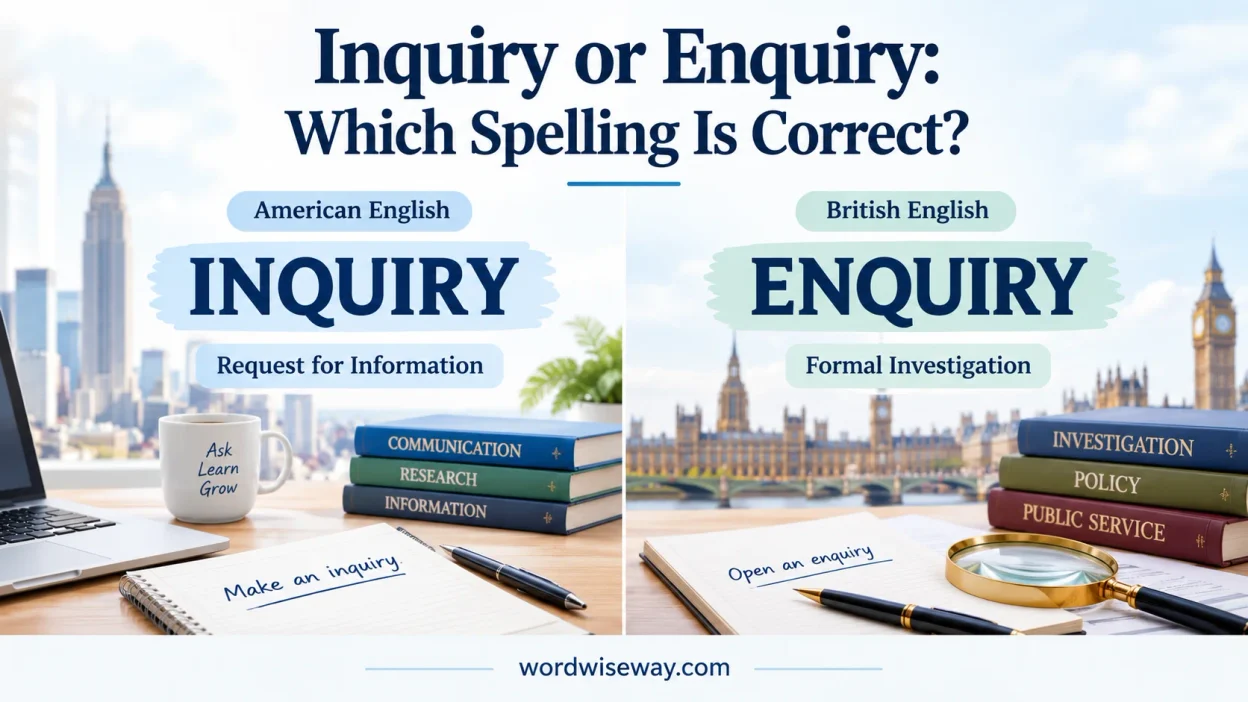
Inquiry or Enquiry: Which Spelling Is Correct? can confuse writers because inquiry and enquiry are commonly confused words in the English language.
Their spelling, pronunciation, and meanings are similar, creating confusion and uncertainty. Inquire and enquiry may be used interchangeably, but meaning can slightly vary with context and regional dialect. Knowing the distinction helps you choose the correct word and connotation.
The main spelling differences involve British English and American English. British usage often favors enquiry, while American usage generally prefers inquiry. These differences reflect English history, changing spellings, and usage.Understanding these usage rules improves clarity and confidence in writing, including emails, blogs, academic papers, business messages, and other professional material.
When you search for inquiry or enquiry, consider your audience and English variety. In academic writing, accurate spelling and careful word choice matter. Both remain familiar English words, and their common use does not make them wrong. Their regional preferences simply guide which form works best in each situation.
Quick Answer:
Inquiry is the preferred spelling in American English.
Enquiry is a common spelling in British English, particularly when someone asks for information.
However, British English also uses inquiry, especially for official investigations. Dictionaries such as Oxford and Cambridge recognize both forms and explain that British usage can distinguish them by meaning, but that distinction isn’t absolute.
| Word | American English | British English | Common meaning |
| Inquiry | ✅ Standard | ✅ Used | Question, request, or investigation |
| Enquiry | Less common | ✅ Common | Question, request, or investigation |
| Inquiries | ✅ Standard plural | ✅ Used | Multiple questions or investigations |
| Enquiries | Uncommon | ✅ Common | Multiple questions or requests |
So, if you write in US English, choose inquiry. If you write in British English, enquiry is often natural for a simple request, while inquiry frequently appears in formal investigative contexts.
What Does “Inquiry” Mean?
Inquiry is a noun that refers to an attempt to obtain information or discover facts. It can describe something as simple as asking about a product or something as formal as an official investigation.
For example, if you email a company to ask about the price of a service, you’ve made an inquiry. If a government appoints a committee to investigate an important event, that committee may conduct an inquiry.
Cambridge defines inquiry as the process of asking a question and also as an official process used to discover facts about something that happened.
Inquiry as a Request for Information
The everyday meaning of inquiry involves seeking information.
You might make an inquiry when you want to know:
- How much something costs
- When a service is available
- Whether a course has open places
- How to apply for a position
- When an event begins
- What documents you need
- Whether a product is in stock
Consider this example:
I sent an inquiry about the course schedule.
Here, inquiry simply means a request for information. Nothing formal or investigative is happening.
Businesses commonly use the word in customer communication as well. A customer might submit an inquiry through a website, contact a support department, or ask a sales representative for details.
Inquiry as a Formal Investigation
Inquiry can also describe a structured investigation.
In this sense, an inquiry goes beyond asking one question. A person, committee, court, or government body may gather information, examine evidence, interview people, and reach conclusions.
For example:
The committee launched an inquiry into the financial records.
This usage has a more serious and institutional tone. The goal isn’t merely to receive an answer. The goal is to establish facts.
Common expressions include:
- official inquiry
- public inquiry
- judicial inquiry
- government inquiry
- formal inquiry
- inquiry into the matter
- line of inquiry
- committee of inquiry
Oxford lists both an information-seeking meaning and an official investigative meaning for inquiry.
What Does “Enquiry” Mean?
Enquiry carries essentially the same core meanings as inquiry, but British English uses the spelling more frequently.
An enquiry can mean a simple request for information:
I made an enquiry about the available courses.
It can also refer to a formal investigation:
The committee conducted an enquiry into the incident.
Oxford specifically notes that British English sometimes distinguishes enquiry for a general request for information from inquiry for a more particular official investigation. However, Oxford also states that either spelling can be used for either meaning.
That final point matters. Treating the distinction as an unbreakable rule would oversimplify real English usage.
Enquiry as a Request for Information
In British English, enquiry is especially natural when someone wants information.
For example:
We received several enquiries about the new program.
A school might receive enquiries from prospective students. A hotel might receive enquiries about available rooms. A company might receive enquiries about its services.
Oxford gives examples involving prospective students and customer service, showing how naturally enquiry works in these situations.
Enquiry and Formal Investigations
British English can also use enquiry for an investigation.
For example:
The authorities opened an enquiry into the incident.
Yet inquiry is also possible in British English, particularly when the investigation has an official or institutional character.
This explains why you’ll sometimes see both spellings in British publications. The choice can depend on the organization, house style, context, or writer’s preference.
Inquiry or Enquiry in American English
If you’re writing American English, use inquiry.
This applies to both ordinary questions and formal investigations.
For example:
- I submitted an inquiry about the application process.
- We received several customer inquiries.
- The company responded to my inquiry.
- The committee opened an inquiry into the allegations.
- Please direct all inquiries to customer service.
The spelling enquiry isn’t necessarily incomprehensible to American readers. It simply isn’t the usual American form.
Cambridge’s American English entry uses inquiry for requests for information and official attempts to discover facts. Oxford’s American English dictionary likewise lists inquiry with meanings covering both information requests and investigations.
For that reason, American writers generally don’t need to switch between the two spellings based on meaning.
Why “Inquiry” Works Best in US English
American English tends to use one spelling across the word family:
- inquiry
- inquiries
- inquire
- inquired
- inquiring
For example:
I called to inquire about the application.
The office received several inquiries.
Using enquiry in these contexts can make the writing look British rather than American.
Inquiry or Enquiry in British English
British English gives you more flexibility.
Enquiry is widely used for ordinary requests for information:
I made an enquiry about the train times.
However, inquiry also remains common, particularly for formal investigations:
The government ordered an inquiry into the accident.
Oxford notes that British speakers sometimes make this meaning-based distinction, with enquiry referring to a general information request and inquiry referring to a formal investigation. At the same time, Oxford says either spelling can be used in either meaning.
That makes the British pattern a preference rather than a rigid grammar rule.
A Useful British English Rule
If you want a practical shortcut, think of it this way:
Enquiry = asking for information
Inquiry = investigating something
This distinction works well in many British contexts, but don’t treat it as mandatory. Established British usage allows inquiry and enquiry to overlap.
Inquiry vs. Enquiry in Business Writing
Business writing makes the regional difference particularly visible.
An American company will usually write:
Please send all inquiries to our customer service department.
A British company may write:
Please send all enquiries to our customer service department.
Neither sentence is grammatically wrong. The spelling reflects the variety of English being used.
Common Business Examples
| American English | British English |
| customer inquiry | customer enquiry |
| product inquiry | product enquiry |
| sales inquiry | sales enquiry |
| further inquiries | further enquiries |
| business inquiry | business enquiry |
| inquiry about a service | enquiry about a service |
When writing for an international company, consistency matters more than trying to mix both forms.
If your website uses American English everywhere else, inquiry makes sense. If your organization follows British English, enquiry may fit the established house style.
Inquiry vs. Enquiry in Formal Investigations
Formal investigations create one of the most interesting differences between these spellings.
In American English, inquiry handles the job:
The committee launched an inquiry into the incident.
In British English, both forms can occur:
The committee launched an inquiry into the incident.
The committee launched an enquiry into the incident.
However, British writers who follow the traditional distinction may prefer inquiry for the official investigation and enquiry for an ordinary request.
Oxford gives examples such as a murder inquiry, public inquiry, and commission of inquiry.
This is why replacing every British inquiry with enquiry can sometimes make a sentence sound less natural.
Common Phrases With Inquiry
The noun inquiry appears in several useful expressions.
Inquiry About
Use inquiry about when someone wants information concerning something.
I made an inquiry about the course.
The company received an inquiry about its refund policy.
Inquiry Into
Use inquiry into when the inquiry concerns an issue being examined or investigated.
The committee opened an inquiry into the financial dispute.
Police launched an inquiry into the incident.
The preposition helps reveal the meaning. About often introduces the subject of a request, while into commonly introduces something being investigated.
Make an Inquiry
This phrase means to ask for information or investigate something.
I’ll make an inquiry and get back to you.
It works in both American and British English, although British English may use make an enquiry instead.
Further Inquiry
It means additional questioning or investigation.
Further inquiry revealed that the records contained an error.
This phrase often appears in formal writing because it emphasizes that the first answer wasn’t enough.
Common Phrases With Enquiry
British English frequently uses enquiry in expressions related to information requests.
Examples include:
- make an enquiry
- customer enquiry
- general enquiry
- further enquiry
- telephone enquiry
- email enquiry
- enquiry desk
- enquiry office
For example:
Please contact the enquiry desk for more information.
Oxford even lists enquiries as a British English term for a place where people can obtain information.
Inquiry vs. Enquiry Example Sentences
Seeing the words in context makes the distinction much easier.
American English
I sent an inquiry about the scholarship.
We received several inquiries from customers.
Please direct your inquiry to the admissions office.
The government launched an inquiry into the matter.
British English
I sent an enquiry about the scholarship.
We received several enquiries from customers.
Please direct your enquiry to the admissions office.
The government launched an inquiry into the matter.
Notice something important: the first three examples can naturally use enquiry in British English, while inquiry remains common for the formal investigation.
Common Mistakes
Mistake: Calling “Enquiry” Incorrect
Enquiry is not a misspelling.
It is an established English spelling, especially in British English. Cambridge identifies enquiry as another spelling of inquiry in its British English materials.
So correcting every instance of enquiry to inquiry would create unnecessary errors.
Mistake: Assuming the Words Always Have Different Meanings
The distinction isn’t absolute.
Some style guides and British writers use enquiry for questions and inquiry for investigations. Other writers use the two forms more freely.
Oxford explicitly recognizes this variation.
Mistake: Mixing Regional Spellings
A document should normally follow one regional spelling system.
For example, an American business page that consistently uses color, center, and organize will usually look more consistent with inquiry.
Likewise, a British publication using colour, centre, and organise may naturally use enquiry in suitable contexts.
Consistency creates a cleaner reading experience.
Mistake: Using “Enquiry” in Standard American Writing
American readers will understand enquiry, but inquiry is the standard choice in US English.
If your audience is primarily in the United States, there’s little reason to choose the British spelling.
Inquiry vs. Enquiry vs. Query
Inquiry, enquiry, and query overlap, but they aren’t interchangeable in every sentence.
An inquiry or enquiry usually involves seeking information. A query is also a question, but it can suggest a specific point of uncertainty, especially in technical, academic, or professional contexts.
| Word | Typical meaning | Example |
| Inquiry | Request for information or investigation | I sent an inquiry about the program. |
| Enquiry | British spelling for a request or investigation | I made an enquiry about the program. |
| Query | Question or point requiring clarification | I have a query about the invoice. |
For example, a customer might make an inquiry about a service. An accountant might raise a query about an unusual charge.
The context determines which word sounds most natural.
Read More: Input or Imput: Which Spelling Is Correct?
Which One Should You Use?
The best choice depends mainly on your audience.
If You Write in American English
Choose inquiry.
This is the clearest option for American websites, emails, academic writing, business communication, and general prose.
Use:
Please send your inquiry to our support team.
Not:
Please send your enquiry to our support team.
If You Write in British English
You can use enquiry for a general request for information.
For example:
I made an enquiry about the available positions.
For formal investigations, inquiry is also a common British choice:
The government launched an inquiry into the incident.
Still, enquiry can also appear in investigative contexts. The distinction depends on usage and style rather than an absolute grammatical rule.
If You Write for an International Audience
Choose the variety of English that matches your main audience.
If your website targets US readers, use inquiry consistently. If it targets UK readers, enquiry may be preferable for general information requests.
The key isn’t to declare one spelling universally correct. The key is to use the spelling that fits your chosen variety of English.
Quick Comparison
| Feature | Inquiry | Enquiry |
| Standard US spelling | ✅Yes | ❌ No |
| Common UK spelling | ✅ Yes | ✅ Yes |
| Request for information | ✅ | ✅ |
| Formal investigation | ✅ | ✅ |
| Common in US business writing | ✅ | Rare |
| Common in UK business writing | Common | Common |
| British meaning distinction | Often formal investigation | Often general request |
| Always different in meaning? | ❌ No | ❌ No |
| Plural | inquiries | enquiries |
FAQs
Is inquiry or enquiry the correct spelling?
Both inquiry and enquiry are correct spellings. The choice mainly depends on the variety of English you use. Inquiry is more common in American English, while enquiry is widely used in British English.
Is inquiry American or British English?
Inquiry is strongly associated with American English, where it is the standard spelling in most situations. However, British English also uses inquiry in certain formal contexts, so it is not exclusively American.
Is enquiry only used in British English?
Enquiry is most commonly associated with British English and is also familiar in other varieties influenced by British usage. American English generally prefers inquiry instead.
Do inquiry and enquiry have the same meaning?
In many everyday situations, inquiry and enquiry have the same basic meaning: a request for information or an investigation. Regional usage can influence which spelling people choose.
Should I use inquiry or enquiry in academic writing?
Choose the spelling that matches the English variety required by your school, university, publisher, or audience. If you are following American English, use inquiry. For British English, enquiry may be appropriate depending on the context.
What is the difference between inquire and enquiry?
Inquire is a verb meaning to ask for information or investigate something. Enquiry is a noun meaning a request for information or an investigation. Their grammatical roles differ, even though the words are closely related.
Which spelling should I use in a professional email?
The best choice depends on your audience and regional English standard. Inquiry works well for American audiences, while enquiry is commonly accepted in British English. Consistency matters more than choosing one form universally.
Is inquiry more formal than enquiry?
Neither spelling is automatically more formal. The perceived difference usually comes from regional conventions and context. Both can appear in formal, professional, and academic writing.
Why are inquiry and enquiry spelled differently?
The two forms developed through the history of English and became associated with different regional spelling conventions. Over time, American English favored inquiry, while British English retained broader use of enquiry.
Can I use inquiry and enquiry interchangeably?
You can often use them interchangeably when they have the same intended meaning, but your spelling should match your chosen variety of English. Following one consistent style makes your writing clearer and more professional.
Conclusion
Choosing between inquiry and enquiry becomes much easier once you recognize that both spellings are legitimate. The main difference comes from regional English rather than one form being universally correct. Inquiry is the usual choice in American English, while enquiry remains common in British English.
Your audience should guide the spelling you choose. If you are writing for an American audience, inquiry is generally the safer option. For British readers, enquiry may fit the expected style. The same principle applies to emails, academic writing, business documents, and other formal communication.
Ultimately, consistency is the key. Once you decide which English variety you are following, stick with its preferred spelling throughout your writing. That simple habit keeps your work clear, polished, and easier for readers to understand.