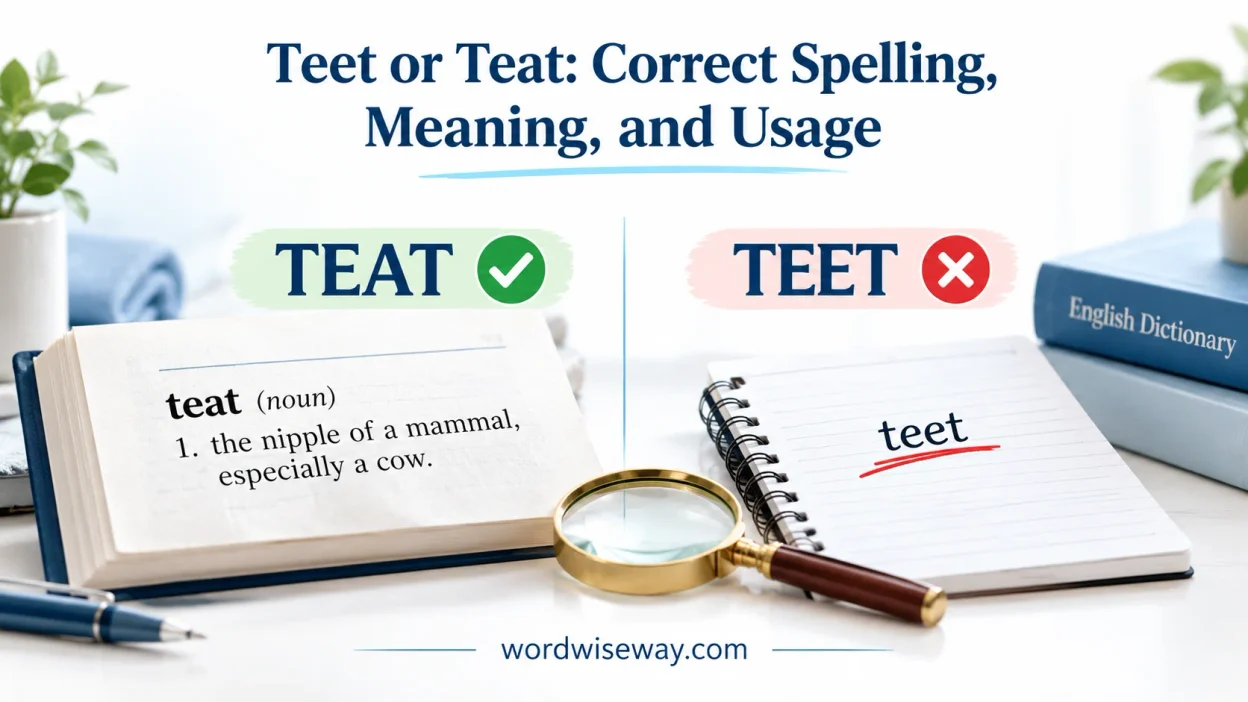
Teet or Teat: Correct Spelling, Meaning, and Usage explains why teat is the correct spelling when discussing animal anatomy, milk, and farming. In standard English, teat is the correct spelling for the part of an animal’s body through which milk is released.
Its meaning and usage appear often in farming content, animal care, and biology texts, while teet may occur in informal writing, searches, or as a spelling variation. However, it is generally a mistaken form rather than a widely accepted English word for this anatomical term.
This difference can reduce confusion for students, writers, and farmers who encounter these words in specific contexts.The origins and meanings of these terms also provide useful clarification. Teat is directly linked with animals and anatomy-related topics, while teet can create uncertainty because the two forms look and sound similar.
When handling spelling questions, checking the context makes correct usage easier to recognize. Examples and real-world examples involving animal anatomy also make the distinction clearer and explain why readers sometimes mix them up, especially when their searches involve unfamiliar terms.
Quick Answer:
Teat is the correct standard spelling when you mean the milk-producing or milk-releasing structure of a female mammal’s breast or udder.
Teet is generally an incorrect spelling of teat in standard English. If you’re writing about a cow, goat, sheep, or another mammal, use teat for one and teats for more than one.
| Word | Correct? | Meaning |
| Teat | ✅ Yes | A nipple-like structure through which milk is released |
| Teats | ✅Yes | More than one teat |
| Teet | ❌ Usually incorrect | Common misspelling of teat |
For example:
- Correct: The veterinarian examined the cow’s teat.
- Correct: The goat has two teats.
- Incorrect: The veterinarian examined the cow’s teet.
So, if you’re choosing between teet or teat, remember: teat is the standard spelling.
What Does “Teat” Mean?
The noun teat describes a structure on the breast or udder of a mammal through which milk is delivered. The term commonly appears in animal-related contexts, particularly when people discuss livestock and veterinary care.
For example, cows have an udder divided into four quarters, with each quarter associated with a teat. Goats generally have two teats. Other mammals have different numbers and arrangements depending on their species.
The word therefore has a specific biological meaning rather than being a general term for the entire breast or udder. In practical writing, this distinction matters because farmers, veterinarians, and animal scientists often need precise anatomical terms.
Teat Definition in Biology
A teat is the external structure through which milk exits a mammary gland. It contains openings connected to the mammary system and allows milk to reach the outside of the animal’s body.
The surrounding anatomy can vary considerably between species. For example, the udder of a dairy cow has four functional mammary quarters, while a goat’s udder has two. These differences make teat a useful term in veterinary and agricultural discussions.
The word can describe the structure in both domestic and wild mammals. However, you’ll encounter it most often when people discuss animals that produce milk for human use.
Teat in Farming and Veterinary Care
In dairy farming, teat is a routine technical term. Farmers and veterinarians may discuss teat health, teat condition, milking practices, or problems affecting milk flow.
Good teat health matters because damage or infection can affect an animal’s comfort and milk production. Veterinary professionals may therefore examine the teats as part of routine animal care.
You’ll also see the word in agricultural guides and scientific research. In those settings, teat isn’t unusual or informal. It’s an established anatomical term.
What Does “Teet” Mean?
When someone writes teet while referring to a mammal’s milk-releasing structure, they’re usually making a spelling error. The standard word is teat.
English contains many words whose pronunciation can make spelling tricky. That’s particularly true when a word has a vowel sound that doesn’t clearly reveal which letters belong in its written form. Teat is one of those words that can lead to phonetic spelling mistakes.
If you encounter teet in an ordinary sentence about animal anatomy, the intended word is almost certainly teat.
Is “Teet” a Word?
Teet isn’t the standard spelling for the anatomical term discussed in this article.
That doesn’t mean every appearance of the letter sequence teet in every possible context represents the same thing. Names, usernames, abbreviations, and specialized references can sometimes produce unusual spellings. However, those isolated uses don’t change the standard spelling of the anatomical noun.
For normal English writing, use teat.
Why Do People Write “Teet”?
The main reason comes down to spelling by sound. Someone who has heard the word but hasn’t seen it written may choose teet because the pronunciation doesn’t provide an obvious clue that the word contains ea.
The plural can add another layer of confusion:
- One teat
- Two teats
When spoken, teats can sound close to what a person might expect from the spelling teet. This can create a mental shortcut that leads to the wrong spelling.
The solution is simple: connect the word with its correct written form rather than relying entirely on sound.
Key Differences
The distinction between these two forms is straightforward.
| Feature | Teat | Teet |
| Standard spelling | ✅ Yes | ❌ No for this meaning |
| Part of speech | Noun | Usually a misspelling |
| Meaning | Milk-releasing structure of a mammal | No standard anatomical meaning |
| Singular form | Teat | Not applicable |
| Plural form | Teats | Not teets |
| Common contexts | Biology, farming, veterinary medicine | Spelling errors |
The important point is that teat has an established meaning and grammatical role. Teet, when used with that intended meaning, doesn’t replace it in standard English.
Teat: Singular and Plural Forms
English makes the number distinction especially easy with this word.
The singular form is teat. The plural form is teats.
This follows the ordinary English pattern of adding -s to form the plural of many nouns.
Singular
Use teat when referring to one structure.
The veterinarian examined the animal’s teat.
Plural
Use teats when referring to two or more.
The veterinarian examined the animal’s teats.
This distinction is worth remembering because teats isn’t spelled teet. The s is part of the plural ending.
A Simple Memory Trick
Think of the word as:
TEAT → TEATS
The base word stays intact. You simply add s for the plural.
That means:
- One = teat
- More than one = teats
- Not = teet
- Not = teets
Once that pattern becomes familiar, the spelling becomes much harder to forget.
How to Use “Teat” in a Sentence
Because teat has a specific anatomical meaning, your sentence should make that meaning clear.
Here are several natural examples:
- The farmer checked the cow’s teat before milking.
- The veterinarian examined the goat’s teats during the health inspection.
- Proper hygiene can help protect an animal’s teat health.
- The calf feeds through the cow’s teats.
- The researcher recorded the condition of each teat.
- The goat’s udder has two teats.
These examples show how the word appears in different contexts without changing its meaning.
Teat in a Veterinary Sentence
Veterinary writing often requires precise anatomical language. For example:
The veterinarian examined the affected teat during the routine checkup.
Here, teat identifies one specific structure. Replacing it with teet would introduce a spelling error.
Teat in an Agricultural Sentence
The word also appears naturally in farming:
The dairy farmer monitored the condition of each cow’s teat.
In this context, the word fits because dairy production depends on healthy mammary structures and proper milking practices.
Common Mistakes
Spelling mistakes often become easier to understand once you see exactly where they occur.
Mistake 1: Writing “Teet” Instead of “Teat”
This is the most common error in the teet or teat debate.
❌ The farmer examined the cow’s teet.
✅ The farmer examined the cow’s teat.
The correct spelling contains ea, not ee.
Mistake 2: Confusing “Teat” With “Teats”
Some writers understand the correct word but mix up singular and plural forms.
❌ The cow has one teats.
✅ The cow has one teat.
❌ The cow has four teat.
✅ The cow has four teats.
Number controls the form.
Mistake 3: Writing “Teets” as the Plural
Adding s to the incorrect form doesn’t make it correct.
❌ The animal has two teets.
✅ The animal has two teats.
The correct sequence is teat → teats.
Mistake 4: Spelling the Word Only From Its Sound
English spelling contains plenty of traps. Words that sound similar don’t necessarily share the same spelling pattern.
For this reason, remembering the written form teat is more reliable than trying to reconstruct it from pronunciation.
Pronunciation
In US English, teat has a long e sound. It rhymes with common words such as eat, heat, and meat.
Its pronunciation is:
/tiːt/
The word contains one syllable, making it short and easy to say. The spelling, however, deserves more attention than the pronunciation because ee might seem like the obvious vowel combination.
The key spelling pattern is ea:
teat
not:
teet
That distinction is similar to other English words where ea represents the long e sound.
Teat vs. Nipple
The words teat and nipple overlap in meaning, but they aren’t always used in exactly the same way.
Nipple is a broad anatomical term used for humans and other mammals. Teat is particularly common when referring to animals, especially livestock.
For example, a veterinary report might naturally refer to a cow’s teat. A general discussion of human anatomy would more commonly use nipple.
The difference is therefore partly about biological context and common usage.
| Word | Typical Context | General Meaning |
| Teat | Animal anatomy, farming, veterinary science | Milk-releasing structure of a mammal |
| Nipple | Human and general mammalian anatomy | Projection through which milk can be released |
There can be overlap, but choosing the term that fits the context makes your writing more precise.
Teat vs. Tit
The Teat and tit can both occur in anatomical vocabulary, but their usage differs greatly by context and register.
Teat is a clear, established anatomical term and is especially common in animal-related writing. Tit has several meanings in English and can also function as an informal anatomical term.
Because tit has other meanings and can sound informal, teat is often the clearer choice in veterinary, agricultural, and educational writing.
For formal or technical communication, precision matters. The surrounding context should make the intended meaning unmistakable.
Correct and Incorrect Examples
The following examples show how the spelling works in real sentences.
| Incorrect | Correct |
| The cow has an injured teet. | The cow has an injured teat. |
| The veterinarian examined the teet. | The veterinarian examined the teat. |
| The animal has four teet. | The animal has four teats. |
| The farmer checked both teets. | The farmer checked both teats. |
| One teats was examined. | One teat was examined. |
Notice the pattern. The correct spelling never changes from teat to teet. For the plural, simply add s.
Why the Correct Spelling Matters
A spelling mistake may look tiny on the page, but it can affect clarity. In technical writing, readers expect anatomical terms to follow recognized English spelling conventions.
Using teat correctly becomes particularly important in:
- School assignments
- Biology reports
- Veterinary documents
- Agricultural articles
- Animal-care instructions
- Research writing
- Professional communication
Imagine reading an agricultural report filled with unfamiliar spellings. Even when the meaning remains understandable, the errors can make the writing appear less precise.
Correct terminology keeps the message clean.
A Practical Case Study: Choosing the Right Form
Consider this sentence:
The farmer inspected each cow’s teet before milking.
At first glance, the meaning seems obvious. However, teet isn’t the standard spelling for the structure being described.
The corrected version is:
The farmer inspected each cow’s teat before milking.
Now consider a sentence involving several structures:
The farmer inspected the cow’s teats before milking.
Here, teats is correct because the sentence refers to more than one.
This tiny example reveals the entire rule:
One → teat
More than one → teats
Teet → incorrect for this anatomical meaning
Facts About the Word “Teat”
A few useful facts make the word easier to understand and remember:
- Teat is a noun.
- It refers to a milk-releasing structure in a mammal.
- The plural is teats.
- Teet is generally a misspelling when used for this meaning.
- The word is common in veterinary and agricultural contexts.
- The word has one syllable in English.
- Teat is pronounced with a long e sound.
- The word can refer to structures found in both domestic and wild mammals.
- In dairy farming, teat condition can be relevant to animal health and milk production.
- Teat and nipple can overlap in meaning, although their typical contexts differ.
Which One Should You Use?
If you’re writing about mammalian anatomy, choose teat.
If you’re talking about more than one, use teats. Don’t change the vowel spelling to ee.
A quick check can help:
One teat ✅
Two teats ✅
One teet ❌
Two teets ❌
This rule works in everyday writing as well as more formal biological and agricultural contexts.
Read More: Payor or Payer: Correct Spelling, Meaning, and Usage
FAQs
Is Teat the Correct Spelling?
Yes, teat is the standard spelling used in English for the part of an animal’s body through which milk is released.
Is Teet a Correct English Word?
Teet is generally not the standard spelling for this anatomical term. It commonly appears as a spelling mistake for teat.
What Does Teat Mean?
A teat is the nipple-like part of an animal’s mammary gland through which milk passes, especially when referring to livestock and other mammals.
Why Do People Confuse Teet and Teat?
People often confuse them because teet and teat look and sound similar. Fast typing, unfamiliarity, and informal writing can also cause the mistake.
How Do You Use Teat in a Sentence?
You can use teat when discussing animal anatomy, milk production, or animal care. For example, a farmer may examine an animal’s teat when checking its health.
Is Teat Used Only for Farm Animals?
No. Although teat commonly appears in farming and veterinary contexts, it can refer to the milk-producing nipple of various mammals.
Can Teet Be Used in Formal Writing?
It is better to use teat in formal writing when you mean the anatomical structure. Using teet may make the writing appear misspelled or unclear.
What Is the Difference Between Teet and Teat?
The main difference is spelling and standard usage. Teat is the established English term, while teet is usually a mistaken spelling of the same word.
Where Is the Word Teat Commonly Used?
The word teat commonly appears in animal anatomy, veterinary information, farming, livestock care, biology, and discussions about milk production.
How Can I Remember Teat Instead of Teet?
A simple way to remember teat is to connect it with teat milk and animal anatomy. When referring to this body part, choose teat, not teet.
Conclusion
The confusion between teet and teat usually comes from their similar appearance and sound, but the distinction becomes simple once you know the correct term. Teat is the standard English spelling used for the part of an animal’s body through which milk is released. It commonly appears in farming, animal care, biology, and anatomy-related writing.
When you encounter teet in a sentence, check whether the writer is actually referring to an animal’s anatomy. In most cases, teet is simply a spelling mistake for teat. Paying attention to the context can help students, writers, farmers, and other readers avoid this common mix-up and choose the appropriate word with confidence.
Remembering the difference is useful whenever you write about animals, livestock, milk production, or biology. Choose teat when you mean the anatomical term, and treat teet cautiously unless a specific context gives it another meaning. A quick spelling check can turn an easy-to-miss error into clear, accurate writing.