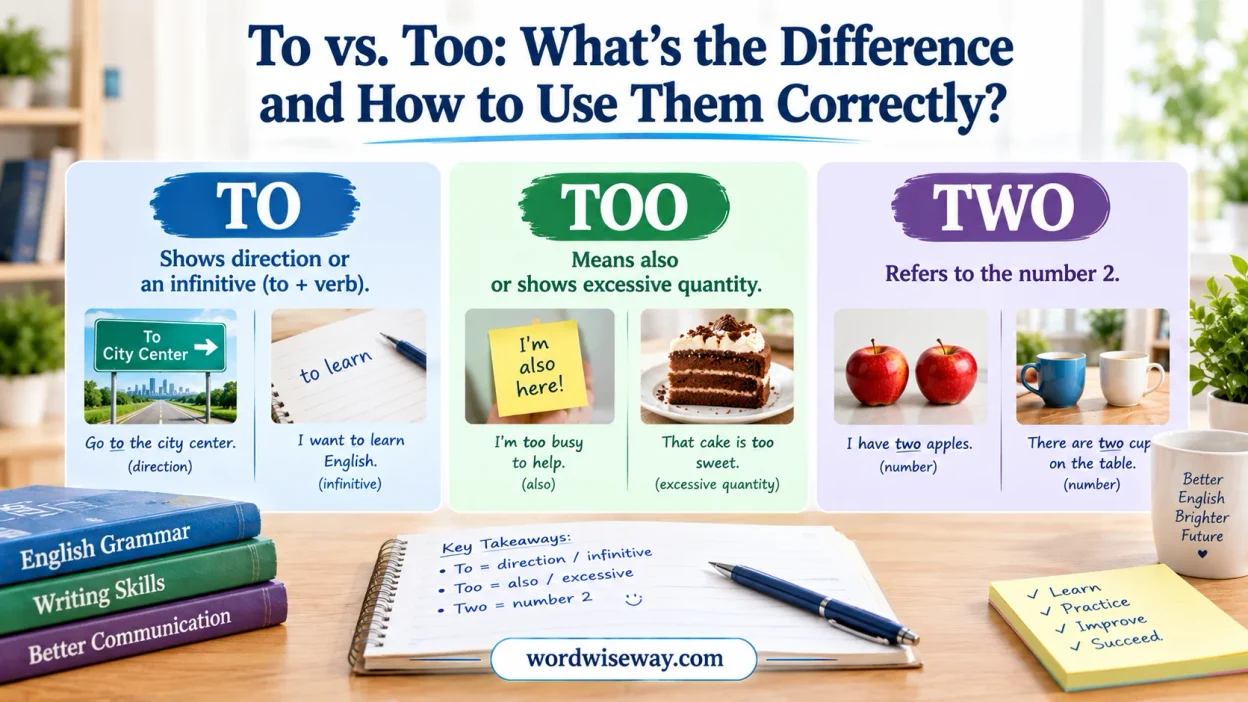
To vs. Too: What’s the Difference and How to Use Them Correctly? These word pairs are commonly confused in English because they sound exactly alike and are pronounced the same. However, their meanings, grammatical functions, and uses are different. To usually shows direction or comes before a verb, while too means also or something excessively.
When learning their difference, children can improve their writing, speaking, and grammar skills. Simple examples and tricks can make their usage easier to remember. For example, “I went to school” shows direction, while “I want too” can express also.
This guide will explain these uses through clear examples and everyday language. A better understanding of each word, its meaning, and spelling helps you avoid mistakes and use both words correctly in every sentence.
Quick Answer
The simplest way to understand to vs. too is to focus on what each word means in the sentence.
| Word | Main Function | Common Meaning | Example |
| To | Preposition or infinitive marker | Direction, connection, or purpose | “She went to school.” |
| Too | Adverb | Also or excessively | “She wants to come too.” |
| Two | Number | The number 2 | “She has two books.” |
Here’s the quickest test:
- If you mean direction or movement, use to.
- If you place it before a base verb as an infinitive, use to.
- If you mean also, use too.
- If you mean more than necessary, use too.
- If you mean the number 2, use two.
For example:
“I want to visit the museum too.”
The first to introduces the verb visit. The second word, too, means also.
What Does “To” Mean?
To has several grammatical functions in English. It most commonly works as a preposition or as an infinitive marker.
Because its uses are broad, you’ll encounter to in countless everyday sentences.
“To” as a Preposition
As a preposition, to often shows direction, movement, destination, or a relationship between things.
Consider these examples:
- “We drove to the airport.”
- “She walked to the door.”
- “Give the letter to James.”
- “I spoke to my teacher.”
- “This belongs to Sarah.”
In each example, to connects one element of the sentence with another.
When to indicates movement, it often identifies the destination:
“They traveled to Chicago.”
The word Chicago represents the destination. The preposition to establishes that relationship.
“To” Before a Verb
You’ll also see to directly before a verb in the infinitive form.
Examples include:
- to read
- to write
- to study
- to learn
- to improve
- to understand
These combinations are called to-infinitives.
For example:
- “I want to learn English.”
- “She decided to stay home.”
- “They hope to win.”
- “He needs to practice.”
In these sentences, to doesn’t mean “also” or “excessively.” Instead, it forms the infinitive with the base verb.
A useful pattern is:
verb + to + base verb
Examples:
- want to go
- need to study
- hope to succeed
- plan to travel
- decide to leave
“To” for Time and Range
English also uses to when expressing certain time relationships and ranges.
Examples:
- “It’s ten minutes to six.”
- “The office is open from nine to five.”
- “Read pages ten to fifteen.”
- “The temperature fell from 20 to 15 degrees.”
Here, to connects two points within a time, numerical, or physical range.
Common Expressions With “To”
Many familiar English expressions contain to.
Some common examples include:
- according to
- next to
- similar to
- close to
- listen to
- talk to
- belong to
- respond to
- refer to
- look forward to
Pay particular attention to look forward to.
In the sentence:
“I look forward to meeting you.”
The word to functions as a preposition. Therefore, the following word takes the -ing form rather than the infinitive.
That distinction matters because English learners sometimes incorrectly write “look forward to meet.”
What Does “Too” Mean?
Unlike to, the word too normally functions as an adverb. It has two major meanings:
- Also
- Excessively or more than necessary
These meanings are easy to separate when you examine the context.
“Too” Meaning “Also”
When too means also, it adds another person, thing, or situation to the statement.
Examples:
- “I like chocolate too.”
- “She wants to join us too.”
- “He speaks Spanish too.”
- “We watched the movie too.”
In these sentences, too could usually be replaced by also.
For example:
“I want to come too.”
means:
“I also want to come.”
In everyday conversation, too often appears at the end of a sentence.
It can also appear in other positions for emphasis or a particular writing style:
“She, too, agreed with the decision.”
The meaning remains also.
“Too” Meaning “Excessively”
The second major use of too describes something that goes beyond a desirable, suitable, or reasonable level.
Examples:
- “The soup is too hot.”
- “The box is too heavy.”
- “The music is too loud.”
- “This shirt is too expensive.”
- “He drives too quickly.”
Notice the difference between very and too.
“The coffee is very hot.”
This simply says the coffee has a high temperature.
“The coffee is too hot.”
This suggests the coffee has a temperature higher than is suitable for the situation.
That distinction makes too more than a stronger version of very. It often carries an idea of excess.
“Too” With Adjectives and Adverbs
A common structure is:
too + adjective
Examples:
- too expensive
- too difficult
- too cold
- too small
- too complicated
You can also use:
too + adverb
Examples:
- too quickly
- too slowly
- too loudly
- too carelessly
For example:
“The instructions are too complicated.”
The sentence suggests that the instructions exceed a practical level of complexity.
Another common structure combines too with an infinitive:
“The bag is too heavy to carry.”
Here, both too and to are correct.
- too heavy = excessively heavy
- to carry = infinitive
This is one of the clearest examples of why these words shouldn’t be treated as interchangeable.
Key Differences
The most important difference between to vs. too involves their grammatical functions and meanings.
Difference in Meaning
To commonly expresses:
- direction
- destination
- connection
- relationship
- an infinitive
Too commonly expresses:
- also
- excessively
- more than necessary
Compare:
“She went to the store.”
Here, to indicates destination.
“She went too.”
Here, too means also.
The spelling changes because the meaning changes.
Difference in Grammar
To can function as a preposition or an infinitive marker.
Too normally functions as an adverb.
This grammatical difference explains why you can’t substitute one for the other.
For example:
“I need to study.”
The word to introduces the infinitive study.
But:
“I need to study too.”
The word too adds another meaning: also.
Difference in Spelling
The spelling provides a useful visual clue:
- to → one o
- too → two o’s
You can use the extra o as a memory hook. Think of too as adding something extra.
That fits both major meanings:
- “I want one too.” → another one is included.
- “It’s too expensive.” → the amount exceeds the acceptable level.
Examples
Real sentences make the distinction easier to recognize.
Examples With “To”
Here are common uses of to:
- “I went to school early.”
- “She gave the keys to her brother.”
- “We need to leave soon.”
- “He wants to learn French.”
- “They decided to stay.”
- “Please listen to me.”
- “I spoke to the manager.”
- “The train travels from Lahore to Islamabad.”
Each sentence uses to for a specific grammatical relationship.
Examples With “Too”
Now compare sentences using too:
- “I want to go too.”
- “She likes tea too.”
- “The room is too cold.”
- “This question is too difficult.”
- “He talks too loudly.”
- “The bag is too heavy.”
- “There are too many people here.”
- “You’re walking too quickly.”
The context tells you which meaning applies.
Examples With “To” and “Too” Together
These words can easily appear in the same sentence.
Consider:
“I want to come too.”
The first to forms the infinitive to come. The second too means also.
Another example:
“It’s too late to call.”
Here, too means excessively or beyond a suitable time. The second to introduces the infinitive call.
One more example:
“She needs to study too.”
The first word introduces the infinitive. The final word means also.
These sentences provide a useful reminder: to and too aren’t competing versions of the same word. They serve different grammatical purposes.
To vs. Too in Common Sentences
The following mistakes appear frequently in informal writing, messages, and schoolwork.
| Incorrect | Correct | Why |
| I want too go. | I want to go. | To introduces the infinitive. |
| I want to come to. | I want to come too. | Too means “also.” |
| This is to expensive. | This is too expensive. | Too means excessively. |
| She likes it to. | She likes it too. | Too means also. |
| It is to late. | It is too late. | Too indicates excess. |
| He needs too study. | He needs to study. | To comes before the base verb. |
| I have to books. | I have two books. | Two represents the number 2. |
A useful proofreading habit is to stop whenever you type to or too. Ask what you actually mean before moving on.
Common Mistakes
Using “Too” Before a Verb
A frequent error occurs when writers use too before a verb.
Incorrect:
“I want too go home.”
Correct:
“I want to go home.”
The word to forms the infinitive with go. The extra o in too isn’t appropriate here.
Using “To” for “Also”
Another common mistake happens when someone wants to say also.
Incorrect:
“I want to come to.”
Correct:
“I want to come too.”
If you can replace the word with also, too is usually the correct choice.
Confusing “Too” With “Very”
These two words don’t have exactly the same meaning.
Compare:
| Sentence | Meaning |
| The water is very hot. | The water has a high temperature. |
| The water is too hot. | The water is hotter than suitable or desired. |
The word too often introduces a problem or unwanted excess.
For example:
“The shoes are very expensive.”
This describes their price.
“The shoes are too expensive.”
This suggests the price exceeds what the speaker considers acceptable.
Confusing “Too Much” and “Too Many”
Too much comes before uncountable nouns.
Examples:
- too much water
- too much sugar
- too much noise
- too much time
Too many comes before plural countable nouns.
Examples:
- too many books
- too many people
- too many questions
- too many mistakes
Compare:
“There is too much traffic.”
“There are too many cars.”
The noun determines whether you need much or many.
Forgetting the Second “O”
Because to and too sound similar in many contexts, writers sometimes choose the spelling based on sound alone.
That strategy can cause mistakes.
Instead, focus on meaning:
Does the word mean “also” or “excessively”?
If yes, too is likely correct.
If it expresses direction, connection, or an infinitive, to is likely correct.
How to Remember the Difference?
A few simple tests can make to vs. too much easier.
Use the “Extra O” Trick
Think of too as having something extra.
The word has an extra o, and its meanings involve an additional or excessive idea.
- “I want it too.” → an additional person wants it.
- “It’s too expensive.” → the price exceeds the acceptable level.
This isn’t a grammatical rule. It’s simply a useful memory device.
Use the Infinitive Test
When the word appears immediately before a base verb, check whether you’re forming an infinitive.
Examples:
- to eat
- to sleep
- to work
- to write
- to practice
If the construction is an infinitive, use to.
“I need to practice.”
Not:
“I need too practice.”
Use the “Also” Test
Try replacing too with also.
“I like this movie too.”
becomes:
“I also like this movie.”
The meaning stays intact.
If also fits naturally, too may be the correct choice.
Use the “Excessive” Test
Ask whether the word means more than necessary, wanted, or suitable.
“The jacket is too small.”
The jacket isn’t merely small. Its size creates a problem because it doesn’t fit adequately.
If that idea of excess exists, use too.
Grammar Rules at a Glance
Keep this table handy when you’re proofreading.
| Situation | Correct Word | Example |
| Direction | to | We went to the park. |
| Destination | to | She traveled to Boston. |
| Recipient | to | Give it to him. |
| Infinitive | to | I want to learn. |
| Relationship | to | This belongs to me. |
| Also | too | I want one too. |
| Excessive degree | too | It’s too cold. |
| Excessive amount | too much | There’s too much noise. |
| Excessive number | too many | There are too many errors. |
| Number 2 | two | I bought two pens. |
To vs. Too vs. Two
The confusion doesn’t stop with to and too. English has a third word, two, that sounds similar.
These three words are commonly called homophones because they can share the same pronunciation in many varieties of English while having different spellings and meanings.
What Does “Two” Mean?
Two is the number 2.
Examples:
- “I have two sisters.”
- “She bought two notebooks.”
- “Wait two minutes.”
- “They live two miles away.”
Unlike to and too, two represents a quantity.
To, Too, and Two Compared
| Word | Function | Meaning | Example |
| To | Preposition / infinitive marker | Direction, connection, or infinitive | “I want to read.” |
| Too | Adverb | Also or excessively | “I want to read too.” |
| Two | Number | 2 | “I have two books.” |
A single sentence can contain all three:
“I want two tickets to the concert too.”
Here:
- two = the number 2
- to = indicates the destination or relationship
- too = means also
That sentence captures the entire distinction in one place.
To and Too in Everyday English
The difference matters most when you’re writing quickly.
Text messages often encourage people to type based on sound. That’s where to and too can get mixed up.
The same issue appears in:
- school assignments
- emails
- social media posts
- workplace messages
- online comments
- blog posts
- formal documents
A typo may seem tiny, but repeated mistakes can make otherwise strong writing look careless.
For formal writing, proofreading is especially worthwhile. Search your document for to and too when you’re finished. Then check whether each one matches the intended meaning.
A Practical Case Study: Fixing a Common Paragraph
Consider this short paragraph:
“I want too learn how to write better. I know it can be difficult to improve, but I want to try to. My friend wants to improve too.”
Several errors appear in the first two sentences.
A corrected version is:
“I want to learn how to write better. I know it can be difficult to improve, but I want to try too. My friend wants to improve too.”
Now the functions are clear:
- to learn → infinitive
- to improve → infinitive
- to try → infinitive
- too → also
This is why checking meaning works better than relying only on pronunciation.
Quick Revision:
Remember these core rules:
- To commonly shows direction or destination.
- To introduces many infinitives.
- To can show a relationship between people or things.
- Too can mean also.
- Too can mean excessively.
- Too much goes with uncountable nouns.
- Too many goes with plural countable nouns.
- Two means the number 2.
- If also works in the sentence, too is usually correct.
- If you have to + base verb, you’re likely using the infinitive marker to.
The key isn’t memorizing dozens of isolated examples. Learn the function of each word. Once you recognize what the sentence is trying to say, the spelling usually follows naturally.
Practice:
Choose to, too, or two for each blank.
- I want ___ learn Spanish.
- She wants to come ___.
- This coffee is ___ hot.
- We walked ___ the library.
- I bought ___ notebooks.
- He needs ___ practice more.
- There are ___ many people here.
- Can you give this ___ Sarah?
- I like that song ___.
- It’s ___ late ___ call him.
Answers and Explanations
- to → “to learn” forms an infinitive.
- too → It means “also.”
- too → It means excessively hot.
- to → It shows the destination.
- two → It represents the number 2.
- to → “to practice” is an infinitive.
- too → “too many” indicates an excessive number.
- to → It identifies the recipient.
- too → It means “also.”
- too, to → “too late” indicates excess, while “to call” forms an infinitive.
Read More: Objective vs. Subjective: Meaning, Differences, and Examples
FAQs
1. What is the main difference between to and too?
To and too sound alike, but they have different meanings and grammatical roles. To commonly shows direction or connects with a verb, while too usually means “also” or “more than needed.” Understanding this basic difference can prevent many common spelling mistakes.
2. When should you use to in a sentence?
Use to when you want to show movement toward a place or person. You can also place it before a verb to form an infinitive. For example, “She walked to school” shows direction, while “She wants to study” uses to before a verb.
3. When should you use too?
Use too when you mean “also” or when something is excessive. For example, “I want to come too” means “I also want to come.” In “The coffee is too hot,” too means the coffee has an excessive level of heat.
4. Why are to and too commonly confused?
These words cause confusion because they have the same pronunciation in many varieties of English. Their spelling gives you no useful sound-based clue. You need to look at the meaning and grammatical function of the word within the sentence.
5. Can too appear at the end of a sentence?
Yes, too often appears at the end of a sentence when it means “also.” For example, “I enjoyed the movie too” tells the reader that another person enjoyed it as well. In other positions, too can also emphasize an excessive degree.
6. Does to always show direction?
No. Although to frequently shows direction, it also appears before verbs. In “We went to the park,” it shows movement. In “We want to play,” it introduces the verb play, so its function is different.
7. How can children remember the difference between to and too?
A simple memory trick is to remember that too has an extra “o.” Think of that extra letter as meaning “extra” or “also.” To has one “o,” so it can remind you of its more basic grammatical uses.
8. Are to and too pronounced differently?
In standard English pronunciation, to and too are commonly pronounced alike, although to can have a reduced pronunciation in connected speech. This similarity explains why listening alone may not help you choose the correct spelling. Context usually provides the answer.
9. What is a common mistake with to and too?
A common mistake is writing too when to should appear before a verb. For example, “I want to learn” is correct, not “I want too learn.” Another mistake is using to when the intended meaning is “also” or “excessively.”
10. What is the easiest way to choose between to and too?
First, check what the word does in the sentence. If it shows direction or comes before a verb, to is usually correct. If it means “also” or expresses something excessive, choose too. This quick check makes the distinction much easier.
Conclusion
Knowing the difference between to and too can make your English writing more accurate. Although these words sound alike, they don’t perform the same grammatical job. To commonly expresses direction or works with a verb, while too expresses addition or excess.
The easiest way to avoid confusion is to focus on meaning rather than pronunciation. When you see to, ask whether it shows movement or connects to a verb. When you see too, check whether you could replace it with “also” or whether it describes something as excessive.
Regular practice can make this distinction almost automatic. Try writing short sentences with both words, then check whether each spelling matches the intended meaning. Reading English regularly can also help you recognize their natural usage in context.
Once you understand how these words function, you won’t need to guess based on their sound. A little attention to meaning, grammar, and sentence structure can help you use to and too correctly and avoid one of English’s most common word-choice mistakes.

Emma Smith has dedicated 14 years to Princeton University’s English Department, mentoring students in textual interpretation, literary movements, and critical frameworks. Her research explores Shakespearean drama, Victorian serial fiction, postcolonial narrative theory, and manuscript studies and probing how literary forms evolve across cultures and centuries. Emma has delivered lectures at international humanities congresses and published findings in distinguished academic journals, underscoring her commitment to scholarly depth and vibrant teaching.