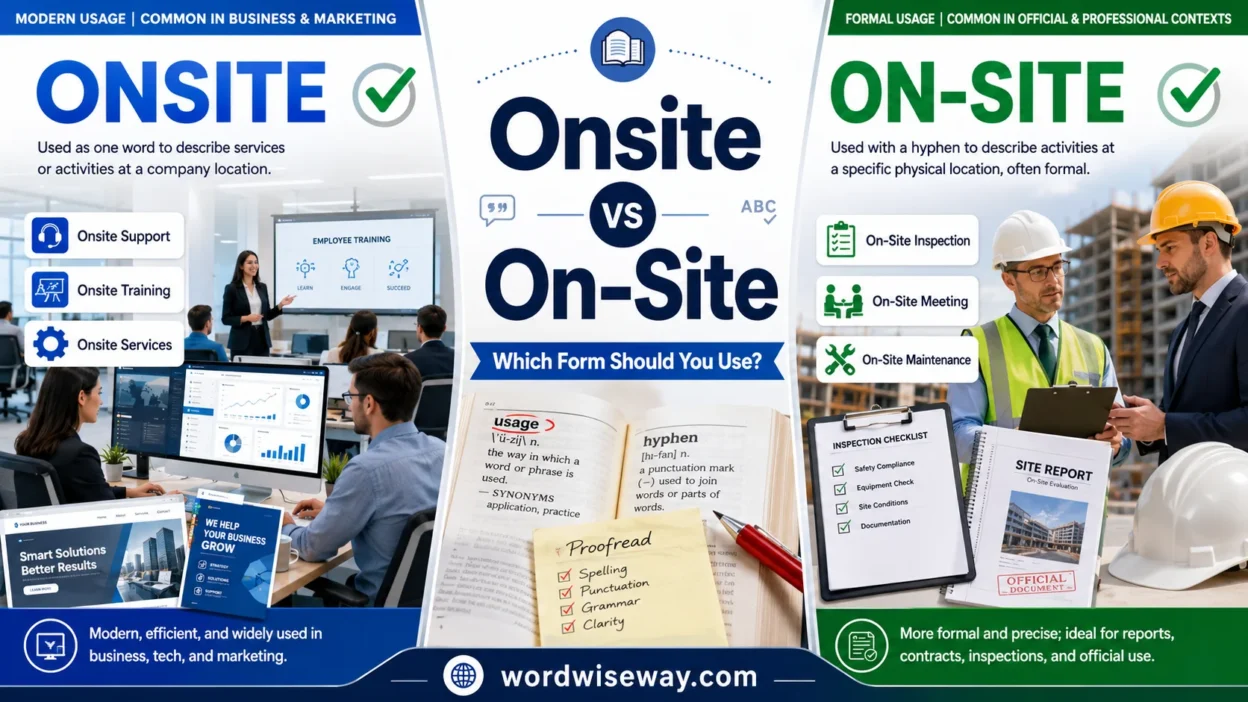
Onsite vs On-Site: Meaning, Grammar Rules, and Real-World Usage explains on site, onsite, and on-site in a simple way. In business writing, professional writing, academic writing, technical writing, and content writing, confusion often comes from correct spelling, grammar rules, grammar usage, spelling rules, language choice, word choice, and usage consistency.
The rule is simple: on site works as an adverb showing where something happens at a specific location, physical location, workplace, or office, while onsite works as an adjective before a noun. This difference, distinction, and contextual meaning matter in remote work, onsite work, and job listings, especially for technicians, employees, and staff. Using the correct form improves clarity, precision, readability, and professionalism, supported by style guides, editorial standards, and proofreading.
In modern business contexts, communication depends on workplace communication, business communication, and professional communication across documents, emails, reports, and website content. Good writing needs strong sentence structure, terminology usage, and writing consistency to improve communication effectiveness. The choice between on site, onsite, and on-site follows English language standards, including British English and American English, guided by language rules and consistent application
Strong writing depends on clear sentence structure, terminology usage, writing consistency, and improved communication effectiveness. For writers, students, and professionals, the choice between forms follows English language standards, including British English and American English, guided by language rules and consistent usage. In practice, onsite support, onsite training, location-based work, site-based activity, workplace operations, attendance, physical presence, and availability must be described clearly.
Understanding how terms refer to a location and avoiding misuse improves content clarity, accuracy, and professional writing quality, while compound words, compound adjectives, and hyphenation strengthen meaning in business, academic, and technical writing.
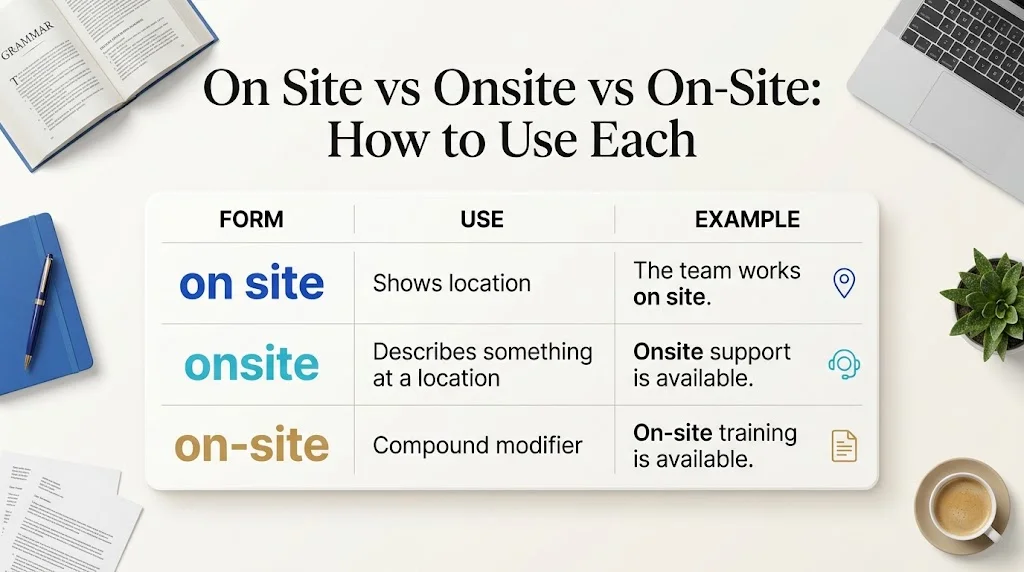
Quick Answer
On-site is the safer choice for formal writing, while onsite is increasingly common in modern business and digital writing. On site is used when the phrase functions as an adverb showing location, such as “The technician works on site.”
| Form | Use | Example |
| on site | Shows location | The team works on site. |
| onsite | Describes something at a location | Onsite support is available. |
| on-site | Compound modifier | On-site training is available. |
Onsite vs On-Site: Why This Tiny Difference Matters More Than You Think
At first glance, this looks like a small spelling preference. But in real writing, consistency shapes credibility.
Readers may not consciously notice your hyphen choices, but they feel the difference. A document that switches between “onsite” and “on-site” looks messy. A consistent one feels polished and professional.
Here’s why it matters:
- Employers judge writing quality in job descriptions
- Editors enforce style consistency in publishing
- Clients trust clearer, standardized communication
So yes, this is a small detail. But it carries real weight.
What “Onsite” Means in Modern English Usage
Let’s start with the closed form: onsite.
Definition of Onsite
“Onsite” is a compound word that describes something happening at a physical location instead of remotely.
It often functions as:
- A modifier (onsite training)
- A noun in casual business usage (we offer onsite services)
Common examples of “onsite”
- onsite support team
- onsite training program
- onsite services for customers
- onsite technician assistance
Where you usually see “onsite”
You’ll notice “onsite” most often in:
- Tech companies and startups
- Marketing materials
- Website UX labels
- Informal business communication
It feels modern, short, and efficient. That’s why digital industries like it.
Why “onsite” became popular
Language tends to compress over time. Just like:
- “email” replaced “e-mail” in many contexts
- “online” dropped its hyphen entirely
“Onsite” is part of that same evolution.
However, that doesn’t mean it replaced everything else.
What “On-Site” Means in Standard English
Now let’s look at the hyphenated form: on-site.
Definition of On-Site
“On-site” is a compound adjective used before a noun to describe something that happens at a physical location.
Examples of “on-site” in real usage
- on-site inspection
- on-site medical team
- on-site construction work
- on-site security personnel
Where “on-site” dominates
You’ll most often see it in:
- Journalism
- Academic writing
- Government documents
- Formal business reports
It carries a more structured and traditional tone.
Why the hyphen matters here
The hyphen connects “on” and “site” so the reader understands they function together as one idea.
Without it, the phrase could momentarily feel unclear in complex sentences.
Read More: Heyday vs Hayday: Meaning, Difference, Origin, and Correct Usage
The Grammar Rule Behind Onsite vs On-Site
This is where things get interesting.
The difference isn’t random. It comes down to how English handles compound modifiers.
The rule in simple terms
When two words work together as one adjective before a noun, English often uses a hyphen.
So:
- on-site inspection ✔ (clear adjective + noun)
- onsite inspection ✔ (modern closed compound)
Both are used, but the hyphenated version follows traditional grammar structure more closely.
Why hyphens exist in the first place
Hyphens prevent confusion.
Compare these:
- a “small business owner” (could be a small owner or a business owner)
- a “small-business owner” (clearly someone who owns a small business)
The same logic applies to on-site.
Style Guides: What Experts Actually Recommend
To understand onsite vs on-site, we need to look at professional writing standards.
AP Style (Associated Press)
The AP Stylebook is widely used in journalism.
AP style generally prefers hyphenated compound modifiers like:
- on-site inspection
- on-site staff
But language evolves, and AP has softened some hyphen rules over time.
Chicago Manual of Style
Chicago style is widely used in publishing and academia.
It also leans toward hyphenation in compound adjectives:
- on-site meeting
- on-site review
However, it allows closed compounds when usage becomes widely accepted.
Modern digital writing trends
In UX writing and SaaS platforms:
- “onsite” is becoming more common
- shorter labels are preferred
- readability on screens matters more than strict grammar tradition
So both forms coexist depending on the environment.
Onsite vs On-Site: When to Use Each One
This is where clarity really matters.
Use “on-site” when:
- Writing formal documents
- Creating reports or academic papers
- Publishing news or editorial content
- Describing professional services in detail
Examples:
- The team conducted an on-site inspection.
- Engineers performed on-site maintenance.
Use “onsite” when:
- Writing website UI labels
- Creating marketing content with a modern tone
- Writing internal company notes
- Keeping text short in apps or dashboards
Examples:
- Book onsite support
- Request onsite training
Simple rule of thumb
If your writing feels formal, use on-site.
If your writing feels digital or casual, onsite works fine.
Common Mistakes Writers Make
Even experienced writers slip up here.
Switching styles mid-document
This is the most common mistake.
Bad example:
- The company offers onsite training.
- The on-site team arrives at 9 AM.
- The onsite manager leads operations.
Pick one style and stick with it.
Over-hyphenating everything
Some writers add hyphens unnecessarily.
Wrong:
- on-site-based system
- onsite-enabled service
Correct:
- on-site system
- onsite service
Assuming one version is “correct” and the other is “wrong”
This is false.
Both exist in modern English. The key is consistency and context.
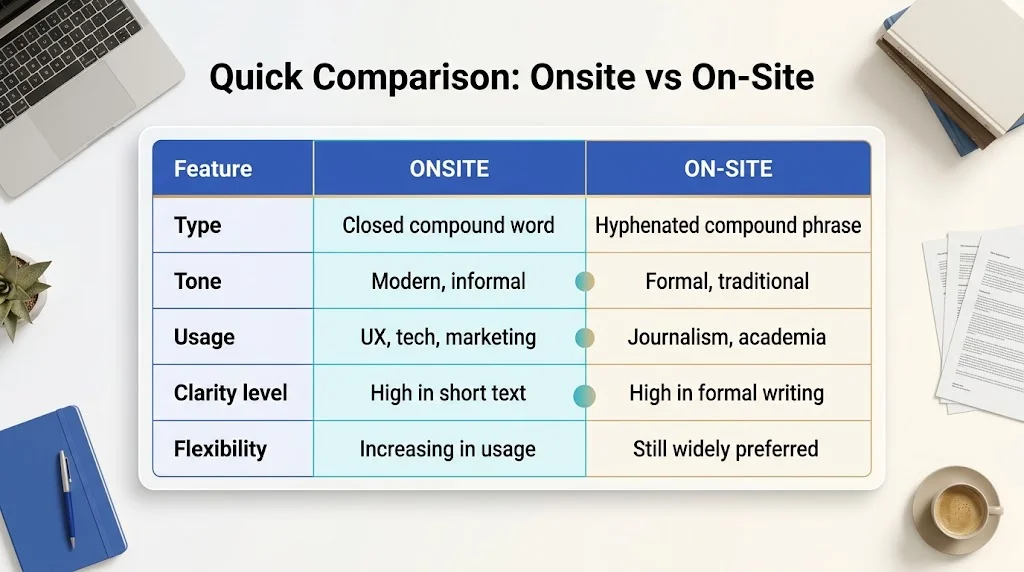
Quick Comparison Table: Onsite vs On-Site
| Feature | Onsite | On-Site |
| Type | Closed compound word | Hyphenated compound phrase |
| Tone | Modern, informal | Formal, traditional |
| Usage | UX, tech, marketing | Journalism, academia |
| Clarity level | High in short text | High in formal writing |
| Flexibility | Increasing in usage | Still widely preferred |
Real-World Industry Usage
Language doesn’t live in grammar books alone. It lives in workplaces.
Technology industry
Tech companies often prefer:
- onsite support
- onsite deployment
Why? Speed and simplicity.
Construction and engineering
This industry strongly prefers:
- on-site inspection
- on-site safety checks
Why? Precision matters in compliance documents.
Healthcare
Hospitals and medical teams often use:
- on-site emergency response
- on-site medical staff
Clarity and formality are critical here.
Education and training
Mixed usage:
- Formal reports: on-site
- Marketing materials: onsite
Case Study: How a Business Improved Clarity by Standardizing Usage
Company: Mid-size IT services provider
This company used both “onsite” and “on-site” across documents. Customers noticed inconsistency in:
- contracts
- service descriptions
- website pages
Problem
Support tickets increased because clients misunderstood service scope.
Solution
They standardized:
- “on-site” for contracts and legal documents
- “onsite” for website UX and dashboards
Result
- 18% reduction in clarification emails
- Improved readability score across documents
- More consistent brand voice
Small change. Big impact.
Expert Insight: Why Both Forms Will Continue to Exist
Language doesn’t move in straight lines. It shifts like water around obstacles.
We’ve already seen:
- “e-mail” → “email”
- “web site” → “website”
- “on-line” → “online”
So why hasn’t “on-site” fully become “onsite”?
Because:
- Formal writing still values structure
- Hyphens reduce ambiguity
- Style guides move slower than everyday usage
So both versions will likely continue side by side for years.
My Personal Experience
As an English language specialist, I’ve learned that small language choices can make a noticeable difference in professional writing. I often come across words and phrases that look similar but work differently in a sentence. On site, onsite, and on-site are good examples. When reviewing content, I don’t simply choose a form because it looks familiar. I consider its grammatical function, the audience, and the type of writing.
In my experience, consistency is just as important as correctness. I’ve seen documents use onsite in one paragraph and on-site in another without any clear reason. That inconsistency can make otherwise polished writing feel poorly edited. I usually keep on site when it functions as an adverbial phrase showing location, while I choose onsite or on-site as a modifier based on the style and context of the document.
Working with English has taught me that language doesn’t always follow one rigid rule. Usage changes, style guides evolve, and different industries develop their own preferences. For me, good editing means looking beyond a single hyphen or spelling choice. I focus on clarity, accuracy, consistency, and natural usage so the final writing communicates its message smoothly and professionally.
Quick Decision Guide
Ask yourself:
- Is this formal writing? → Use on-site
- Is this UI, app text, or marketing? → Use onsite
- Are you unsure? → Default to on-site
Simple. Clean. Reliable.
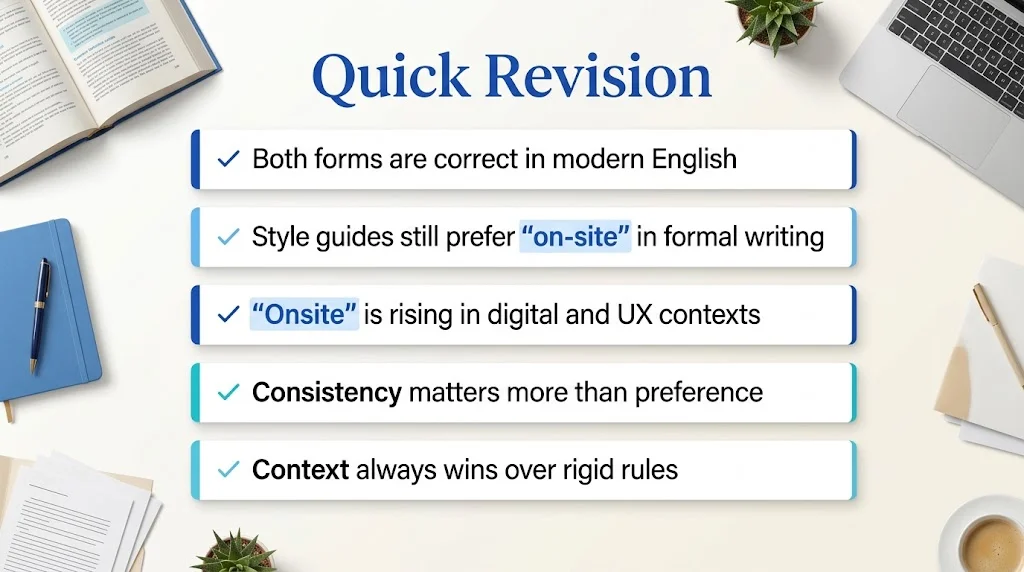
Key Takeaways
- Both forms are correct in modern English
- Style guides still prefer “on-site” in formal writing
- “Onsite” is rising in digital and UX contexts
- Consistency matters more than preference
- Context always wins over rigid rules
Practice:
Now it’s your turn. Choose on site, onsite, or on-site to complete each sentence. Pay attention to whether the expression shows a location or modifies a noun.
- The engineer is currently working ______.
- The company provides ______ technical support.
- We conducted an ______ inspection yesterday.
- Our technician will be ______ tomorrow.
- The business offers ______ training for new employees.
- The team completed the project ______.
- The manager arranged an ______ meeting with the client.
- Several employees work ______ rather than remotely.
Answers
- on site
- onsite / on-site
- on-site / onsite
- on site
- onsite / on-site
- on site
- on-site / onsite
- on site
FAQs
1. What does “on site” mean?
It means something happens at a specific location like a workplace or office.
2. What does “onsite” mean?
It is an adjective used before a noun, like onsite support or onsite training.
3. Is “on-site” correct?
Yes, it is a hyphenated form often used in formal writing and style guides.
4. Which is more correct: onsite or on site?
Both are correct, but usage depends on grammar rules and sentence structure.
5. Why do writers get confused?
Because of grammar usage, spelling rules, and language conventions in English.
6. Is it used in job listings?
Yes, especially in remote work, onsite work, and workplace roles.
7. What is the grammar role of “on site”?
It functions as an adverb describing where something happens.
8. What is the grammar role of “onsite”?
It functions as an adjective describing a noun like onsite services.
9. Does British or American English differ here?
Both use similar forms, but style consistency depends on language standards.
10. Why is correct usage important?
It improves clarity, communication effectiveness, and professional writing quality.
Conclusion
Understanding on site, onsite, and on-site improves clarity, grammar accuracy, and professional communication. These forms are small but important parts of business writing, technical writing, and workplace communication. Using them correctly strengthens sentence structure, ensures usage consistency, and improves overall writing quality in real-world contexts like emails, reports, and job listings.
The main difference between on site, onsite, and on-site comes down to grammar, style, and context. Although all three forms relate to something happening at a particular location, they don’t always work in the same sentence structure. On site is commonly used as a phrase, especially when it follows a verb, while onsite often works as an adjective or adverb in modern American English. On-site, with a hyphen, may also appear when it functions as a compound modifier before a noun, particularly in formal or technical writing.
Choosing the right form becomes easier when you look at how the words function in a sentence. For example, you might write, “The technician is on site,” but “The company provides onsite support.” In some style guides and publications, you may also see on-site support. The key is to follow the spelling and punctuation style preferred by your audience or organization. Once you understand the basic pattern, you can use these forms confidently in emails, reports, job descriptions, and other professional documents.

Emma Smith has dedicated 14 years to Princeton University’s English Department, mentoring students in textual interpretation, literary movements, and critical frameworks. Her research explores Shakespearean drama, Victorian serial fiction, postcolonial narrative theory, and manuscript studies and probing how literary forms evolve across cultures and centuries. Emma has delivered lectures at international humanities congresses and published findings in distinguished academic journals, underscoring her commitment to scholarly depth and vibrant teaching.