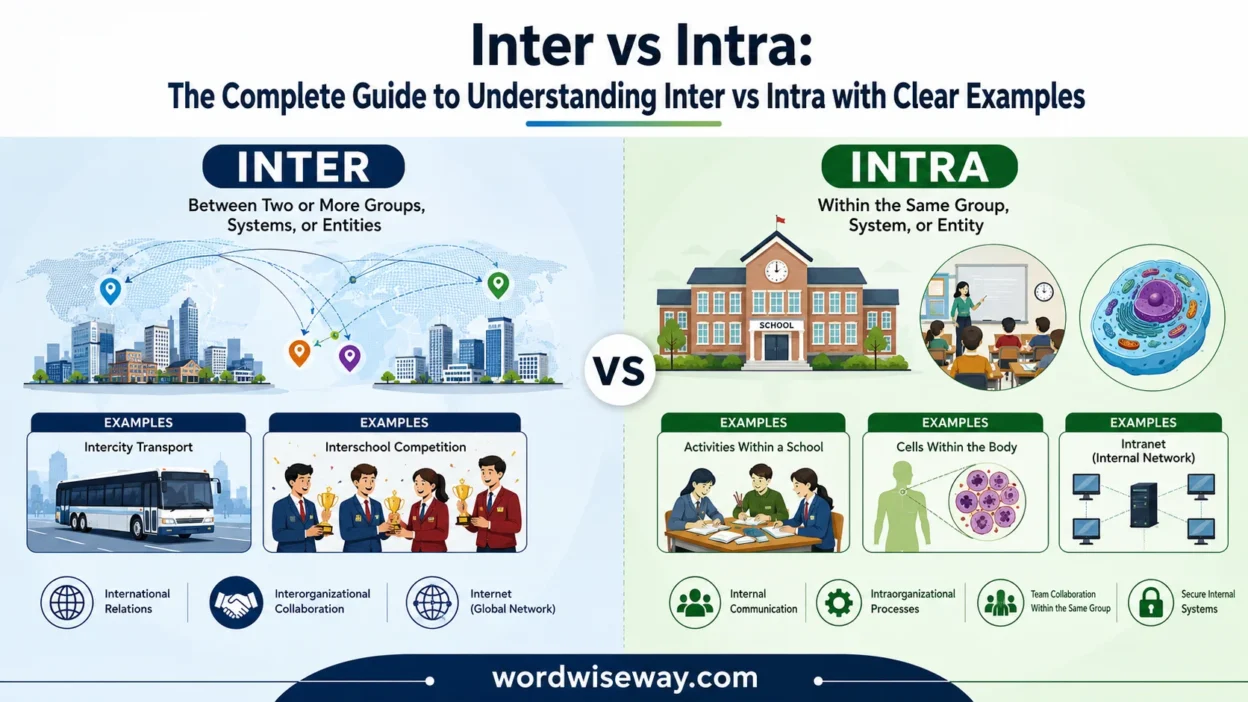
The text Inter vs Intra: The Complete Guide to Understanding Inter vs Intra with Clear Examples acts as an essential initial guide for those trapped in this lexicon puzzle. In my corporate career, I have seen how a single letter in a prefix alters structural communication traffic. When people search for this specific keyword, they seek wisdom to clarify how an organization handles its internal networks.
The fundamental difference lies in whether activities flow outward or stay local. While inter-departmental integration bridges distinct partners, intra-departmental practices remain localized. Using the wrong terminology leads to frequent mistakes in formal documentation, making a complete grasp of these prefixes vital.
Mastering this vocabulary distinction is a priority for leadership aiming for systematic clarity. An organizational structure relies on an internal intranet for local messaging, while outward-facing transactions connect with an independent external sector.
By evaluating these relationships, professionals can successfully manage their subsidiaries, employees, and teams. Exploring linguistic origins and examples makes it easy to explain the two apart.
Misinterpreting these things is a common pitfall, but mapping out how communication flows ensures that every professional can grasp the science of organizational connectivity without writing the wrong term
Meaning Explained in Simple Terms
Before comparing them, you need to understand each word on its own. Both prefixes come from Latin roots and are still widely used in English, science, business, and technology.
What “Inter” Means in Inter vs Intra
The prefix inter- means:
Between or among multiple groups, places, or things
Think of it as something that crosses boundaries or connects different sides.
When you see inter, imagine movement, exchange, or interaction happening across two or more separate entities.
Common idea behind “Inter”
- Between different groups
- Across boundaries
- Connection or communication
- External interaction
Simple Inter examples
- Intercity travel (between cities)
- International relations (between countries)
- Inter-school competition (between schools)
What “Intra” Means in Inter vs Intra
The prefix intra- means:
Inside or within a single group, place, or system
It stays contained. Nothing crosses outside boundaries.
When you see intra, think of something happening internally within one unit.
Common idea behind “Intra”
- Inside one group
- Internal process
- No external connection
- Closed system activity
Simple Intra examples
- Intra-school activities (within one school)
- Intracellular processes (inside a cell)
- Intranet (internal company network)
Core Difference:
The difference becomes crystal clear once you compare them side by side. One focuses on between, the other on within.
| Feature | Inter vs Intra: Inter | Inter vs Intra: Intra |
| Meaning | Between groups | Within a single group |
| Scope | External interaction | Internal activity |
| Boundary | Crosses boundaries | Stays inside boundary |
| Movement | Across systems | Inside system |
| Complexity | Multiple entities involved | One entity involved |
A simple way to remember:
- Inter = interaction between
- Intra = internal inside
Why this Confusion Happens So Often
People mix them up for three main reasons:
1. Similar spelling
The only difference is two letters. That’s enough to cause mistakes.
2. Similar pronunciation
Both words sound close when spoken quickly, especially in conversations or exams.
3. Overlapping contexts
Both are used in education, science, sports, and technology. So your brain keeps switching between them.
But once you understand the logic of “between vs within”, the confusion starts disappearing naturally.
Real Examples of Everyday Life
Let’s move beyond definitions. This is where things start to click.
In Travel
- Intercity travel: Travel between cities
Example: Lahore to Islamabad bus route - Intracity travel: Travel inside one city
Example: Local rickshaw or metro inside Lahore
Here, inter involves distance and multiple cities. Intra stays local.
In Education
- Inter-school competition: Different schools compete
- Intra-school competition: Students of the same school compete internally
Imagine a science fair:
- Inter-school = schools compete against each other
- Intra-school = students compete inside their own school
In Sports
Sports is one of the easiest ways to understand this concept.
- Inter-league match: Teams from different leagues play
- Intra-squad match: Practice match within the same team
Example:
A cricket team divides itself into two groups for practice. That’s intra-team play. But when two different clubs play, that becomes inter-club competition.
In Science and Biology
Science uses these prefixes very precisely. Once you see them in biology, they become unforgettable.
Intercellular vs Intracellular
- Intercellular space: Space between cells
- Intracellular activity: Processes inside a cell
Cells are like tiny rooms in a building:
- Intercellular = hallways between rooms
- Intracellular = activity inside a room
Intermolecular vs Intramolecular
- Intermolecular forces: Forces between molecules
- Intramolecular forces: Forces inside a molecule
This difference is critical in chemistry because it affects:
- Boiling points
- Melting points
- Chemical stability
In Business and Technology
Modern workplaces rely heavily on these terms.
In Business Communication
- Inter-company communication: Communication between companies
Example: A supplier emailing a manufacturer - Intra-company communication: Communication within a company
Example: HR emailing employees
In Networking
Technology gives one of the clearest contrasts:
- Internet: Inter-network system
A global system connecting millions of networks - Intranet: Internal private network
Used inside a company or organization only
Think of it like this:
- Internet = world city highway
- Intranet = private office corridor
Read More: Ignitor vs Igniter: Spelling, Meaning, Differences and Usage
Memory Tricks
You don’t need heavy memorization. Just connect meaning with imagery.
Simple memory tools
- Inter = International
- Think countries connecting
- Intra = Internal
- Think something happening inside your body or room
Visual trick
- Inter = arrows going outward between dots
- Intra = circle with everything contained inside
Once your brain locks into this pattern, mistakes reduce drastically.
Common Mistakes in Usage
Even strong students slip here. Let’s fix the most common errors.
Mistake 1: Using inter when it should be intra
Example:
- Wrong: Inter-school activities within one school
- Correct: Intra-school activities
Mistake 2: Confusing internet and intranet
- Internet = global network
- Intranet = private internal network
Mistake 3: Biology confusion
Students often mix:
- Intercellular
- Intracellular
The fix is always the same:
Ask yourself: “between or inside?”
Case Study In a Real School System
Let’s bring this into a real scenario.
Scenario: A school sports day
A school organizes two types of events:
Inter-school event
- Schools from across the city participate
- Competition is external
- Winners represent their school publicly
Intra-school event
- Only students from one school participate
- Teams are divided internally
- Focus is practice and internal ranking
Result
Students understand both competition levels better because they experience both systems.
This is exactly how educational institutions reinforce the Inter vs Intra concept in real life learning environments.
Quick Quiz For Your Understanding
Try answering without checking earlier sections.
- Inter-school or intra-school exam within one school?
- Intercellular or intracellular process inside a cell?
- Intercity or intracity transport inside one city?
- Inter-company or intra-company email system?
Answers
- Intra-school
- Intracellular
- Intracity
- Intra-company
If you got the most correct, your understanding is solid.
One-Line Rule to Remember
Here is the simplest version:
Inter means between many. Intra means inside one.
That’s it. No extra complexity needed.
Why Understanding Inter vs Intra Actually Matters?
This isn’t just vocabulary. It affects:
- Academic exams in biology, chemistry, and English
- Business communication clarity
- Technology understanding (networks and systems)
- Everyday language accuracy
Misusing these terms can completely change meaning in technical writing.
For example:
- Intracellular drug delivery is very different from intercellular interaction in medicine
- Internet security is not the same as intranet security
Precision matters..
FAQs
1. What is the main difference between inter and intra?
Ans: The core difference lies in the scope of boundaries. Inter implies a connection, relationship, or transaction between two or more separate entities, groups, or independent organizations. On the other hand, intra means that the activities or practices are contained strictly within the boundaries of a single organization, department, or place.
2. Can you give a simple real-world example of inter vs intra?
Ans: Think of the internet versus an intranet. The internet is an international, publicly accessible network connecting millions of independent computers worldwide (between networks). An intranet is a private, internal network accessible only to employees within a specific company or organization.
3. Why do people commonly make mistakes with these two prefixes?
Ans: Because they share a very similar lexicon and prefix structure, differing by just a single letter. At a quick glance, their definitions and spellings look almost identical, creating a persistent linguistic puzzle that causes frequent confusion for students and writers.
4. How does inter vs intra apply to organizational structure?
Ans: In an organizational structure, inter-departmental communication happens across different teams (e.g., Marketing talking to Finance). Intra-departmental communication refers to the internal traffic and engagement occurring strictly within a single department (e.g., discussions among the design team only).
5. What does an inter-company transaction mean?
Ans: An inter-company transaction involves business activities, agreements, or financial transactions occurring between two or more completely separate, independent companies or external partners.
6. What is an intra-company transfer?
Ans: An intra-company transfer is when a company moves its employees, assets, or inventory to different positions, subsidiaries, or departments strictly within its own systematic corporate umbrella.
7. Is it intercollegiate or intracollegiate sports?
Ans: Both exist, but they mean different things. Intercollegiate sports involve athletic competitions played between two or more different colleges. Intracollegiate (often called intramural) sports involve games played exclusively between students or groups within the same college.
8. Why is mastering this distinction important for leadership?
Ans: For corporate leadership, precise terminology is a priority to manage operations effectively and efficiently. Clear usage ensures that strategic planning, mapping, and structural integration are communicated without any errors or pitfalls across the business.
9. Are there any simple tricks to remember which is which?
Ans: Yes. A helpful trick is to associate the “E” in inter with “External” or “Everyone” (crossing boundaries), and the “A” in intra with “All inside” (staying completely within).
10. Is the word “interdependent” related to these definitions?
Ans: Yes. Interdependent means that two or more independent parties or groups rely on each other. Because the reliance occurs between separate entities, it properly uses the inter prefix.
Conclusion
Mastering the structural nuances of language is essential for navigating modern corporate dynamics successfully. Gaining wisdom on how a single letter completely shifts a word’s meaning allows professionals to communicate with absolute clarity. Whether you are coordinating cross-border international trade or optimizing the internal flow of your company’s private intranet, recognizing this fundamental boundary line is key. By avoiding common mistakes and using these prefixes correctly, you ensure your formal writing, organizational roles, and daily communication remain highly professional, sharp, and impactful.

Emma Smith has dedicated 14 years to Princeton University’s English Department, mentoring students in textual interpretation, literary movements, and critical frameworks. Her research explores Shakespearean drama, Victorian serial fiction, postcolonial narrative theory, and manuscript studies and probing how literary forms evolve across cultures and centuries. Emma has delivered lectures at international humanities congresses and published findings in distinguished academic journals, underscoring her commitment to scholarly depth and vibrant teaching.