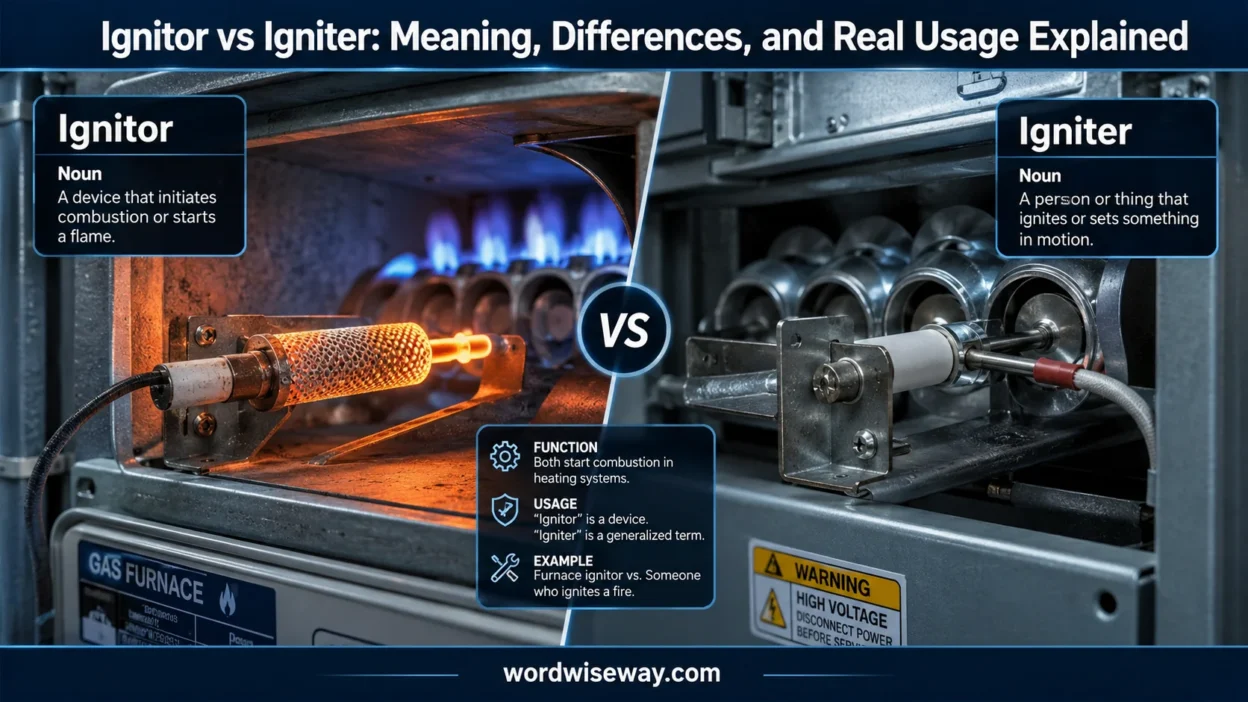
Ignitor vs Igniter: Meaning, Differences, Usage, shows how people often hear the terms ignitor, igniter, or igniter-or-ignitor and wonder which term to use. In simple meaning, both refer to the same thing: a device that initiates combustion in engines, stoves, and equipment. The core idea is an ignition-device or combustion-device working inside an ignition-system
. From experience and reviewing documents and industry sources, this truth shows both forms are treated as equivalent-terms even if spelling creates confusion.The difference, differences, and subtle distinction come mainly from context and regional or technical usage. Some technical-term and practical application settings prefer one spelling based on regional-preference or regional-spelling.
Still, both are used in real-world application with the same meaning and function.In professional writing, choosing the correct word-choice and terminology improves communication, writing, and clarity. Across product-descriptions, industry-standards, and academic-papers, the usage may vary due to spelling-variation and alternative-spelling. Following language-guides, rules, and proper usage-rules helps ensure correct-usage and accuracy.
Maintaining correctness, precision, and semantic-accuracy supports better understanding in technical writing. This reduces errors and improves clarity in explanations, especially when describing ignition systems in appliance and mechanical contexts.
What This Debate Is Really About
At the heart of the issue is not engineering, but language.
Both “ignitor” and “igniter” refer to a device that starts combustion. That could mean lighting gas in a furnace, triggering a flame in a stove, or initiating fuel combustion in industrial burners.
However, English allows multiple valid suffix patterns, and this is where the split happens:
- Igniter → more aligned with modern technical writing
- Ignitor → older or alternative spelling still used in catalogs and product naming
So the difference is not mechanical. It is linguistic and historical.
Before going deeper, here’s the simplest truth:
Ignitor and igniter describe the same component. Only the spelling differs.
Read More: Of Course or Ofcourse: Grammar, Meaning, and Correct Usage
What Igniter Means in Real Engineering Terms
An igniter is a device that initiates combustion by producing heat, a spark, or an electrical arc.
It plays a critical role in systems where controlled ignition is required instead of open flames or manual lighting.
Where Igniters Are Used
Igniters appear in many everyday and industrial systems:
- Home appliances
- Gas ovens
- Stovetops
- Water heaters
- HVAC systems
- Furnaces
- Boilers
- Heat pumps with gas backup
- Automotive systems
- Spark ignition engines
- Cold start systems
- Industrial equipment
- Gas turbines
- Boilers
- Chemical processing burners
Core Function
An igniter does three things:
- Converts energy into heat or spark
- Transfers that energy to a fuel-air mixture
- Starts controlled combustion
A simple example is your gas stove. When you turn the knob, the igniter produces a spark. That spark lights the gas flow. Without it, you’d need a match every time.
What Ignitor Means in Practical Usage
Now let’s talk about ignition.
In engineering terms, it is not a different device. It is simply an alternate spelling of igniter.
You will still see it in:
- Parts catalogs
- HVAC replacement listings
- Industrial procurement systems
- Older technical documentation
Manufacturers sometimes prefer “ignitor” for branding consistency or legacy naming systems.
Important Reality Check
There is no functional distinction such as:
- Different voltage
- Different materials
- Different performance levels
If two products say “ignitor” and “igniter,” they can still be physically identical parts from the same production line.
Side-by-Side Technical Comparison
Let’s remove all confusion with a direct comparison.
| Feature | Igniter | Ignitor |
| Meaning | Device that starts ignition | Same device |
| Function | Produces spark or heat to ignite fuel | Same function |
| Usage in writing | Preferred in modern technical English | Common in catalogs and legacy systems |
| Industry presence | HVAC, automotive, engineering docs | Retail listings, OEM catalogs |
| Technical difference | None | None |
| Accuracy | Standardized spelling | Accepted variant |
The conclusion is simple: they are interchangeable in meaning, not interchangeable in style.
Why Two Spellings Exist in the First Place
Language evolves slowly, while industry evolves fast. That mismatch is exactly why this confusion exists.
1. English suffix variation
English uses both:
- “-er” (heater, igniter)
- “-or” (actor, generator, ignitor)
Both forms are historically valid depending on word evolution patterns.
2. Industrial naming habits
Manufacturers often choose naming conventions based on:
- Internal documentation systems
- Supplier catalog history
- Regional preferences
Once a term enters a supply chain database, it tends to stick for decades.
Where You Will Commonly See
The spelling you encounter often depends on the industry.
HVAC Systems
Furnace parts are the biggest source of confusion.
You will see:
- Hot surface igniter
- Hot surface ignitor
Both refer to the same ceramic heating element used to light gas burners.
Automotive Systems
In cars, especially ignition systems:
- “Igniter” is more common in technical manuals
- “Ignitor” may appear in aftermarket parts listings
Industrial Burners
In industrial settings like refineries and power plants:
- Documentation tends to use “igniter”
- Procurement systems may list “ignitor”
E-commerce platforms
Online marketplaces amplify the confusion:
- Sellers duplicate listings with both spellings
- Search engines index both independently
- Buyers assume they are different parts
How an Igniter Actually Works (Technical Breakdown)
Now let’s move beyond spelling and into mechanics.
An igniter operates through controlled energy conversion.
Step-by-step process
- Power input
- Electrical current is supplied to the igniter system
- Energy transformation
- The igniter converts electrical energy into heat or spark
- Ignition trigger
- Heat or spark reaches fuel-air mixture
- Combustion starts
- Fuel ignites and sustained flame forms
Types of igniters and how they function
Hot Surface Igniter
- Made of silicon carbide or silicon nitride
- Heats up to extremely high temperatures
- Glows orange-hot before ignition
Typical use:
- Modern gas furnaces
Spark Igniter
- Produces repeated electrical sparks
- Works like a controlled lightning arc
Typical use:
- Gas stoves and grills
Piezoelectric Igniter
- Uses mechanical pressure to generate voltage
- No external power required
Typical use:
- Lighters and portable gas systems
Real Case Study: Furnace Ignition Failure
Let’s ground this in a real-world scenario.
Situation
A homeowner reports:
- Furnace clicks but does not start
- No heat output
- Repeated ignition attempts fail
Diagnosis process
Technician checks:
- Power supply to igniter
- Resistance of hot surface igniter
- Gas valve function
Findings
The igniter is cracked due to thermal fatigue.
Important detail
The replacement part is listed as:
- “Igniter” in OEM manual
- “Ignitor” in aftermarket store
Same part. Different spelling.
Outcome
After replacement:
- Furnace ignites normally
- Heat cycle stabilizes
- System efficiency returns to normal
This shows the real takeaway: function matters, not spelling.
Common Misconceptions
Let’s clear up the myths that keep circulating online.
Misconception 1: They are different components
Reality: They are the same device.
Misconception 2: One is newer or more advanced
Reality: No technical difference exists between the terms.
Misconception 3: Ignitor is incorrect English
Reality: Both spellings are accepted, though “igniter” is more standardized in technical writing.
Misconception 4: They affect performance
Reality: Performance depends on design, not spelling.
How Manufacturers and Retailers Use Both Terms
Manufacturers do not always follow one universal standard.
Why both exist in databases
- Legacy naming conventions remain unchanged
- Supplier chains preserve original terminology
- Catalog duplication improves search reach
Practical effect for buyers
If you search only one term, you might miss listings.
For example:
- Searching “furnace igniter” may show different results than “furnace ignitor”
That’s why professionals often search both.
Which Term Should You Use?
This depends on context.
Use “igniter” when:
- Writing technical documentation
- Producing engineering reports
- Creating educational content
- Following modern industry standards
Use both when:
- Searching for replacement parts
- Browsing online catalogs
- Comparing supplier listings
Simple rule
Use “igniter” for writing. Search both for shopping.
FAQs:
1. What is the difference between ignitor and igniter?
Ans: There is no functional difference. Both words refer to the same device used to start combustion in engines, stoves, heaters, and similar systems.
2. Is ignitor a correct spelling?
Ans: Yes, ignitor is a correct spelling, but it is less commonly used in modern English compared to igniter.
3. Which is more commonly used, ignitor or igniter?
Ans: Igniter is more widely used in technical writing, academic content, and product documentation.
4. Do ignitor and igniter work differently?
Ans: No, both terms describe the same device and function in exactly the same way.
5. Why do two spellings exist?
Ans: The difference comes from regional preferences, historical spelling variations, and usage differences in technical language.
6. Where is an igniter used?
Ans: It is used in engines, gas stoves, heaters, burners, and other systems where controlled ignition is required.
7. Is the ignitor still used today?
Ans: Yes, ignitor is still used in some industries, older manuals, and regional writing styles.
8. Which spelling should I use in exams or formal writing?
Ans: Igniter is generally preferred in exams, academic writing, and standardized English.
9. Are ignitor and igniter interchangeable?
Ans: Yes, both are interchangeable because they refer to the same ignition device with the same function.
10. Does spelling change the meaning or function?
Ans: No, spelling does not change the meaning or function. It only affects how the word is written.
Conclusion
The confusion between ignitor and igniter is only about spelling, not meaning. Both words describe the same device used for ignition in engines, stoves, and other equipment. While igniter is more commonly accepted in modern English, ignitor still appears in regional and technical usage. Understanding this helps improve clarity, avoids mistakes, and ensures correct usage in writing and communication.

Amelia Sanders has spent 14 years in Harvard University’s English Department, helping students navigate literary analysis, interpretive theory, and narrative techniques. Her academic pursuits center on 18th-century British prose, romantic poetry, diasporic writing, and digital editing exploring how textual choices influence cultural perspectives. Amelia has spoken at major international meetings and contributed essays to respected academic volumes, demonstrating her dedication to thoughtful scholarship and effective teaching.