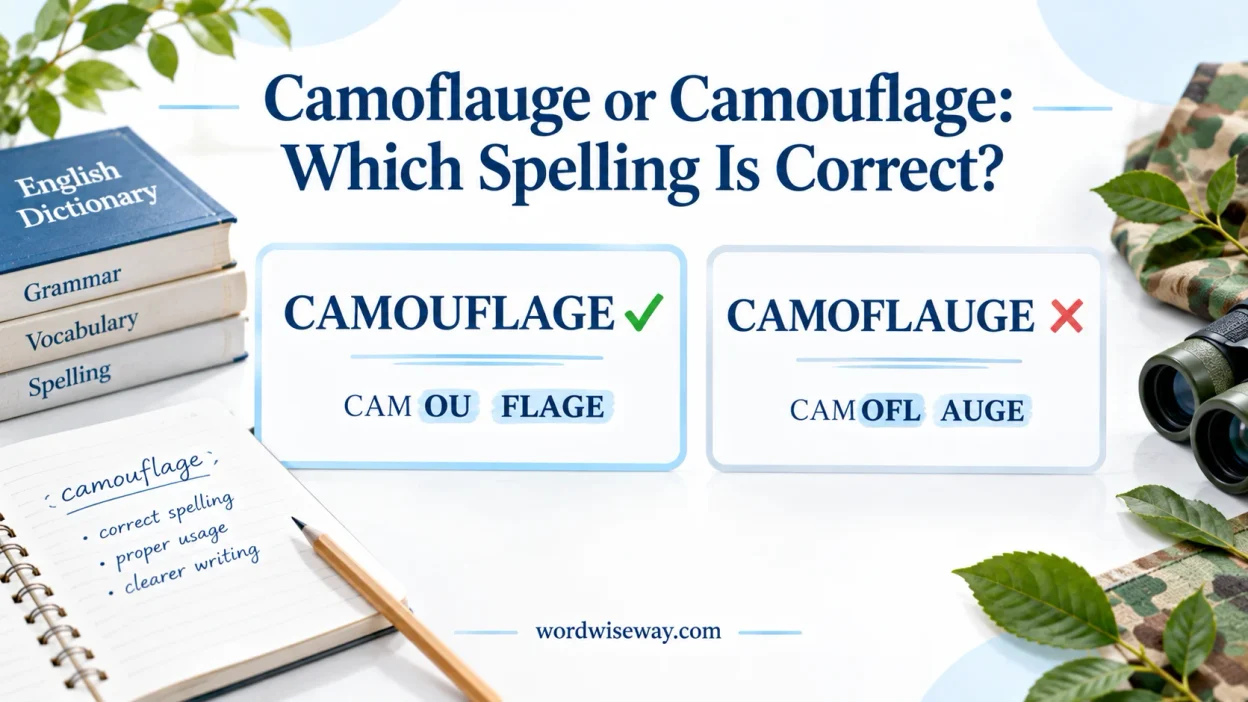
Camouflage is the correct English spelling, while camoflage is a common misspelling. If you’re unsure about Camoflauge or Camouflage: Which Spelling Is Correct?, remember the extra u after the o. The letters in the middle can cause confusion, especially when you type quickly. This simple spelling choice helps writers avoid a common spelling mistake.
The word describes a method, pattern, appearance, or technique that helps a person, animal, object, or place blend into its surroundings and become harder to notice. You’ll find camouflage in wildlife, military clothing, outdoor activities, fashion, photography, art, and visual design.
The standard spelling works in British English and American English. Using camouflage in academic writing, business writing, social media, emails, and assignments keeps your writing clear and professional. Understanding its context and usage also helps you avoid common mistakes and remember the correct spelling.
Quick Answer:
Camouflage is the correct spelling.
Camoflauge is a misspelling.
| Spelling | Correct? | Meaning |
| Camouflage | ✅ | A method of concealing something or making it blend into its surroundings |
| Camoflauge | ❌ | Incorrect spelling of camouflage |
The easiest part to remember is the middle and ending of the word:
camou + flage = camouflage
Don’t write camoflauge. The letters “au” and “ou” aren’t interchangeable here.
What Does Camouflage Mean?
Camouflage refers to something that helps an object, person, animal, or other subject avoid being easily seen or recognized.
The basic idea is simple: make something harder to detect.
An animal might naturally have colors that match its habitat. A soldier might wear patterned clothing that blends into woodland terrain. A vehicle might receive a paint pattern designed to make its shape less obvious.
Camouflage doesn’t always mean complete invisibility. In many situations, it simply reduces visual contrast or makes identification more difficult.
For example:
- A snowshoe hare can blend into a snowy environment.
- A green insect can become difficult to spot among leaves.
- A military vehicle can use patterned colors to break up its outline.
- A person can wear camouflage clothing while moving through woodland.
- A building can use colors that make it less noticeable against its surroundings.
The concept also works figuratively. Someone might camouflage their feelings by pretending everything is fine. In that context, the word describes concealment rather than literal blending with the environment.
Camouflage as a Noun
As a noun, camouflage refers to the concealment method, appearance, pattern, or material itself.
Consider this sentence:
The bird’s camouflage made it difficult to spot among the branches.
Here, camouflage describes the bird’s natural coloring and pattern.
You could also say:
- The jacket has a traditional camouflage pattern.
- The insect relies on camouflage for protection.
- The vehicle was covered in camouflage.
- The camouflage helped the animal avoid predators.
In each example, camouflage names the means or appearance used for concealment.
Camouflage as a Verb
Camouflage can also work as a verb. In this form, it describes the act of hiding or disguising something by helping it blend into its surroundings.
For example:
The patterned fabric camouflages the equipment.
Here, camouflages describes what the fabric does.
Other examples include:
- The colors camouflage the animal against the rocks.
- Leaves can camouflage small insects.
- The workers camouflaged the structure with natural materials.
- The pattern camouflaged the object’s outline.
- The paint helps camouflage the vehicle.
The noun and verb look identical in their basic form. Context tells you which role the word plays.
Why Is Camouflage So Easy to Misspell?
The spelling camouflage contains an unusual combination of letters. That’s the heart of the problem.
Many English words don’t prepare you for the sequence:
c-a-m-o-u-f-l-a-g-e
When people spell the word from memory, they may unconsciously rearrange the vowels and consonants. That’s how camoflauge appears.
The incorrect version often feels plausible because the pronunciation doesn’t clearly expose every letter.
This is an important lesson about English spelling: sound and spelling don’t always travel together.
If you try to spell camouflage purely by listening to it, you may hesitate. If you memorize its visual structure instead, the problem becomes much smaller.
What’s the Difference?
The difference is spelling rather than meaning.
Camouflage is the standard English word. Camoflauge doesn’t represent a separate word with a different definition. It’s simply an incorrect rearrangement of letters.
Look closely:
Correct: camouflage
Incorrect: camoflauge
The mistake happens because the letters around f-l-a-g-e get rearranged.
| Correct Form | Incorrect Form |
| camouflage | camoflauge |
| camou + flage | camo + flauge |
| Standard spelling | Misspelling |
A useful visual checkpoint is the sequence flage at the end.
If you find yourself writing flauge, stop and check the word.
How to Spell Camouflage Correctly
Instead of trying to memorize all ten letters as one long string, divide the word into two useful chunks:
camou + flage
Now combine them:
camouflage
This approach gives your brain a visual pattern rather than a vague collection of sounds.
Another useful strategy involves focusing on the troublesome section:
CAMOUFLAGE
The word contains OU before the FL.
That means:
camou + flage
Not:
camo + flauge
A Simple Memory Trick for Camouflage
Think of the correct ending as:
FLAGE
Then place CAMOU before it.
CAMOU + FLAGE = CAMOUFLAGE
The incorrect spelling changes that structure to FLAUGE.
So when you’re unsure, remember:
Camouflage has “flage,” not “flauge.”
That small distinction can save you from repeatedly making the same spelling error.
How Do You Pronounce Camouflage?
Camouflage is commonly pronounced approximately as KAM-uh-flahzh in American English.
The final sound is particularly important because the spelling -age doesn’t sound like the ordinary “age” in a word such as age itself.
The word generally has three syllables:
cam-o-flage
The pronunciation may vary slightly among English speakers, but the standard word remains spelled camouflage.
This difference between pronunciation and spelling explains why simply sounding the word out isn’t always enough to reconstruct its letters.
Examples of Camouflage in Sentences
Seeing a word in several contexts makes its meaning and grammar much easier to understand.
Camouflage as a Noun
- The lizard’s camouflage helped it blend into the rocky ground.
- The soldiers wore camouflage uniforms during the exercise.
- The insect’s natural camouflage made it almost impossible to notice.
- The vehicle was painted with a camouflage pattern.
- The bird’s feathers provide excellent camouflage among the leaves.
- The photographer struggled to find the animal because of its natural camouflage.
- The jacket features a woodland camouflage design.
Notice that the noun can refer to a pattern, appearance, material, or natural characteristic.
Camouflage as a Verb
- The dark colors camouflage the animal at night.
- Dense leaves camouflaged the nest.
- The patterned fabric camouflages the equipment.
- The insect uses its appearance to camouflage itself.
- The workers camouflaged the structure with surrounding vegetation.
- Shadows can camouflage small objects.
- The colors help camouflage the vehicle against the terrain.
The grammatical role changes, but the central idea stays the same: concealment through appearance or blending.
Common Mistakes
Writing Camoflauge
The biggest mistake is simply writing camoflauge.
It looks close enough to the correct spelling that spellcheck or a quick glance may not immediately draw attention to the problem. However, it isn’t the standard spelling.
Remember:
Camouflage ✓
Camoflauge ✗
Confusing Spelling With Pronunciation
English contains plenty of words whose spelling isn’t obvious from their pronunciation.
Camouflage is one of them.
If you rely entirely on sound, the unusual letter sequence can disappear. That’s why visual memorization works better here.
Learn the written pattern camou + flage rather than trying to construct the word from its sounds every time.
Assuming Camouflage Only Means Military Clothing
Military clothing is probably the first image that comes to mind when you hear camouflage. However, the word has a much broader meaning.
Animals use natural camouflage. Plants can blend into their surroundings. Objects can be visually concealed. People can even camouflage emotions in a figurative sense.
So the word isn’t restricted to uniforms or military equipment.
Camouflage in American English
In US English, the standard spelling is camouflage.
The same spelling applies whether you’re using it as a noun or a verb.
Common forms include:
- camouflage: base noun or verb
- camouflages: third-person singular verb
- camouflaged: past tense or past participle
- camouflaging: present participle or gerund
For example:
The pattern camouflages the object.
The object was camouflaged by the surrounding colors.
The artist is camouflaging the design within the background.
The spelling changes slightly when suffixes are added, but the core word remains recognizable.
Camouflage vs. Concealment
Camouflage and concealment overlap, but they aren’t exact synonyms.
Concealment is the broader concept of keeping something hidden or out of sight.
Camouflage specifically involves disguising something so it becomes harder to detect or recognize, often by making it blend into its surroundings.
For example, placing an object inside a closed box is concealment. Painting that object so it visually blends into the surrounding wall is camouflage.
In other words:
Camouflage is one method of concealment.
That distinction matters when choosing the most precise word.
Camouflage vs. Disguise
A disguise changes or hides someone’s or something’s recognizable appearance. Camouflage generally helps something blend into its environment.
Imagine two different situations.
A person wearing clothing and accessories to look like someone else is using a disguise.
An animal whose colors make it difficult to distinguish from leaves is using camouflage.
The concepts can overlap, but their emphasis differs. A disguise often changes identity or appearance. Camouflage usually reduces visibility or detectability.
Camouflage vs. Cover
Cover can mean placing something over an object or using something as protection or concealment.
Camouflage is more specific.
If you place a blanket over a chair, you’ve covered the chair. If you use a pattern that makes the chair visually disappear into its surroundings, you’ve used camouflage.
The distinction becomes clearer when you focus on the mechanism:
| Word | Main Idea | Example |
| Camouflage | Blend into surroundings | The insect uses camouflage among the leaves. |
| Concealment | Keep something hidden | The box provided concealment. |
| Disguise | Alter recognizable appearance | The costume served as a disguise. |
| Cover | Hide or protect with something | The cloth covered the equipment. |
These words can overlap in some contexts, but they aren’t interchangeable in every sentence.
Camouflage: Noun and Verb Forms
Understanding the different grammatical forms can prevent another common mistake: assuming the word only functions as a noun.
| Word Form | Part of Speech | Example |
| camouflage | Noun | The animal’s camouflage was effective. |
| camouflage | Verb | The colors camouflage the animal. |
| camouflages | Verb | The pattern camouflages the object. |
| camouflaged | Verb/adjective | The vehicle was camouflaged. |
| camouflaging | Verb | The leaves are camouflaging the insect. |
This flexibility makes camouflage useful in both everyday and technical writing.
Where Did the Word Camouflage Come From?
The spelling becomes less mysterious when you look at the word’s history.
Camouflage entered English from French. Its French origin helps explain why the spelling doesn’t follow some of the more familiar patterns English speakers might expect.
The word originally carried the sense of disguising or concealing something. English adopted it while retaining much of its distinctive spelling.
That history also explains why trying to force the word into a familiar English spelling pattern can lead to mistakes.
The important takeaway isn’t the entire linguistic history. It’s this:
Camouflage is a borrowed word with an unusual spelling, so memorizing its exact letter order is more reliable than guessing from pronunciation.
How to Remember Camouflage vs. Camoflauge
When the spelling starts to feel slippery, return to the simplest structure:
CAMOU + FLAGE
Then write:
CAMOUFLAGE
You can also use these quick checkpoints:
- Look for OU before FL.
- Remember the ending FLAGE.
- Avoid the incorrect ending FLAUGE.
- Don’t rely only on pronunciation.
- Visualize the complete word before typing it.
A short spelling drill can help:
camouflage → camouflaged → camouflaging → camouflages
Seeing the word in several forms reinforces the same letter pattern.
Quick Ways to Check the Spelling
If you’re writing quickly and suddenly hesitate, don’t guess.
Use a simple mental check:
Is it “camouflage” or “camoflauge”?
Now look at the middle:
CAMOUFLAGE
The correct sequence is:
CAMOU + FLAGE
If your spelling contains FLAUGE, you’ve rearranged the letters incorrectly.
This tiny check works particularly well because the error usually comes from one specific part of the word rather than from the entire spelling.
Why the Correct Spelling Matters
A spelling mistake doesn’t always prevent readers from understanding you. Most people will recognize camoflauge as an attempt to write camouflage.
Still, correct spelling matters in polished writing.
A misspelled word can distract readers, weaken an otherwise professional sentence, and make important content look less carefully prepared. In schoolwork, business writing, publishing, and online content, those small errors can accumulate.
Knowing the correct form also helps you recognize related words such as camouflaged and camouflaging.
Once the base spelling becomes familiar, the rest follows naturally.
Key Facts
Here are the most useful points to remember:
- Camouflage is the correct spelling.
- Camoflauge is incorrect.
- Camouflage can function as both a noun and a verb.
- The word can describe natural or artificial concealment.
- Animals, objects, clothing, vehicles, and people can all be associated with camouflage.
- The word doesn’t refer only to military patterns.
- Its unusual spelling makes it easy to rearrange incorrectly.
- The helpful spelling pattern is camou + flage.
- The ending is flage, not flauge.
- Pronunciation alone doesn’t reliably reveal the spelling.
Read More: Focussing or Focusing: Correct Spelling, Meaning, and Usage
FAQs
Is “camouflage” the correct spelling?
Yes, camouflage is the correct spelling in standard English. The spelling camoflauge and camoflage are common mistakes. The easiest way to remember the correct form is to keep the u before the final part of the word.
If you often type the word quickly, the middle letters can become confusing. Reading the word a few times can help you recognize its correct shape instead of relying only on how it sounds.
Why is “camoflage” spelled incorrectly?
Camoflage is incorrect because it leaves out the u found in the standard spelling camouflage. The mistake is understandable because the word’s pronunciation doesn’t make every letter obvious.
When you’re writing an assignment, email, or article, check the spelling if you hesitate between the two forms. Once you become familiar with camouflage, the incorrect version starts to look noticeably unusual.
What does camouflage mean?
Camouflage means using a color, pattern, appearance, or technique that helps something blend into its surroundings. This can make a person, animal, object, or place harder to notice.
You can encounter the word in discussions about wildlife, military clothing, outdoor activities, fashion, photography, art, and visual design. The exact meaning depends on the context in which the word appears.
Is “camouflage” used in American English?
Yes, camouflage is the standard spelling in American English. American writers should use this form when writing schoolwork, professional material, online content, or everyday communication.
The same spelling is also standard in British English. Therefore, you don’t need to switch between camouflage and another spelling based on which variety of English you’re using.
Is “camouflage” also correct in British English?
Yes, camouflage is also the standard spelling in British English. Although British and American English sometimes use different spellings, this particular word keeps the same form.
That makes the spelling choice fairly simple. Whether you’re writing for a British or American audience, choose camouflage rather than camoflage or camoflauge.
How can I remember the spelling of camouflage?
A useful trick is to focus on the u in the middle of camouflage. The incorrect forms often appear when that letter gets dropped or the surrounding letters are rearranged.
You can also write the word several times or use it in a sentence. Repeated exposure helps its spelling become familiar, which can reduce mistakes when you’re writing quickly.
Is “camoflauge” a correct word?
No, camoflauge is not the standard English spelling. It rearranges the letters in the middle of camouflage, which makes it a misspelled form.
This mistake can happen because the word is not spelled exactly as someone might expect from its pronunciation. If you’re unsure, compare the two forms carefully and choose camouflage.
Where is the word camouflage commonly used?
The word appears across many subjects and types of writing. You might see it in wildlife articles, military discussions, hunting blogs, fashion articles, photography, art, and visual design.
It also appears in academic writing, business writing, social media posts, emails, and assignments. Its broad usage makes learning the correct spelling useful for both casual and professional writing.
Can camouflage be used as both a noun and a verb?
Yes. As a noun, camouflage can refer to a pattern, appearance, or method used to hide or disguise something. For example, military clothing may use camouflage patterns.
As a verb, camouflage means to hide or disguise something by making it blend with its surroundings. The meaning remains connected to concealment, but the grammatical role changes according to the sentence.
What is the difference between camouflage, camoflage, and camoflauge?
Camouflage is the correct spelling, while camoflage and camoflauge are misspellings. The three forms look similar, which explains why writers sometimes confuse them.
The safest choice is to use camouflage in every standard English context. Remembering its spelling can help you avoid an unnecessary mistake in academic, business, social, or everyday writing.
Conclusion
Camouflage is the spelling you should choose whenever you write this word in standard English. Both American English and British English use camouflage, while camoflage and camoflauge are misspelled forms. The unusual arrangement of letters can make the word tricky, but keeping the u in the middle provides a useful reminder.
The word itself has a wide range of uses. It can describe a pattern that helps an animal disappear into its surroundings, military clothing designed to reduce visibility, or a visual technique used in fashion, photography, art, and design. Its meaning can also shift slightly depending on whether you use camouflage as a noun or a verb.
So, when you’re writing an assignment, email, article, social media post, or professional document, stick with camouflage. A quick spelling check can prevent a small error from distracting your reader. Once the correct form becomes familiar, the letters become much easier to remember, and the camoflage and camoflauge versions can stay firmly off your page.

Emma Smith has dedicated 14 years to Princeton University’s English Department, mentoring students in textual interpretation, literary movements, and critical frameworks. Her research explores Shakespearean drama, Victorian serial fiction, postcolonial narrative theory, and manuscript studies and probing how literary forms evolve across cultures and centuries. Emma has delivered lectures at international humanities congresses and published findings in distinguished academic journals, underscoring her commitment to scholarly depth and vibrant teaching.