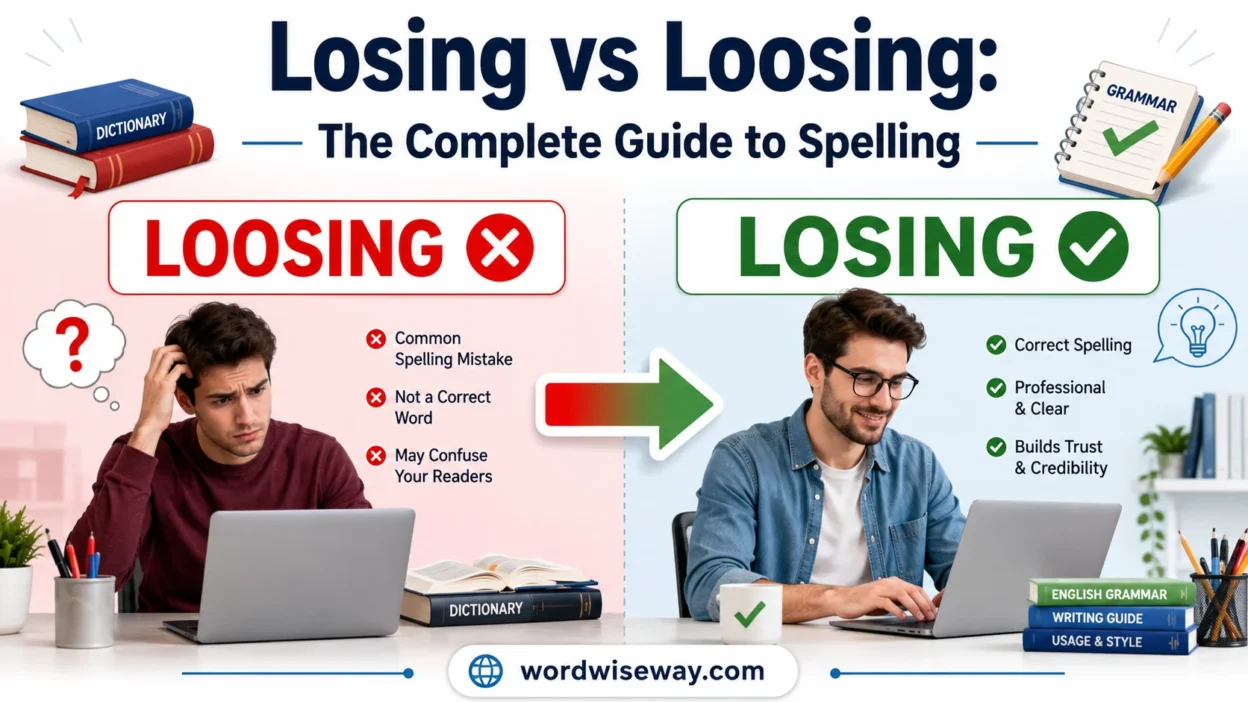
Losing vs Loosing: The Complete Guide helps English learners, native speakers, student groups, writers, and every writer understand this exact query with clarity and confidence. Many people search for loosing and losing because the two words look similar, almost identical, but have different meanings and distinct ways they function in the language.
In this article and guide, the first point is clear: losing is the correct word in 99% of cases. The verb form lose refers to failing to keep an item, being defeated, or misplacing something. Its definition, meaning, usage, and practical uses appear in academic writing, emails, social media posts, publications, and everyday communication.
Based on my editing experience, this remains one of the most common spelling and grammar mistakes that can confuse a learner and even experienced professional editors.
In contrast, loosing means to release, let go, or make something loose, less tight, or free. A strong understanding of this difference helps reduce confusion, prevent errors, and maintain credibility in both formal and casual speaking and writing. Many real-life examples, case studies, data-backed insights, practical rules, and expert tips show how a simple slip can change an entire sentence.
When talking about choosing the right term, this complete explanation breaks the topic down into an approach that improves accuracy, builds confidence, and makes both words completely understandable every time, while avoiding the causes of errors that almost never happen.
Quick Answer:
Losing is the correct word when you mean failing to keep something, being defeated, misplacing something, or experiencing a decline.
Example: She is losing her phone.
Loosing is a rare word that means releasing, setting something free, or making something loose.
Example: The sailor is loosing the ropes.
Easy rule:
Lose → Losing = failure or loss
Loose → Loosing = release or freedom
Why This Confusion Happens So Often
Let’s start with something you’ve probably noticed.
People say “losing” and “loosing” almost the same way when speaking quickly. The difference gets blurred, especially in casual speech. When that sound lands on a keyboard, spelling mistakes sneak in.
Here’s what usually causes the confusion:
- Fast typing without checking spelling
- Autocorrect guessing the wrong word
- No clear understanding of lose vs loose
- Visual similarity between the words
- Habit from seeing incorrect usage online
A surprising fact: search engines report that “loosing” is typed millions of times per month, even though most of those searches are mistakes.
So this is not a small issue. It’s a widespread pattern.
Quick Answer
Let’s clear the fog immediately.
Correct usage
- Losing → used for failure, misplacement, or decline
- Example: She is losing her phone.
Incorrect in most cases
- Loosing → often a spelling mistake
- Example: She is loosing her phone. ❌
Rare correct usage
- Loosing → releasing something that is fastened or tight
- Example: The sailor is loosing the ropes.
If you remember nothing else, remember this:
Losing comes from “lose.” Loosing comes from “loose.”
Understanding The Root of the Problem
This confusion becomes easy to fix once you separate the two root words.
Lose: Meaning and Real Usage
According to the Merriam-Webster dictionary, lose means “to fail to keep possession of” or “to suffer deprivation of.”
Common examples
- I always lose my keys in the morning chaos
- The team might lose the match
- Don’t lose hope during tough times
Grammar insight
- Base verb: lose
- Present participle: losing
- Past tense: lost
So when you say “I am losing,” you are describing something happening right now.
Loose: Meaning and Real Usage
The Oxford English Dictionary defines loose as “not firmly fixed in place” or “free from restraint.”
Common examples
- My shirt feels loose today
- The screw is loose
- The dog is running loose in the yard
Important point
“Loose” usually works as an adjective, not a verb.
That’s why “loosing” feels unusual in modern writing.
Why These Two Words Get Mixed Up
Here’s where things get interesting.
Even though they look similar, they serve completely different purposes.
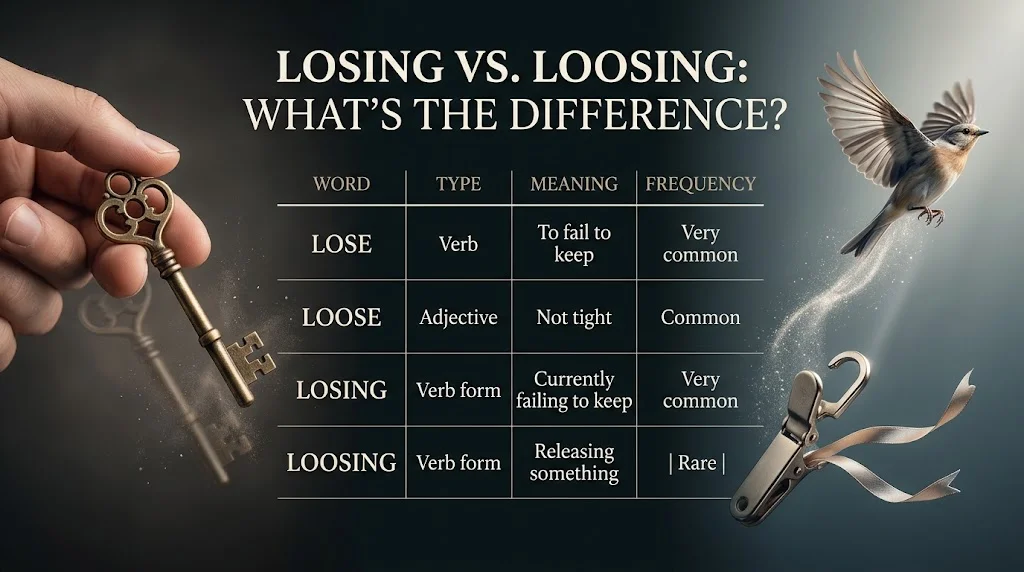
| Word | Type | Meaning | Frequency |
| Lose | Verb | To fail to keep | Very common |
| Loose | Adjective | Not tight | Common |
| Losing | Verb form | Currently failing to keep | Very common |
| Loosing | Verb form | Releasing something | Rare |
Most confusion happens because:
- They differ by only one letter
- Pronunciation overlaps in casual speech
- People rely on intuition instead of grammar rules
Think of it like two doors that look almost identical. One leads to a busy city street. The other opens into a storage room you rarely visit.
Losing Explained in Depth
Now let’s focus on the word you will actually use most of the time.
Grammar Structure of Losing
The word losing is the present participle of lose.
You use it in:
- Present continuous tense
- Gerund forms (acting as a noun)
Examples in action
- I am losing focus during long lectures
- She is losing patience with the situation
- Losing sleep affects your mood
Notice how the action feels ongoing. That’s the key idea.
Common Contexts Where “Losing” Appears
You will see “losing” in:
- Sports competitions
- Academic performance
- Emotional struggles
- Physical items
- Time management
Examples
- The cricket team is losing by 20 runs
- I am losing track of time
- He is losing motivation to study
Real-Life Mini Scenario
Imagine a student preparing for exams.
He studies all night but feels tired the next day. He says:
“I am losing my focus.”
This sentence makes perfect sense. It shows an ongoing decline.
Now imagine if he writes:
“I am loosing my focus.”
That small spelling mistake instantly weakens the sentence. It looks incorrect even if the meaning is clear.
Loosing Explained (Rare but Real)
Now let’s talk about the word that causes the most confusion.
Grammar Structure of Loosing
Loosing comes from the verb loose.
It means:
- To release something
- To set something free
- To unfasten something
Examples
- The farmer is loosing the cattle into the field
- The sailors are loosing the sails before the storm
- He is loosing the knots on the rope
Read More: Homie or Homey: Which One Is Correct?
Why You Rarely See “Loosing”
Here’s the truth:
- “Loose” is mostly used as an adjective
- People rarely use it as a verb
- Modern English favors simpler expressions
Instead of “loosing the ropes,” people often say:
- releasing the ropes
- untying the ropes
- letting go of the ropes
So “loosing” naturally appears less often.
A Helpful Analogy
Think of “loosing” like an old tool in a toolbox.
It still works, but you almost never need it in daily life.
Side-by-Side Comparison
Let’s break it down clearly.
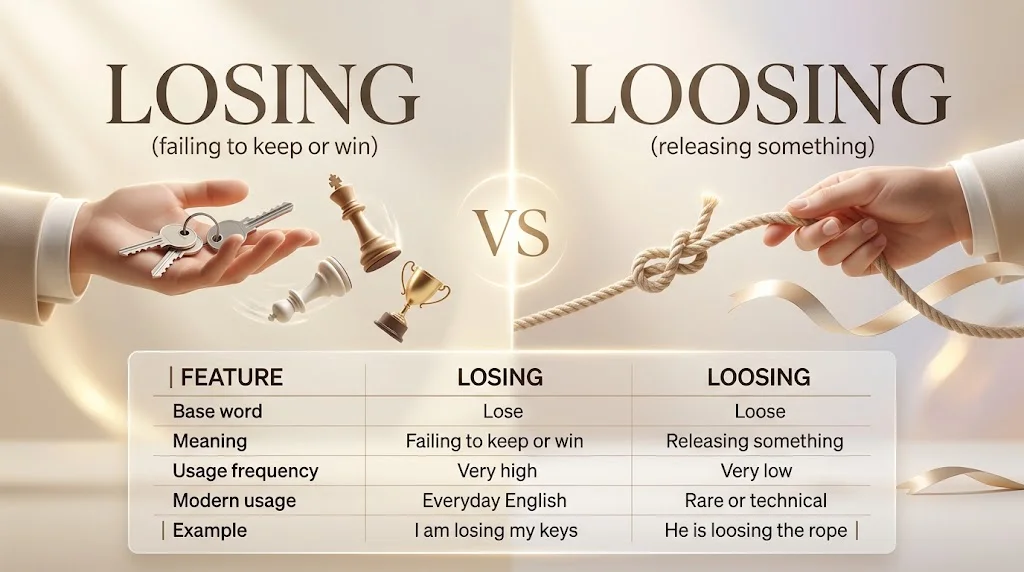
| Feature | Losing | Loosing |
| Base word | Lose | Loose |
| Meaning | Failing to keep or win | Releasing something |
| Usage frequency | Very high | Very low |
| Modern usage | Everyday English | Rare or technical |
| Example | I am losing my keys | He is loosing the rope |
Real-World Mistakes People Make
Now let’s look at how this confusion shows up in real life.
Social Media Posts
You’ll often see captions like:
- “I am loosing weight” ❌
- “I am losing weight” ✔
The incorrect version spreads quickly because people copy what they see online.
Academic Writing Errors
Teachers frequently mark this mistake because:
- It changes word meaning
- It signals weak grammar control
- It stands out in formal writing
Even one spelling error can affect grading in strict exams.
Professional Communication Issues
In emails or resumes:
- “I am loosing clients” looks careless
- “I am losing clients” looks correct and professional
Small spelling differences change perception.
Case Study: The Social Media Manager
A small business hired a freelance social media manager.
She wrote a post:
“We are loosing amazing offers this weekend.”
The post received comments pointing out the mistake. Engagement dropped because readers focused on the error instead of the message.
Later she corrected it:
“We are losing amazing offers this weekend.”
Engagement improved immediately.
This shows how spelling impacts credibility, even in casual content.
Memory Tricks to Never Confuse Losing and Loosing
Let’s make this easy to remember.
The One O vs Two O Rule
- Lose → one “o” → losing
- Loose → two “o” → loosing
Think of it like this:
More “o’s” means more “space” or “extra looseness”
The Missing Letter Trick
- Losing = something disappears
- One “o” disappears too
Simple mental link.
Quick Self-Check Method
Before writing, ask:
- Am I talking about failing to keep something? → use losing
- Am I talking about releasing something? → maybe loosing
Common Related Confusions
People often mix up more than just these two words.
Lose vs Loss
- Lose = verb
- Loss = noun
Example:
- I lose my phone
- The loss was painful
Losing vs Lossing (Incorrect Word)
“Lossing” does not exist in standard English.
If you see it, it’s always wrong.
Lose vs Loose in Speech
Fast speech makes them sound similar, but spelling keeps them separate.
Why Correct Spelling Actually Matters
Some people think spelling mistakes are small. In reality, they shape perception.
Here’s what correct spelling improves:
- Clarity in communication
- Professional credibility
- Academic performance
- Reader trust
- Search engine visibility
Even one wrong letter can distract readers from your message.
Mini Practice Quiz
Try filling in the blanks.
- I am ___ my phone again
- The team is ___ the match
- He is ___ the ropes from the pole
- She is ___ confidence in interviews
Answers
- losing
- losing
- loosing
- losing
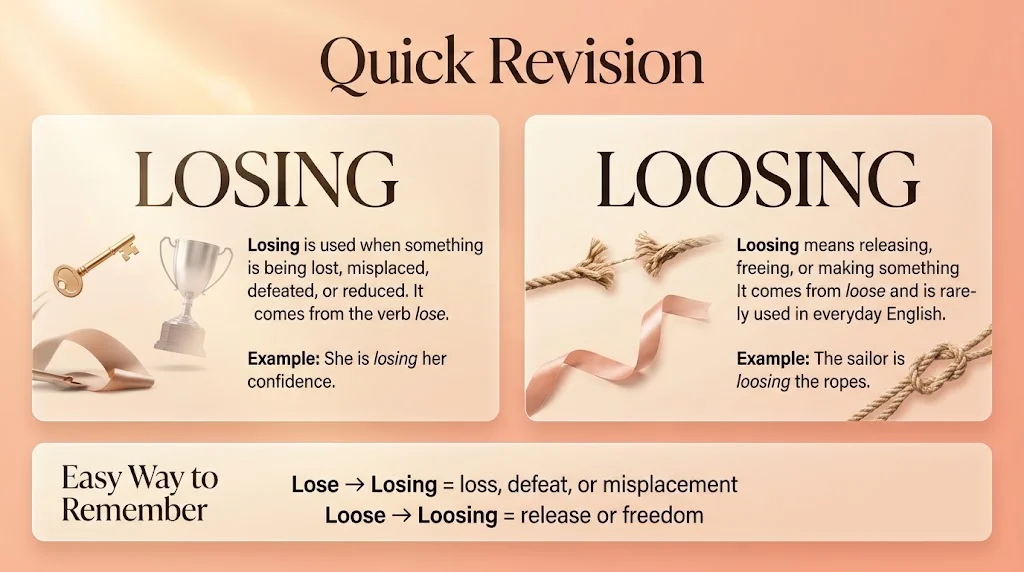
Quick Revision:
Losing is used when something is being lost, misplaced, defeated, or reduced. It comes from the verb lose.
Example: She is losing her confidence.
Loosing means releasing, freeing, or making something less tight. It comes from loose and is rarely used in everyday English.
Example: The sailor is loosing the ropes.
Easy way to remember:
Lose → Losing = loss, defeat, or misplacement
Loose → Loosing = release or freedom
FAQs
Is “losing” always the correct spelling?
No. Losing is correct when you mean experiencing loss, defeat, or no longer having something. Loosing is a real but uncommon word used when something is being released or set free.
Why is “loosing” often considered wrong?
It’s often considered wrong because people usually write it when they actually mean losing. The two words have different meanings, so using loosing in the wrong context creates a spelling and usage error.
Is “loosing weight” correct?
No. The correct phrase is “losing weight.” Here, losing comes from the verb lose, meaning to experience a reduction or loss.
Can “loosing” be used as a verb?
Yes. Loosing is the present participle of loose. It can mean releasing, freeing, or unfastening something, although this usage is uncommon in everyday English.
What is the difference between lose and loose?
Lose is a verb meaning to no longer have something or fail to win. Loose usually describes something that isn’t tight or firmly fixed.
What is the past tense of losing?
The past tense of lose is lost. For example, “She lost her keys yesterday.” Losing is the present participle used for an ongoing action.
How do I remember losing vs loosing?
Connect each word with its root: lose → losing and loose → loosing. If you’re talking about loss or defeat, choose losing. If you’re talking about release, loosing may be correct.
Is “lossing” a correct word?
No. Lossing isn’t the standard spelling. The correct form is losing when you need the present participle of lose.
Why do people type “loosing” instead of “losing”?
The extra o in loosing makes it visually resemble loose, which can cause confusion. Fast typing, autocorrect, and seeing the incorrect form online can also reinforce the mistake.
Which word should I use in most everyday situations?
In most everyday situations, losing is the word you need. Use it for things such as losing a phone, losing a game, losing time, or losing confidence. Loosing is much less common and should only be used when its specific meaning fits.
Conclusion
Understanding the difference between losing and loosing is essential for clear and professional communication. While losing refers to failure, defeat, or misplacing something, loosing means releasing or making something loose. Since losing is the correct choice in the vast majority of situations, learning this distinction helps you avoid common spelling mistakes, improve writing accuracy, and maintain credibility. With the examples, rules, and tips covered in this guide, you can confidently choose the right word every time.
The easiest way to avoid this confusion is to remember the root words. Losing comes from lose, while loosing comes from loose. If you mean losing an item, missing an opportunity, experiencing defeat, or giving something up, losing is the word you need. Use loosing only when you mean releasing or freeing something.
Whether you’re writing an email, completing an assignment, creating online content, or chatting with others, choosing the right spelling makes your message clearer and more accurate. A quick check can help: ask whether you mean loss or release. Once you connect each word with its meaning, losing vs loosing becomes much easier to remember and use correctly.

Emma Smith has dedicated 14 years to Princeton University’s English Department, mentoring students in textual interpretation, literary movements, and critical frameworks. Her research explores Shakespearean drama, Victorian serial fiction, postcolonial narrative theory, and manuscript studies and probing how literary forms evolve across cultures and centuries. Emma has delivered lectures at international humanities congresses and published findings in distinguished academic journals, underscoring her commitment to scholarly depth and vibrant teaching.