Bare vs Bear: Meaning, Difference, and Usage Explained helps learners understand why these words create confusion.
Both homophones sound exactly the same, but their meanings are completely different. This common mistake in English can affect writing, sentence meaning, and communication. The word bear works as a verb meaning to tolerate, carry, or endure, and it can also describe an animal. Common phrases include bear with me, bear in mind, and bear the cost.
The word bare works as an adjective or verb. It means minimal, uncovered, naked, or to reveal something. Its usage connects with ideas of removal and absence, while bear often shows presence or support. Learning their grammar rules, context, and examples improves vocabulary, avoids common mistakes, and builds stronger language skills for everyday English.
Quick Answer:
Before diving deep, here’s a fast snapshot of bare vs bear so you can orient yourself quickly.
| Word | Part of Speech | Core Meaning | Simple Idea | Example |
| Bare | Adjective / Verb | uncovered, minimal, expose | something is empty or revealed | bare feet |
| Bear | Verb / Noun | carry, endure, animal | to hold, tolerate, or a creature | bear pain |
At a glance, the difference is simple:
- Bare = exposed or empty
- Bear = carry, tolerate, or the animal
Now let’s unpack each one properly so it actually sticks in your memory.
Bare vs Bear: Meaning of “Bare” (With Real Usage)
The word bare is all about simplicity, exposure, and lack of covering. Think of it as something stripped down to its most basic form.
Bare as an adjective
When used as an adjective, bare means uncovered or minimal.
Common examples:
- bare feet
- bare walls
- bare minimum
- bare essentials
If something is bare, it’s missing layers. i)No decoration. ii) No protection. iii) No extras.
Example sentences:
- She walked across the bare floor in silence.
- The room had bare walls, nothing hung on them.
- He survived on the bare minimum during his trip.
👉 The idea is always “nothing extra is present.”
Bare as a verb
Less common, but still important, bare can also mean to expose or reveal something.
Meaning:
- to uncover
- to reveal
- to expose
Example sentences:
- He bared his teeth when he smiled angrily.
- She bared her thoughts during the interview.
- The wind bared the roots of the old tree.
Bare in everyday language
You’ll often see bare used when talking about:
- Clothing or lack of clothing
- Empty spaces
- Minimal living conditions
- Emotional exposure
Examples:
- bare skin
- bare bones setup
- bare facts
Bare vs Bear: Meaning of “Bear” (With Real Usage)
Now let’s move to the heavier word, literally and figuratively.
Bear is more complex because it has multiple meanings.
Bear as a verb: to carry or endure
This is the most common use of bear.
Core meanings:
- to carry
- to support
- to tolerate or endure
Example sentences:
- I can’t bear the noise anymore.
- She bore the responsibility of leading the team.
- He struggled to bear the pain after the injury.
👉 Think of it as carrying something heavy, emotionally or physically.
Bear as a noun: the animal
Bear also refers to the large animal.
Examples:
- A polar bear lives in Arctic regions.
- The brown bear is found in forests.
- We saw a bear near the river during the hike.
Common expressions using “bear”
- Bear with me → wait patiently
- Bear fruit → produce results
- Bear in mind → remember something
- Bear the burden → carry responsibility
Example:
- Please bear with me while I fix this issue.
- Hard work will eventually bear fruit.
Bare vs Bear: The Core Difference Explained Clearly
This is where everything clicks.
Bare = exposed or minimal
- No covering
- Nothing extra
- Stripped down
Bear = carry, endure, or animal
- Emotional or physical weight
- Patience or tolerance
- A living creature
Simple shortcut:
- Bare → uncovered
- Bear → carry or endure
Bare vs Bear: Why People Confuse Them
They sound identical
Both are pronounced the same: /bɛr/
Fast typing leads to mistakes
People often type quickly and choose the wrong spelling.
Only one letter difference
- bare = a
- bear = e
Context confusion
Both can appear in emotional sentences, which increases mistakes.
Bare vs Bear: Easy Tricks to Remember the Difference
Memory trick for “Bare”
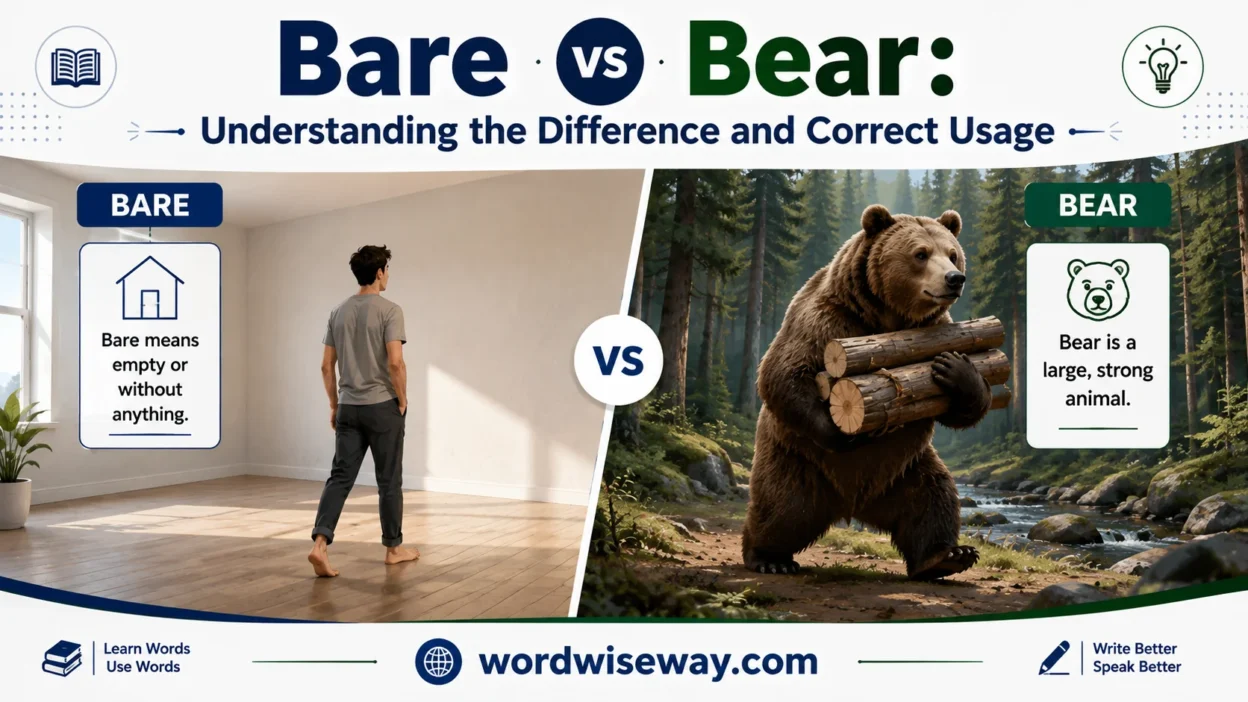
Think: bare = bare skin = uncovered
Visual idea: bare feet on cold ground.
Memory trick for “Bear”
Think: bear = carry weight
Visual idea: a bear carrying logs.
Quick association chart
| Word | Mental Image | Meaning |
| Bare | bare skin | exposed |
| Bear | animal carrying logs | endure |
Bare vs Bear: Common Mistakes and Corrections
- ❌ I can’t bare the pain
✔️ I can’t bear the pain - ❌ She bared the responsibility
✔️ She bore the responsibility - ❌ The bear floor felt cold
✔️ The bare floor felt cold - ❌ Please bare with me
✔️ Please bear with me - Bare vs Bear: Real-Life Usage Examples
1. Bare in action
- The house looked bare after we moved out.
- He walked on bare ground without shoes.
- Only the bare essentials were packed.
2. Bear in action
- I can’t bear loud music.
- She bore the loss bravely.
- The company will bear the cost.
Bare vs Bear: Case Study from Real Writing Mistakes
A student wrote:
“The team could not bare the pressure of finals.”
Correct version:
“The team could not bear the pressure of finals.”
👉 One letter completely changed meaning.
Another viral post said:
“Can’t bare this Monday morning.”
Correct:
“Can’t bear this Monday morning.”
Bare vs Bear: Practice Section (Test Yourself)
Fill in the blanks:
- I can’t ___ this noise anymore.
- He walked on ___ feet across the sand.
- The tree had ___ branches after the storm.
- Please ___ with me.
- She ___ the pain silently.
Answer Key
- bear
- bare
- bare
- bear
- bore
Read More: Therefor vs Therefore: Correct Spelling, Meaning, and Usage
FAQs
What is the main difference between bare and bear?
Bare means uncovered, empty, or without something, while bear usually means to carry, tolerate, or endure. Bear can also refer to the animal, so the meaning depends on the sentence and context.
Are bare and bear pronounced the same?
Yes, bare and bear are homophones, which means they have the same pronunciation but different meanings and spellings.
When should I use bear with me?
Use bear with me when asking someone to be patient or wait. It means asking a person to tolerate a short delay or difficulty.
What does bear in mind mean?
Bear in mind means to remember or consider something important while making a decision or understanding information.
Can bare be used as a verb?
Yes, bare can work as a verb. It means to uncover, reveal, or expose something that was previously hidden.
Is a bear only an animal?
No, bear has multiple meanings. Besides the animal, it can mean to carry, support, produce, or endure something.
What does bare essentials mean?
Bare essentials refers to only the most necessary things. It describes a situation where extra items have been removed.
Why do people confuse bear and bare?
People often confuse them because they sound identical. Their different meanings, spellings, and uses in sentences make them challenging for English learners.
How can I remember the difference between bare and bear?
A simple trick is to connect bare with being empty or uncovered, while bear can be connected with carrying, enduring, or the animal.
Which word is used in bear the cost?
The word bear is used in bear the cost because it means to take responsibility for paying or handling an expense.
Conclusion
Understanding the difference between bare and bear makes English writing clearer and prevents common spelling mistakes. Although these two words sound the same, their meanings and functions are completely different. Bare focuses on ideas like being uncovered, empty, simple, or revealing something, while bear is connected with carrying, tolerating, supporting, or the animal. Learning these differences through examples and context helps writers choose the correct word confidently.
Many English learners struggle with homophones because pronunciation alone cannot show the meaning of a word. By paying attention to sentence structure, grammar rules, and everyday usage, it becomes easier to identify whether a sentence needs bare or bear. Regular practice with common phrases like bear with me, bear in mind, and bare essentials can improve vocabulary and make communication more accurate. These small grammar details create a strong foundation for better English skills.

Emma Smith has dedicated 14 years to Princeton University’s English Department, mentoring students in textual interpretation, literary movements, and critical frameworks. Her research explores Shakespearean drama, Victorian serial fiction, postcolonial narrative theory, and manuscript studies and probing how literary forms evolve across cultures and centuries. Emma has delivered lectures at international humanities congresses and published findings in distinguished academic journals, underscoring her commitment to scholarly depth and vibrant teaching.